



When it comes to security policy, it seems everyone wants to be a "realist" these days. If that term has any meaning at all, though, Barack Obama's nuclear weapons and missile defense policies certainly would not qualify.

To the contrary, these examples of what some call "progressive realism" constitute a near-parody of the ideologically driven disarmament agenda of the radical left. If the implications were not so serious, the discrepancy between Mr. Obama's plans and real world conditions would be hilarious.
Take, for example, Mr. Obama's announced intention to rid the planet of nuclear weapons. The truth is that, no matter how many world leaders, elder statesmen and other advocates champion this goal, it is not going to happen. The associated technology is too widely available, the strategic value of nuclear weapons too great and the possibilities of concealment in closed societies too immutable for all nations actually to forego the temptation to retain covert arsenals.
There is only one country on earth that Team Obama can absolutely, positively denuclearize: Ours. To be sure, the President professes his realism by recognizing that, even as he declares a goal of no nukes, he emphasizes it is unlikely to be achieved any time soon. Still, the cumulative effect of his nuclear agenda would be to advance inexorably the denuclearization of the United States.
This is how Mr. Obama's Secretary of Defense, Robert Gates, described our nuclear posture before last Fall's election: "Currently, the United States is the only declared nuclear power that is neither modernizing its nuclear arsenal nor has the capability to produce a new nuclear warhead." By contrast, he noted, "China and Russia have embarked on an ambitious path to design and field new weapons." Even "the United Kingdom and France have programs to maintain their deterrent capabilities." In fact, every other actual nuclear power and wannabe is building up as we are going out of the business.
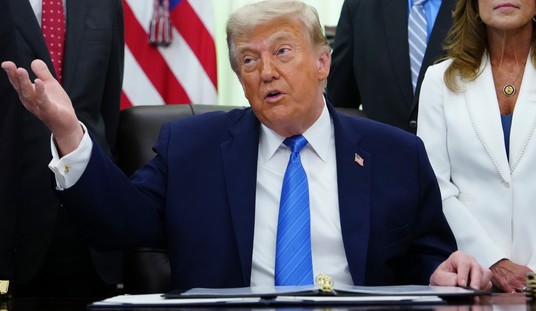
President Obama not only refuses to modernize our deterrent and establish the capability to produce new warheads. His administration is doing nothing to slow, let alone reverse, the steady decline of the infrastructure - both human and physical - required to maintain the nuclear weapons upon which we currently rely.
In addition, Mr. Obama insists that the United States must become a party to the Comprehensive Test Ban Treaty - an accord a majority of the U.S. Senate rejected ten years ago on the grounds that it was unverifiable and inconsistent with the nation's need to maintain a safe, reliable and therefore credible nuclear deterrent. The effect of such a reversal would be permanently to preclude underground tests of the American arsenal, condemning it to assured obsolescence and evaporating credibility.
Far from reducing the global proliferation of nuclear weaponry, the decline of confidence in America's deterrent is likely to exacerbate that trend. As the bipartisan Congressional Commission on the Strategic Posture of the United States put it in an interim report last December: "Our non-proliferation strategy will continue to depend upon U.S. extended deterrence strategy as one of its pillars. Our military capabilities, both nuclear and conventional, underwrite U.S. security guarantees to our allies, without which many of them would feel enormous pressures to create their own nuclear arsenals....The U.S. deterrent must be both visible and credible, not only to our possible adversaries, but to our allies as well." (Emphasis in the original.)
Ironically, these acts of U.S. self-restraint in the interest of setting an "example" for the rest of the world are quintessential progressive realism - a practice that reflexively believes America must stop doing things in its self-defense that, in light of world conditions and hard experience, are perfectly sensible, all in the hope that the rest of the world will behave in ways that history suggests are not in the cards.
An even more dramatic example of this vaulting unrealism is the Obama administration's response to the growing threat of ballistic missiles in the hands of actual and potential U.S. adversaries. The Russians and Chinese are perfecting new generations of advanced missiles, including some designed to defeat defenses and destroy carrier battle groups. Meanwhile, the Iranians and North Koreans are testing ever-longer-range "space-launch vehicles" and other ballistic missiles, apparently with a view to being able to execute strategic electro-magnetic pulse (EMP) attacks against the United States. (For a vivid insight into the horror such an attack would inflict on our society, see the best-selling new novel by Bill Forstchen, One Second After.)
Incredibly, Team Obama thinks the way to address this grave and growing danger is: to cut billions from our anti-missile defense programs - especially those designed to protect our homeland against EMP and other attacks; to forego deployment in Europe of missile defense radars and interceptors as NATO has twice agreed to do; and to resuscitate preposterously out-dated Cold War notions of U.S.-Russian "stability" by imposing new bilateral restrictions on defenses. The only realistic prognosis from such a U.S. approach would be more threatening missiles around the world and fewer American capabilities to defeat them.
American security policy needs to be rooted in realism, alright. But that should be in the sense of what might be called "conservative realism" - in accordance with which the United States needs to equip itself and behave in light of the way the world really is, not on the basis of some fantasy about how it might be if only we disarmed.









Join the conversation as a VIP Member