





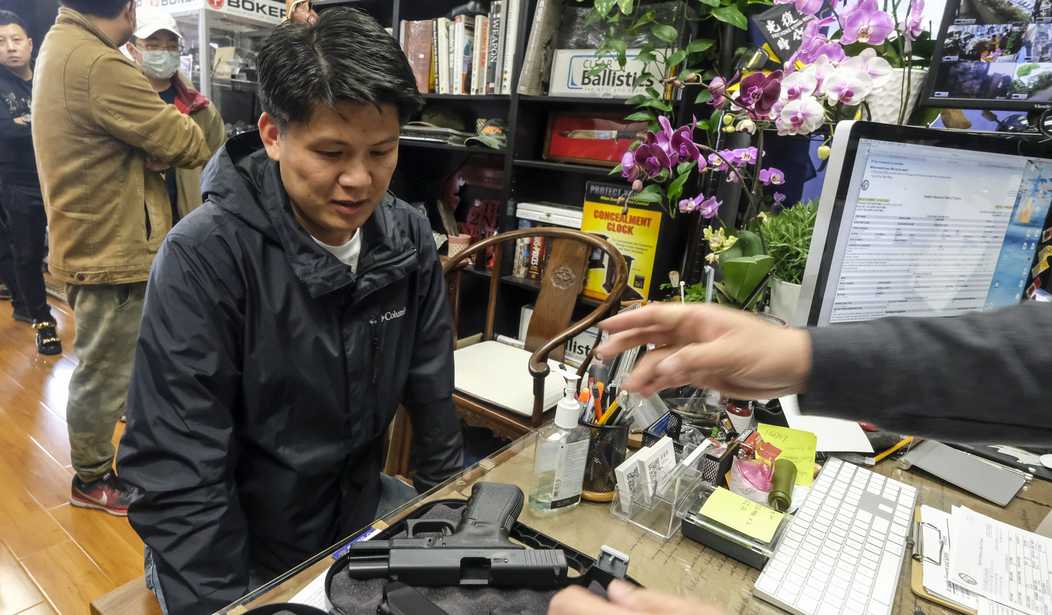
Guns aren't cheap items, generally. Even a cheap pistol is around $150, and that's for something I wouldn't suggest you trust your life to. You're generally looking at $500 or more for a decent handgun.
And the left wants to capitalize on that to keep tabs on who buys guns.
The way they've tried to do it is by pressuring credit card companies to use a specific Merchant Category Code for gun stores. While it's not a surefire way to watch what people buy, it's a good indicator that someone has a gun. Ostensibly, this was sold as a way to try to prevent mass shootings, as it's claimed that these killers buy guns right before carrying out their attacks.
Of course, so do millions of other people who have no such intention.
Instead, it's really just a way to create a database of gun owners, only instead of the government keeping it, it's the financial industry. Only an idiot would believe for a moment that this would never be accessed by federal authorities, especially if they decided to round up the firearms.
The problem for them is that there was severe blowback, which delayed the implementation of any specific MCC for gun stores. In addition, some states have passed laws banning gun store-specific MCCs.
Now, Missouri is looking to do the same.
The bill prohibits government entities from keeping a list, record or registry of privately-owned firearms. Records may be kept during a criminal investigation and prosecution on gun ownership (Aristide Economopoulos for New Jersey Monitor).
Twenty states have enacted laws prohibiting the use of unique merchant category codes to distinguish firearm purchases, and Missouri could be the 21st.
State Sen. Jill Carter, a Republican from Granby, presented legislation to a Senate committee Monday that would create the “Second Amendment Financial Privacy Act.”
The bill prohibits government entities from keeping a list, record or registry of privately-owned firearms. Records may be kept during a criminal investigation and prosecution on gun ownership. It also prohibits credit card networks from using a merchant category code to distinguish firearm sales from any other sale.
“This bill draws a clear line,” Carter said at the hearing. “Lawful gun ownership must never be treated as inherently suspicious.”
Kentucky, Tennessee and Iowa passed similar laws in 2024 banning the use of unique merchant category codes for firearms.
Even if this was well-intentioned, the problem is that it's based on behavior that isn't as unusual as some might claim. When this was first proposed, it was suggested that the financial tools used to find things like money laundering might help curtail mass murders.
The issue is that what most mass killers do is go to the store, buy a gun or two, then go home.
That's pretty much the same thing that most gun buyers do.
And because guns aren't cheap, they tend to get put on either a credit card or a debit card tied to one's checking account. All will utilize an MCC, which right now just says they went to a retail store of some type, maybe a pawn shop. There's a layer of privacy.
Only, based on the behavior of past mass killers, almost anyone buying a gun for over a few hundred dollars in value may find themselves the subject of some kind of investigation.
Plus, you better believe the credit card companies hold onto this data for as long as they can, which means a restrictive government may force them to hand over the names and addresses of everyone who purchased something from a gun store.
While that won't all be gun purchases, it'll give them a place to start if they want to kick in doors.
Is that likely? Not at the moment, but that's no reason not to recognize the infrastructure being put in place should that change.



Join the Conversation
VIP members get the ability to comment on articles.