







"Today we have some good news," claimed President Biden in remarks addressing the escalating supply chain crisis from the White House on Wednesday afternoon after days of criticism from businesses, members of Congress, and everyday Americans.
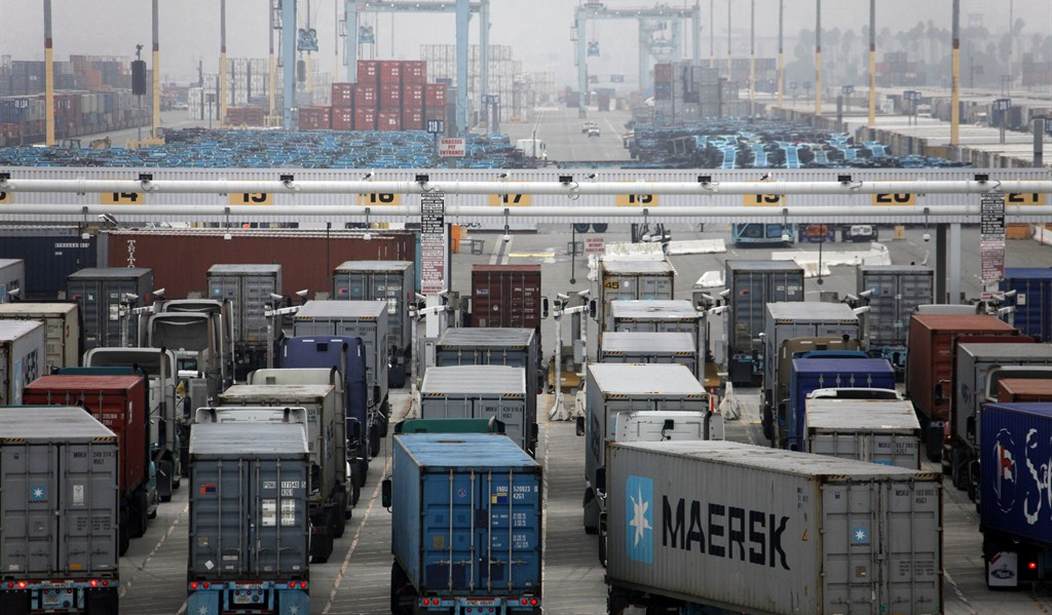
Facing shortages of food, raw materials, and other goods, the Biden administration has seen massive ports — such as the twin ports of Los Angeles and Long Beach where some 40 percent of shipping containers come ashore in the United States — turn into gridlocked parking lots.
The tanker/cargo ship parking lot that has become the ports of Los Angeles and Long Beach: pic.twitter.com/NkuhpxS3sp
— Spencer Brown (@itsSpencerBrown) October 8, 2021
Biden's apparent solution is to convince those ports, along with major retailers and transportation companies such as Wal-Mart, FedEx, and UPS, to begin 24/7 operations to alleviate the crisis Biden minimized as a mere "bottleneck." But round-the-clock operations aren't a long-term fix nor are they necessarily feasible in the short-term.
Apparently, as Biden tried to explain, his plan to address the crisis rests on the fact that roads aren't as crowded in the overnight hours.
Here's the video of President Biden explaining why truckers can make more progress by being allowed to drive overnight and off-peak hours of AM and PM rush hours because -- wait for it -- the roads aren't as crowded.
— Curtis Houck (@CurtisHouck) October 13, 2021
And THAT, ladies and gentlemen, will help fix the supply chain pic.twitter.com/e35xse5AB7
What was missing from Biden's remarks was a substantive strategy to prevent similar supply chain crises from occurring in the future. Nor did he explain who would be driving all the trucks, unloading containers, or keeping the operations running around the clock amid the labor shortages Biden's economic policies created.
Of course never willing to let one of his crises go to waste, Biden also made a pitch for his domestic legislative agenda — costing trillions of dollars — for woke infrastructure, climate change, and bloated budget bills, threatening that without action to pass his plans, the current supply chain crisis wouldn't be the last.
"The world has changed": President Biden says supply chain problems caused the pandemic have shown the need to pass infrastructure and climate change investments to build "greater resilience to withstand the kind of shocks we've seen over and over, year in and year out" pic.twitter.com/DBDESMAFDg
— CBS News (@CBSNews) October 13, 2021
It's a strange equation that the White House continues to trot out: When a crisis caused by their policy or negligence arises, they claim the only way to stop said crisis is by doubling down on the kind of nonsense that caused the crisis in the first place. All, of course, without Biden bearing any blame while simultaneously claiming the buck stops with him.
White House Chief of Staff Ron Klain feebly attempted to claim the supply chain crisis was not the Biden administration's fault, but an "inherited" mess caused by their predecessors in the Trump administration. How convenient.
Transportation Secretary Pete Buttigieg — the former mayor who couldn't manage to fix South Bend, Indiana's potholes, said Wednesday that the Biden administration has been tackling supply chain issues "from the very beginning," a claim that leads one to the conclusion that either Buttigieg is lying, or the Biden White House is wholly unable to respond to supply chain crises.
Secretary Buttigieg says the Biden administration has been working on supply chain issues "from the very beginning."
— Mark Bednar (@MarkBednar) October 13, 2021
Yet it's still a crisis - what does this say about the Biden administration's competence? pic.twitter.com/vkYMPXxGww
As usual, Biden refused to take questions from reporters following his remarks, again highlighting his administration's lack of faith in his ability to defend his own policies.
President Biden addresses supply chain issue in scripted remarks. Leaves without taking one question. Again. His handlers simply won’t allow it, and it speaks volumes he doesn’t have the confidence in his own arguments not to override them.
— Joe Concha (@JoeConchaTV) October 13, 2021



Join the Conversation
VIP members get the ability to comment on articles.