







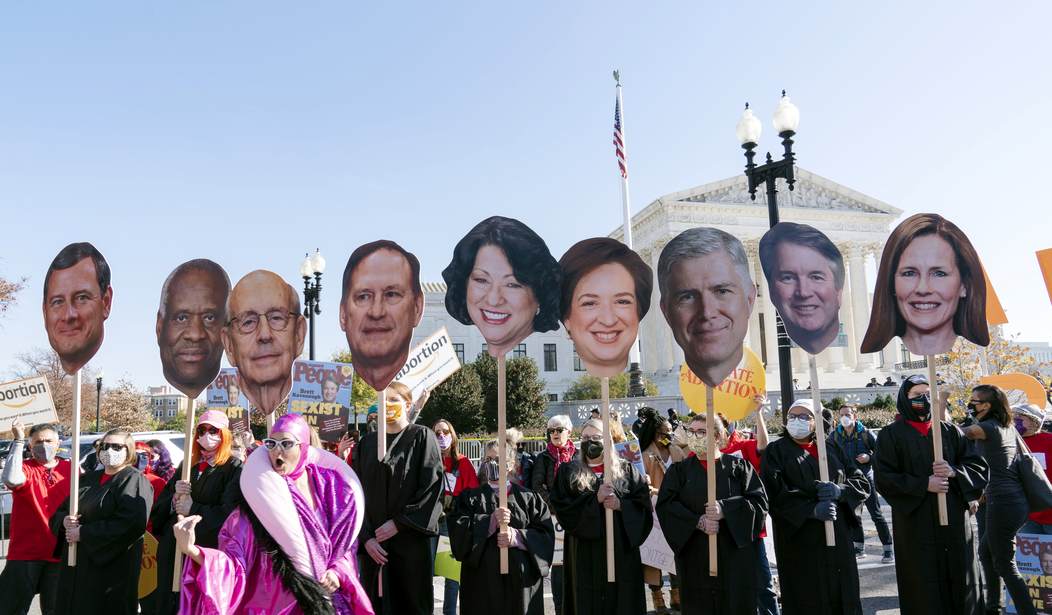
Last Wednesday, the U.S. Supreme Court heard oral arguments in Dobbs v. Jackson to decide the constitutionality of previability abortion bans, specifically to do with Mississippi's Gestational Age Act, which bans most abortions after 15 weeks. When it comes to the major abortion case, people were able to tune in for oral arguments this time, an opportunity not afforded in previous major abortion cases. There's also a transcript available.
One curious part of the oral arguments included a back and forth between Justice Samuel Alito and U.S. Solicitor General Elizabeth B. Prelogar, who bent over backward to oppose the Mississippi law.
"Is it your argument that a case can never be overruled simply because it was egregiously wrong?," Justice Alito asked towards the end of oral arguments.
"I think that at the very least, the state would have to come forward with some kind of materially changed circumstance or some kind of materially new argument, and Mississippi hasn't done so in this case," Prelogar claimed, before Alito cut her off to discuss his point in light of 1896's Plessy v. Ferguson.
The back and forth included insistence from Justice Alito that Prelogar answer his question, as well as some perceived confusion. Either that, or Prelogar was afraid to denounce Plessy because she knew it would undermine her cause.
If you find that your position on an issue requires you to suggest that maybe Plessy wasn’t egregiously wrong, you might want to subject your position to a bit more scrutiny.
— Alexandra DeSanctis Marr (@xan_desanctis) December 3, 2021
"Can a decision be overruled simply because it was erroneously wrong, even if nothing has changed between the time of that decision and the time when the Court is called upon to consider whether it should be overruled?," Alito finally asked.
Prelogar's answer was no:
This Court, no, has never overruled in that situation just based on a conclusion that the decision was wrong. It has always applied the stare decisis factors and likewise found that they warrant overruling in that instance. And -- and [Planned Parenthood v.]Casey did that. It applied the stare decisis factors. If stare decisis is to mean anything, it has to mean that that kind of extensive consideration of all of the same arguments for whether to retain or discard a precedent itself is an additional layer of precedent that needs to be relied on and can form a stable foundation of the rule of law.
Students for Life of America (SFLA) has often grouped Roe in with other cases that were, to use Alito's words, "erroneously wrong," with one such case being Plessy.
.?@KristanHawkins? of ?@StudentsforLife? is holding up a great sign. Let’s hope Roe ends up on the ash heap of history.#ProLife pic.twitter.com/gmBWrwUTBt
— Michael New (@Michael_J_New) November 30, 2021
Kristi Hamrick Stone, the chief media & policy strategist for SFLA, told Townhall that "Roe was wrong — egregiously wrong — something that won’t change no matter how long it takes to fix it. Devaluing people in law, whether Black Americans or preborn Americans doesn’t improve with age. The racism of Plessy v Ferguson was wrong from day one, and the Supreme Court needs to learn a lesson from that, by fixing mistakes as early as possible so that all of us can enjoy Life, Liberty, and the Pursuit of Happiness."
The Court announced earlier on Thursday that it will be releasing decisions tomorrow, on Friday, something of a rarity. One of the decisions could very well be to do with the Texas Heartbeat Act. That law, which the Court allowed to go into effect on September 1, bans most abortions once a fetal heartbeat is detected, at around six weeks.
When it comes to Dobbs a decision is expected in late June, with the potential to overturn or at least weaken Roe v. Wade.



Join the Conversation
VIP members get the ability to comment on articles.