





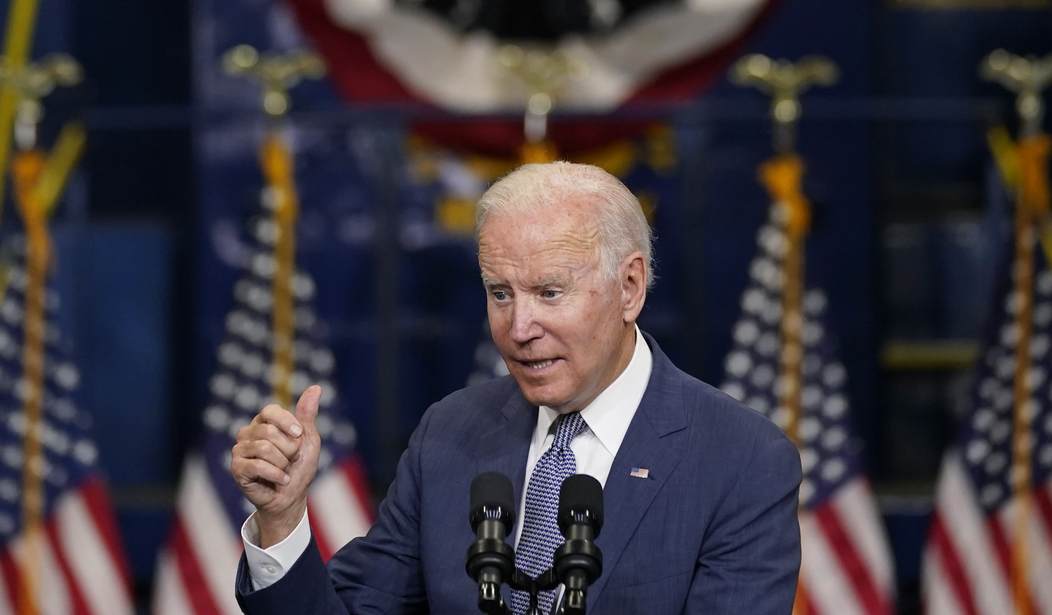
After months of Democratic disarray and disunity, the 1,684 page text of President Joe Biden's $1.75 trillion spending bill is here. It was finally put into place as House Speaker Nancy Pelosi (D-CA) claimed Democrats were close to reaching a deal on a key component of Biden's agenda, the other being the Infrastructure package, which is running into its own problems. As Spencer pointed out, Pelosi has warned her members not to embarrass the president and to hand him a win.
When President Biden announced a deal, the bill's text was not yet released, though a framework was. Touted programs in the framework included:
- Caregiving: Universal pre-school; child-care; elder care and care for people with disabilities; expanded child tax credit
- Energy and Climate Change: Clean energy tax credits and procurements; resilience investments for dealing with extreme weather; incentives for clean energy
- Healthcare: Affordable Care Act tax credits; Medicare coverage of hearing
- Other Middle Class Boosts: Investments in housing; investments in post-high school education and workforce training; earned income tax credit for workers without children; and "equity."
Of course, there were programs not mentioned in the framework or mentioned by just the bare minimum.
When it comes to education, for instance, one section of the bill's text outlines an "Increase in Pell Grants for Recipients of Means-Tested Benefits."
A "Priority" section indicates that these awards will be handed out a basis other than academic merit.
It reads that "In awarding grants under this section to eligible entities, the Secretary shall give priority to eligible entities that propose to use a significant share of grant funds to, among students of color, low-income students, students with disabilities, students in need of remediation, first generation college students, student parents, and other underserved student populations in such eligible entity, improve enrollment, retention, transfer, or completion rates or labor market outcomes."
The Biden administration is particularly fixated on addressing this concept of "equity." The president even acknowledged in June that the "first executive order I signed was insisting that every one of my cabinet members focus on racial equity."
The framework describes equity in the most vague of senses:
Equity and Other Investments: Other targeted investments including maternal health, community violence initiatives, Native communities, disadvantaged farmers, nutrition, pandemic preparedness, supply chain resilience, and other areas.
According to the framework, "Equity" still earns $90 billion.
In the actual text of the bill, however, "equity" is referenced with regards to "tree equity," which will cost $2.5 billion "for tree planting and related activities to increase tree equity and community tree canopy and associated societal and climate co-benefits, with a priority for projects that benefit underserved populations."
When it comes to this concept of equity, is that $10 million is to be set aside until 2031 for addressing "racial equity issues" to do with agriculture through "equity commissions."
As the bill's text explains, "In addition to amounts otherwise available, there is appropriated to the Secretary of Agriculture for fiscal year 2022, to remain available until September 30, 2031, out of any money in the Treasury not otherwise appropriated, $10,000,000 to fund the activities of one or more equity commissions that will address racial equity issues within the Department of Agriculture and the programs of the Department of Agriculture."
The most expensive section, according to the framework, is the $555 billion spent on "Clean Energy and Climate Investments." Next is "Childcare and Preschool," at $400 billion. "Child Tax & Earned Income Tax Credit" amounts to $200 billion. "Housing" and "Home Care" have $150 billion reserved. "ACA Credits, Including in Uncovered States" has $130 billion. An addition $40 billion will go to "Higher Ed and Workforce" and $35 to "Medicare Hearing."
When it comes to "Immigration," which has $100 billion, the framework merely notes that the bill will "Improve Our Immigration System Consistent with the Senate’s Reconciliation Rules." There needs to be further clarification from the Senate parliamentarian on what Democrats can include in this bill so that it get pass with a simple majority.
President Biden’s framework is fully paid for by asking more from the very largest corporations and the wealthiest Americans.
— The White House (@WhiteHouse) October 28, 2021
And no one making under $400,000 will pay a penny more in taxes. pic.twitter.com/rWvJ7C1PZP
The framework for the bill also continues to claim that the bill is paid for, with another oft-repeated line that its offsets involve asking wealthy Americans to "pay [their] fair share." As the section on "Offsets" reads:
Offsets: Ask Largest Corporations and Highest Income Americans to Pay Fair Share and Reduce Cost of Prescription Drugs
The plan is more than fully paid for by asking the wealthiest Americans and most profitable corporations to pay their fair share. It does not raise taxes on small business and anyone making less than $400,000 per year. It will also generate economic growth that will increase tax revenue and contribute to deficit reduction.
What's not in the final text of the bill are still other major Democratic priorities, such as paid family leave, free community college, drug pricing, Medicare coverage of dental and vision, the billionaire tax, and clean electricity performance program.
The bill of the text was released as progressives demanded tying reconciliation to infrastructure bill, and on Thursday were signaling they would defeat the infrastructure bill, which is actually consistent with earlier threats.
The Congressional Progressive Caucus released a statement on Thursday evening endorsing the framework.
Our statement regarding a vote on the infrastructure bill and the Build Back Better Act ?? pic.twitter.com/Hu0KGh3UYv
— Progressive Caucus (@USProgressives) October 28, 2021
As its chair, Rep. Pramila Jayapal (D-WA) told CNN's Manu Raju, though, that the text has been released is not enough for them.
Rep. Pramila Jayapal, the head of the progressive caucus, said having bill text of Build Back Better Act is not enough to vote for infrastructure bill.
— Manu Raju (@mkraju) October 28, 2021
“No,” Jayapal said I when asked if the text is enough to vote for infra proposal.
“We said the two bills have to go together.”
Raju also tweeted that the infrastructure vote will be delayed yet again.
This is the second delay of the vote -- as progressives are pushing Manchin and Sinema to back the larger proposal. Neither Manchin and Sinema have endorsed the legislation yet
— Manu Raju (@mkraju) October 28, 2021
Sen. Joe Manchin (D-WV) however, appears to be on board with the framework's price tag. As Jordain Carney reported for The Hill on Thursday night, Manchin told reporters that the $1.75 billion was what "was negotiated."

Join the Conversation
VIP members get the ability to comment on articles.