


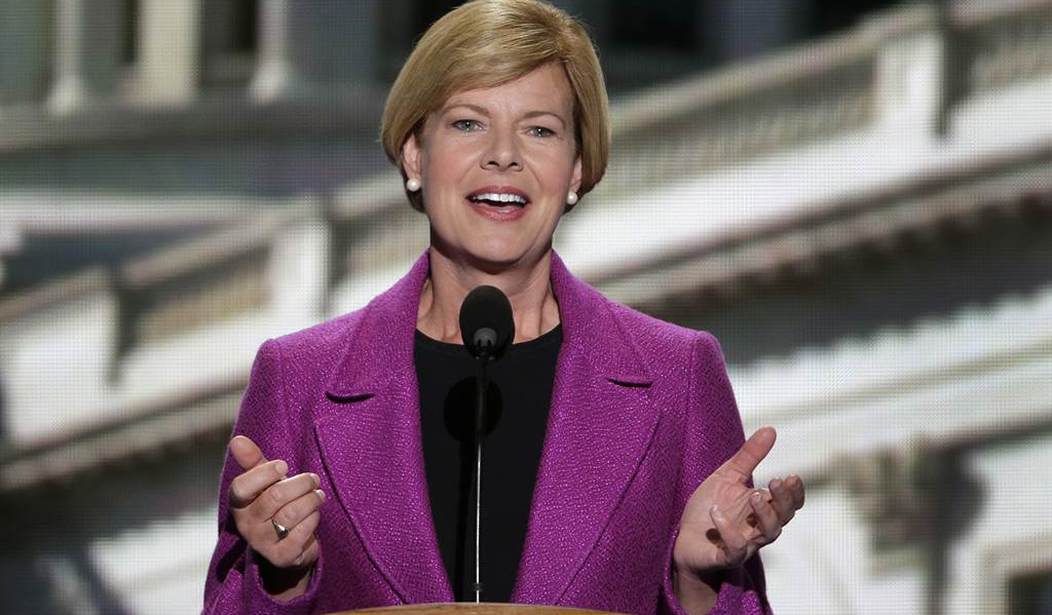
Our friends at NewsBusters posted this little tidbit from Sen. Tammy Baldwin (D-WI), who said on the June 27 broadcast of Up with Steve Kornacki, that the First Amendment only applied to institutions of faith. The discussion revolved around the Obergefell ruling from the Supreme Court, which said there is a constitutional right to gay marriage.
Tammy Baldwin: “Certainly the First Amendment says that in institutions of faith that there is absolute power to, you know, to observe deeply held religious beliefs. But I don’t think it extends far beyond that. We’ve seen the set of arguments play out in issues such as access to contraception. Should it be the individual pharmacist whose religious beliefs guides whether a prescription is filled, or in this context, they’re talking about expanding this far beyond our churches and synagogues to businesses and individuals across this country. I think there are clear limits that have been set in other contexts and we ought to abide by those in this new context across America.”
Well, that simply isn’t the case. Of course, the free exercise clause applies to individuals. For goodness sake, just look at First Amendment law that involves members of Jehovah’s Witnesses. In 1943, the Supreme Court ruled in West Virginia State Board of Education v. Barnette that compulsory flag salutes were a violation of free speech and free exercise in the First Amendment; school officials had punished the students and their families, all members of Jehovah’s Witness, for this infraction.
At the same time, there are restrictions on the free exercise of religion. As the First Amendment Center wrote, “the Supreme Court has interpreted this clause so that the freedom to believe is absolute, but the ability to act on those beliefs is not.” As an example, they noted that an article of faith permitting human sacrifice probably would not be held as a right protected by the First Amendment. But the right for an employee to discuss his faith at work–to a certain degree–is legal, as long as he or she does not create a hostile work environment. Moreover, if a co-worker informs another that his or her religious discussions makes them uncomfortable, the person engaging in religious conversation should respect the request and stop talking about it.
Recommended

Yet, even with respect to the recent gay marriage ruling, Baldwin seems to be unaware that religious exemptions for marriage-related business have rarely–if at all–been upheld by the courts, even in states with statutes similar to that of the federal Religious Freedom Restoration Act.
Nevertheless, overall, this isn’t a proper reading of the First Amendment.









Join the conversation as a VIP Member