





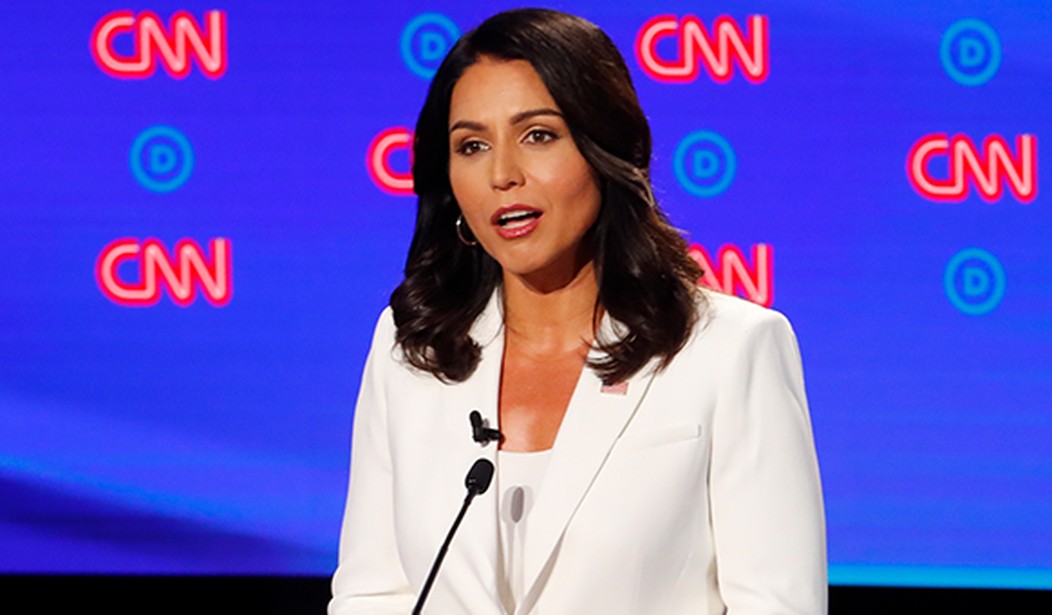
The New York Times published an article devoted exclusively to criticizing Rep. Tulsi Gabbard for wearing a white pantsuit. The arguments in the piece are insane enough, but to make matters worse, the same author wrote for the same paper during the last election cycle about how great it was that Hillary Clinton wore white pantsuits.
The white pantsuit is back on the national (debate) stage, thanks to Tulsi Gabbard. But the reactions are not exactly what they used to be - https://t.co/KHWkWt74GH
— Vanessa Friedman (@VVFriedman) November 21, 2019
Gabbard, the author wrote, seems much less interested in representing a symbol of suffragists, but more to “tap into another tradition, latent in the public memory: the mythical white knight, riding in to save us all from yet another “regime change war.”
It gets better than that, as Glenn Greenwald documents.
"Her white suits are not the white suits of Ms. Clinton, nor even the white of Ms. Williamson, whose early appearances in the shade often seemed tied to her wellness gospel and ideas of renewal and rebirth. Rather, they are the white of avenging angels and flaming swords, of somewhat combative righteousness (also cult leaders). And that kind of association, though it can be weirdly compelling, is also not really community building. It sets someone apart, rather than joining others together. It has connotations of the fringe, rather than the center."
My favorite paragraph from the NYT article depicting Tulsi as a fringe, divisive cult leader because she wears white pants suits - by the same author and paper who heaped praise on how Hillary's white pants suit shows she's ready to carry the nuclear codes.
— Glenn Greenwald (@ggreenwald) November 22, 2019
I mean savor this: pic.twitter.com/uxIK6MVn0M
— Glenn Greenwald (@ggreenwald) November 22, 2019
It goes without saying that the piece was widely ridiculed.
Please appreciate the fact that a professional adult wrote these sentences and was satisfied that they conveyed an intelligible meaning, and then the NYT published it https://t.co/nuu3G3OxPq
— Michael Tracey (@mtracey) November 22, 2019
That is the most ridiculous post-debate article I’ve ever read
— Scott Nystrom (@ScottNystrom1) November 22, 2019
So. Much. Journalisming
— Dennis McElhone (@d_mcelhone) November 22, 2019
This is the "analysis" the @nytimes thinks fit to print? What an embarrassment. pic.twitter.com/5ZHYmCH7ce
— PA4Tulsi (@Pa4Tulsi) November 21, 2019
literally give anyone else a column. anyone on the planet.
— Rick P. Johnson (@G0NinjaG0Ninja) November 22, 2019
Join the Conversation
VIP members get the ability to comment on articles.