





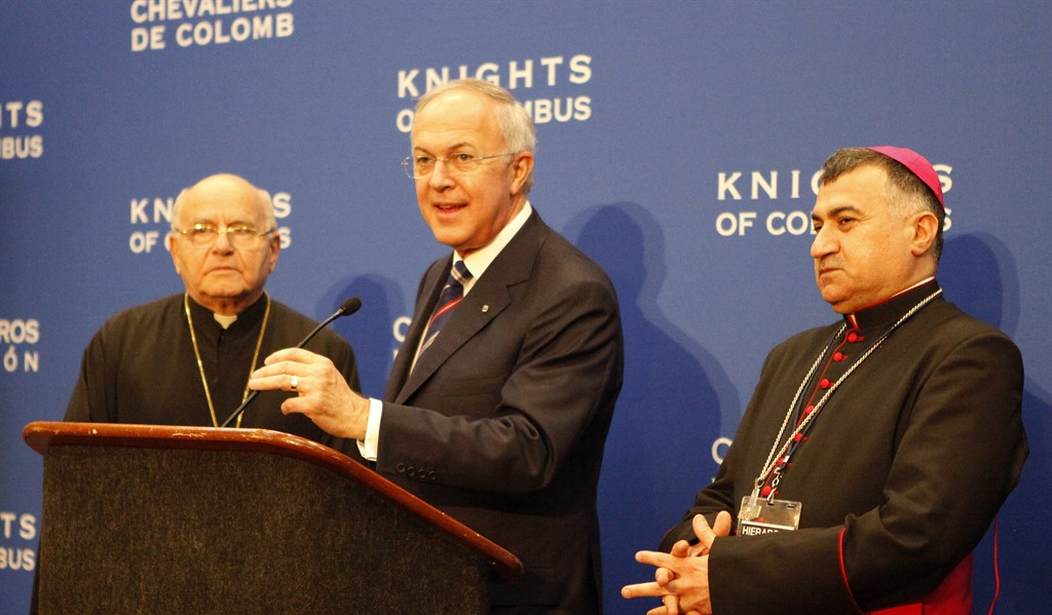
Washington, D.C. - Carl Anderson, the head of the Knights of Columbus, spoke with Townhall Friday during the March for Life about the scrutiny that judicial nominee Brian C. Buescher faced over his membership in the Catholic charitable organization.
In written questions submitted in December, Sens. Mazie Hirono (D-HI) and Kamala Harris (D-CA) expressed concern over the group’s support of defining marriage as being between a man and a woman and the group's opposition to abortion. These positions are both official teachings of the Catholic church.
Anderson told Townhall that he was “greatly surprised” by the senators’ scrutiny and referenced similar criticism that a Democrat, and member of the Knights of Columbus, former president John F. Kennedy had faced decades ago.
“We thought that Sen. John Kennedy when he ran for president back in 1960 kind of put that issue behind us,” he said, “so I don’t think we want to go backward, we want to go forward and their questions really are unfortunate.”
Anderson highlighted the charitable focus of his group, citing the 187 million dollars they gave to charity last year and the 85 million hours of volunteer service.
“They really don’t understand us,” he said of Hirono and Harris, “but what’s the problem to me and it should be a problem to all people of faith is we’re just being faithful to the teaching of our church and we thought this was a country where you could do that without government looking over your shoulder.”
He added that Sen. Dianne Feinstein (D-CA) had made similarly concerning remarks two years ago during the confirmation hearings for Judge Amy Coney Barrett, telling her “the dogma lives loudly within you and that’s of concern.”
“This is why people of faith should be thinking about this and be very concerned about it,” he emphasized, “do we want people coming out of mass on Sunday or another house of worship on Sunday thinking is some government official going to think the dogma lives too loudly in me?”
“No, I think it’s exactly the opposite,” he continued, “we want people of faith to take their faith seriously and it’s no business of government. You want to go into the free marketplace of ideas, that’s what this country’s about, let’s go at it, let’s have a free debate but to say oh wait a minute that idea’s no good because that’s linked to your religion? That’s a bad idea.”
Asked about the scrutiny that Second Lady Karen Pence faced for teaching art at a Christian school that requires their students and teachers to adhere to a Biblical understanding of marriage, Anderson talked about the current of animosity towards such ideas.
“I think there’s a secular presumption among many atheists and I think it finds a political expression in some corners of American society that religious belief, particularly Judeo Christian principles, run contrary to human freedom and therefore should be rejected,” he said. “I think that’s a very dangerous proposition and you can say whether you think that the teaching of a particular religion makes sense to you or doesn’t but that community should have the right in their schools and in their churches, their houses of worship to say what they believe.”
Anderson praised the unanimous consent resolution that Sen. Ben Sasse (R-NE) introduced and the Senate approved Wednesday.
Sasse described the resolution as reaffirming “our oath of office to a Constitution that rejects religious bigotry" and honoring a Constitution that "explicitly rejects religious tests for federal office."
Anderson said he was “very happy” with the resolution.
“There’s one thing I would point out,” he added, “under the procedure he used in the Senate, any senator could have simply said I don’t give consent to unanimous consent and he could’ve blocked it or she could’ve blocked it.”
“Basically as a matter of Senatorial courtesy both the Democratic cloakroom and the Republican cloakroom are notified,” he pointed out, “so that means that nobody in the Senate wanted to stand up and object to Sen. Sasse’s resolution on religious freedom and the constitutional prohibition of a religious test as exemplified in this example so I think it’s pretty important.”
On the Senate floor Friday, Sen. Hirono claimed Sasse’s resolution, which she did not object to at the time of its approval, was part of the “alt-right’s position.”
“If my colleague, the junior Senator from Nebraska, wants to embrace the alt-right’s position by offering this resolution, that is his business,” Hirono said. “Rather than passing a resolution to address a problem that doesn’t exist, we should focus on something real, like ending this totally unnecessary, unjustified shutdown.”
A Marist poll, released Wednesday, found that the vast majority of Americans don’t think religion should be a factor in appointment to federal government jobs.
“By a margin of more than eight to one (85 percent to 11 percent), Americans say that faith should not be a factor in deciding a person's appointment to a position in the federal government,” the poll found. “This includes about three quarters of Republicans (74 percent), and about nine in 10 Democrats (90 percent) and independents (89 percent).”
The survey of 1,066 adults was conducted January 8 through January 10, 2019 by The Marist Poll, sponsored and funded in partnership with The Knights of Columbus.

Join the Conversation
VIP members get the ability to comment on articles.