





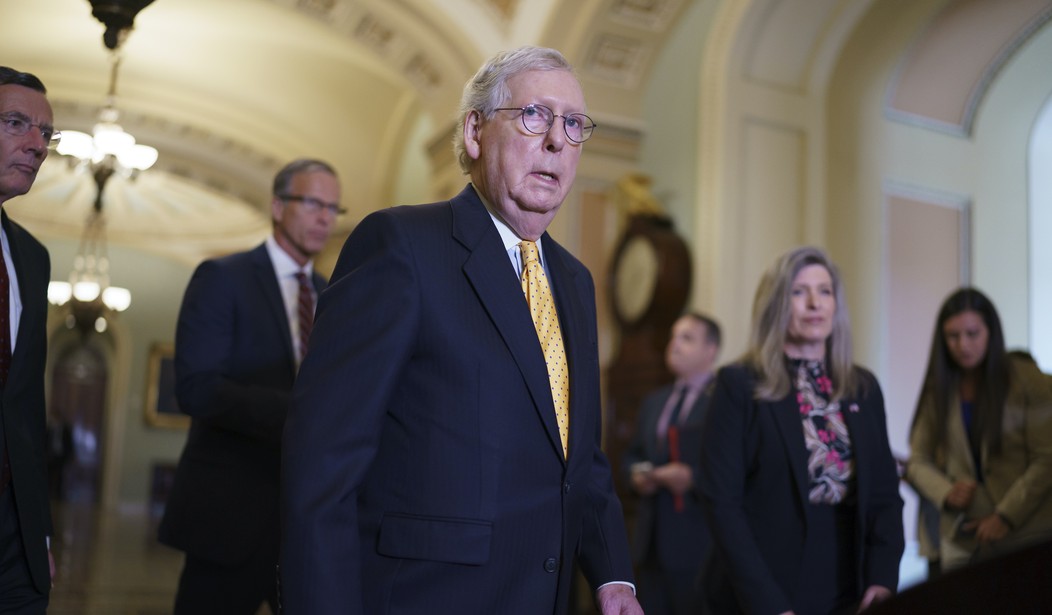
Senate Minority Leader Mitch McConnell (R-KY) said Tuesday that the Republican Party could ruin its chances at a successful showing in the midterm elections if the party chooses to run "unacceptable" candidates in November.
Speaking at a chamber event in Kentucky, McConnell noted that 1994 was the best election year for the GOP but that the political atmosphere ahead of the upcoming elections is even better than it was 28 years ago.
"From an atmospheric point of view, it’s a perfect storm of problems for the Democrats," McConnell said. "How could you screw this up? It's actually possible. And we've had some experience with that in the past."
"In the Senate, if you look at where we have to compete in order to get into a majority, there are places that are competitive in the general election," he continued. "So you can’t nominate somebody who's just sort of unacceptable to a broader group of people and win. We had that experience in 2010 and 2012."
This comes as recent polling indicates that Republicans will take back Congress in November. An NBC News poll from late March found that the GOP has a two-point edge over Democrats (46 percent to 44 percent) when it comes to which party Americans would like to control Congress.
Americans have become increasingly frustrated with the Biden administration and Democratic policies because of issues like surging gas prices, record-high inflation rates, an ongoing crisis at the southern border and foreign policy failures such as the chaotic withdrawal from Afghanistan and the current war Russia is waging on Ukraine.
To regain control of the Senate, Republicans would need a net pickup of one seat in November's elections. The Senate's current majority is currently knotted at 50-50.
Republicans are looking to hold on to 21 Senate seats up for grabs in November while Democrats are defending just 14 seats.
Five seats are rated by the Cook Political Report as toss-ups in November. Of those seats, three (Georgia, Arizona and Nevada) are held by Democrats and two (Pennsylvania and Wisconsin) are currently GOP-controlled. The seat in Pennsylvania is currently held by Republican Sen. Pat Toomey, who is retiring.
The Cook Political Report also ranks three Republican-held seats – Florida, Ohio and North Carolina – as "lean" Republican. Florida GOP Sen. Marco Rubio is running to hold on to his seat while the races in North Carolina and Ohio are open due to the retirements of Republican Sens. Richard Burr (N.C.) and Rob Portman (OH).
Just one seat held by a Democrat is ranked as "lean" Democrat. That seat is in New Hampshire, where Democratic Sen. Maggie Hassan is running for reelection.
Georgia, Arizona, Missouri, Nevada, Pennsylvania, North Carolina, New Hampshire, Ohio and Wisconsin – several of which McConnell listed as crucial states in the battle for the Senate majority – will all be states that could help determine which party ultimately controls the upper chamber following November's elections.
"So far I'm optimistic that, in the places that are going to determine who the next majority leader is, we're going to have fully electable nominees,” McConnell said.



Join the Conversation
VIP members get the ability to comment on articles.