





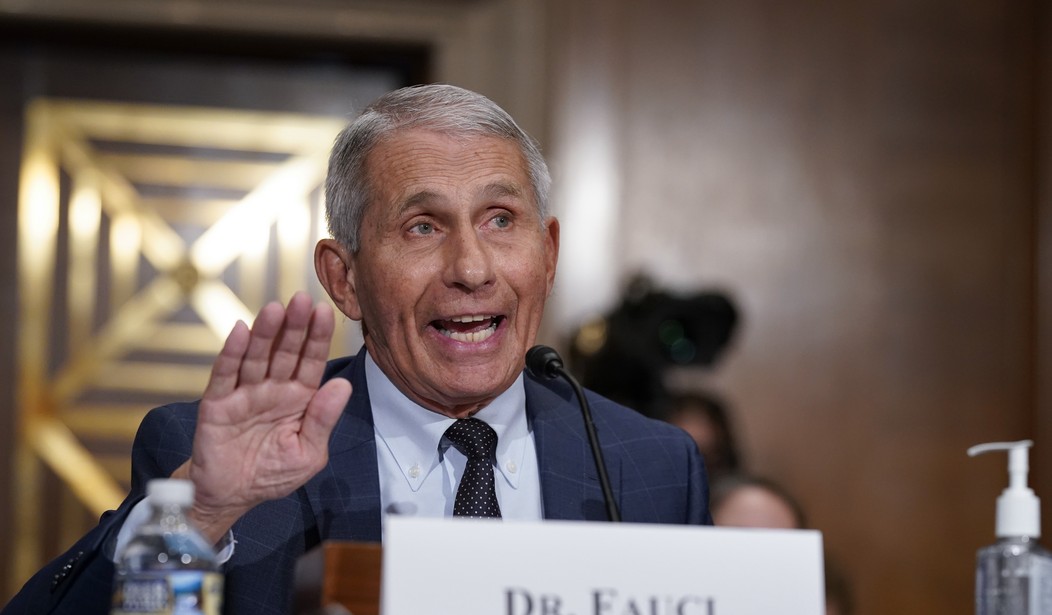
Dr. Anthony Fauci is back on Capitol Hill Thursday for questioning in front of the Senate Health Committee.
Under questioning from Dr. Rand Paul, Fauci again attempted to redefine the meaning of gain-of-function research.
Sen. @RandPaul (R-KY) to Dr. Anthony Fauci: "You appear to have learned nothing from this pandemic...What you're doing is defining away gain-of-function...and what you've done is change the definition on your website to try to cover your ass, basically." pic.twitter.com/Ty7znQtT5J
— Logan Ratick (@Logan_Ratick) November 4, 2021
Fauci has repeatedly denied his agency funded dangerous gain-of-function research at the Wuhan Institute of Virology. Recently, the National Institute of Health disputed that claim.
"The fifth and final progress report for Grant R01AI110964, awarded to EcoHealth Alliance, Inc. is attached with redactions only for personally identifiable information," NIH Principal Deputy Director Larence Tabak explained in a letter to Republican Congressman James Comer. "It includes data from a research project conducted during the 2018-2019 grant period using bat coronavirus genome sequences already existing in nature."
"The limited experiment described the final progress report provided by EcoHealth Alliance was testing if spike proteins from naturally occurring bat coronaviruses circulating in China were capable of biding to the human ACE2 receptor in a mouse model," the letter continues. "In this limited experiment, laboratory mice infected with the SHC014 W1V1 bat coronavirus became sicker than those infected with the W1V1 bat coronavirus."



Join the Conversation
VIP members get the ability to comment on articles.