







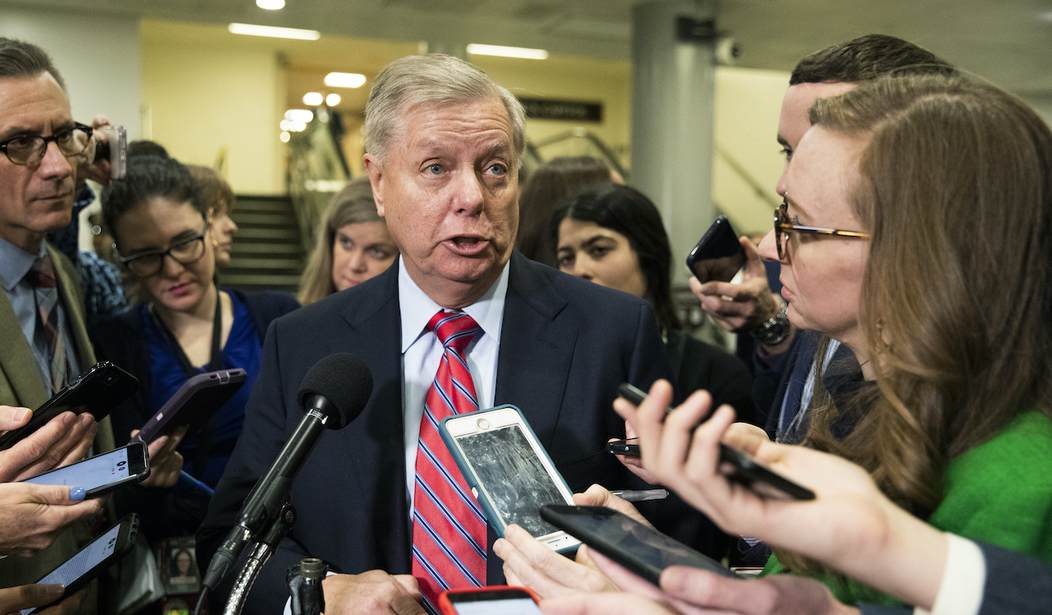
Senate Judiciary Committee Chairman Lindsey Graham is backing President Donald Trump’s calls for Republicans to fill the Supreme Court vacancy left by the late-Justice Ruth Bader Ginsburg.
I fully understand where President @realDonaldTrump is coming from. https://t.co/qlhtEwTCdX
— Lindsey Graham (@LindseyGrahamSC) September 19, 2020
Graham, who would oversee the nomination hearing for a Supreme Court nominee chosen by President Trump, is reiterating the difference between now and 2015 when President Barack Obama's nomination of Judge Merrick Garland failed. He's also rejecting lectures from Democrats about decency and fairness in the aftermath of the Kavanaugh hearings.
Sen. Lindsey Graham, R-S.C., chairman of the Judiciary Committee, which reviews Supreme Court nominations, said he's prepared to advance a nominee if a vacancy occurs this year.
"Yeah. We'll cross that bridge. After [Brett] Kavanaugh, the rules have changed as far as I'm concerned," he told reporters, citing the intense battle over Trump's most recent Supreme Court nominee in 2018, who was narrowly confirmed. "We'll see what the market will bear if that ever happens."
Graham, who chairs the Senate Judiciary Committee, noted that both the Senate and the White House are held by Republicans, versus in 2016, when the GOP-held Senate denied Garland a hearing.“Well, Merrick Garland was a different situation. You had the president of one party nominating, and you had the Senate in the hands of the other party. A situation where you've got them both would be different. I don't want to speculate, but I think appointing judges is a high priority for me in 2020,” Graham said in an interview on “Full Court Press with Greta Van Susteren” set to air Sunday.
"If you look into the history of the country, there had not been an occasion where somebody was confirmed in a presidential election year after primary started when you had divided government," he added.
As to my view of filling a Supreme Court vacancy in 2020, I’d encourage you to review these most recent statements.
— Lindsey Graham (@LindseyGrahamSC) September 19, 2020
NBC Newshttps://t.co/wGnCdcpJjr
The Hillhttps://t.co/cagapf6S9t
Meanwhile, President Trump recently released the list of potential Supreme Court nominees he would consider in a second term. Democratic nominee and former Vice President Joe Biden has refused to reveal who he might nominate.



Join the Conversation
VIP members get the ability to comment on articles.