
The current crisis at the U.S.-Mexico border has been ongoing since January of this year. Much of the focus has been on the large groups of family units and unaccompanied minors willingly turning themselves over to Border Patrol to be processed and, in many cases, released into the United States.
While the large numbers of people surrendering themselves to U.S. law enforcement, oftentimes leading to overcrowded conditions, is the easiest part to see regarding the border crisis, there is a darker side that is harder to document and track as law enforcement along the border has been stretched thin.
It is known that the drug cartels and human traffickers use large groups of people willing to be apprehended as cover to move people or drugs — who don't want to be caught — in the areas where Border Patrol is not present because they are busy processing people. This was evident in the Rio Grande Valley and Del Rio in Texas and during my recent time in Yuma, Arizona.
With the large amount of money the cartels and human traffickers are making due to the demand for human smuggling increasing this year, in part thanks to the Biden administration's open border policies, it is no surprise they feel untouchable.
Fox News National Correspondent Bill Melugin has reported on several instances of suspected cartel gunmen flexing their muscle toward Texas National Guardsmen.
NEW: In multiple instances over the past several days, Texas DPS tells me suspected cartel gunmen involved in human smuggling have stood in & near the Rio Grande in Starr County and taunted TX National Guard soldiers. They wear tac vests & have AK47s.
— Bill Melugin (@BillFOXLA) October 6, 2021
Courtesy: @TxDPS @FoxNews pic.twitter.com/68dpIOa2Nc
NEW: “Holy sh*t!”
— Bill Melugin (@BillFOXLA) October 8, 2021
We witnessed tracer rounds from a suspected cartel machine gun being fired from Mexico into the U.S. early this morning while we were embedded with the TX National Guard in Roma, TX. Soldiers tell us the rounds went above one of their observation posts. @FoxNews pic.twitter.com/wJrcDF885r
As I previously reported in August, U.S. Customs and Border Protection confirmed two Border Patrol agents were shot at within a week by someone, or some people, on the Mexican side of the border while patrolling the U.S.-Mexico border in the El Paso Sector.
Former Acting Department of Homeland Security Secretary Chad Wolf told Townhall that while cross-border shootings are not unusual, what was unusual was how close the incidents occurred from one another.
"I think what it shows you...is how emboldened the cartels have become over the last several months. I think it's important to remember...is the fact the cartels are making millions of dollars a day, that's not a week, that's not a month, a day on this illegal traffic that's occurring; off of the back of these migrants because of the policies being pursued here in the U.S. by this administration," Wolf said.
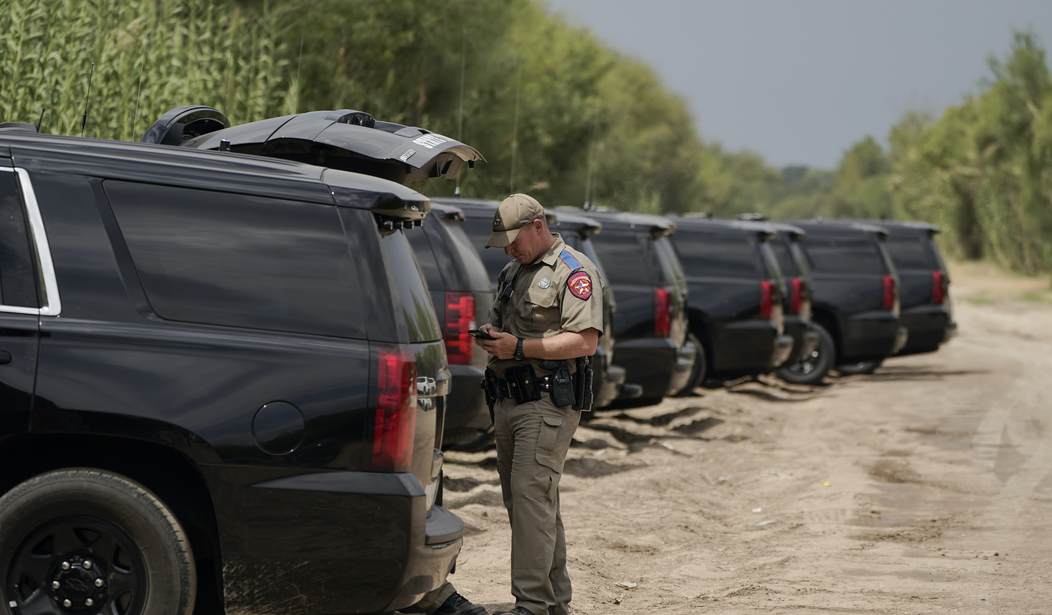
Lt. Christopher Olivarez, a Public Information Officer with the Texas Department of Public Safety, told Townhall these "show of force" incidents from the cartels is something U.S. law enforcement has not seen.
"They are getting even more bold, where they present themselves right along the riverbank, brandishing their weapons in full tactical gear...we're starting to see that more frequently now, which we have not seen in previous years. We feel these drug trafficking organizations are feeling more empowered because of the situation on the border," Olivarez said.
Pointing to his 20-plus year career in law enforcement along the U.S.-Mexico border, Olivarez said the crisis in terms of the apprehensions and drug seizures "is unlike what we have seen before."
Beyond the cartels showing off their power, the smuggling of illegal immigrants who don't want to be caught presents hazards on the road. In one case in August, a smuggling van carrying 24 people lost control and crashed south of a Border Patrol checkpoint in Falfurrias, Texas, killing 10.
Warning: Graphic
— Julio Rosas (@Julio_Rosas11) August 11, 2021
The overcrowded facilities are one part of the current border crisis. Another aspect has been the vehicle crashes while transporting people trying to avoid BP. This one was last week south of Falfurrias, TX. The van had around 24 people, at least 10 were killed. pic.twitter.com/HnZ24nB7En
A law enforcement source told me at the time that there had been an increase in vehicle smuggling this year, leading to more crashes. In the Rio Grande Valley, there were three fatal car crashes in a one-week period, totaling 13 deaths. None of them were the result of the police pursuing the vehicles.
NEW: ICE confirms to @FOXLA that agents from Homeland Security Investigations (HSI) in San Diego have initiated a human smuggling investigation in connection with the fatal crash near El Centro that killed 13 people after 25 had been crammed into a Ford Expedition that seats 7-8. pic.twitter.com/nPgwkRIOKo
— Bill Melugin (@BillFOXLA) March 3, 2021
Even when police do try to stop smugglers, accidents still happen.
NEW: We witnessed a high speed pursuit of a human smuggler who had 12 illegal immigrants in his vehicle. He led TX State Troopers & Border Patrol on a dangerous 40 minute chase before he crashed into the front of a house in a quiet residential neighborhood in McAllen. @FoxNews pic.twitter.com/ZoZCDYlVhm
— Bill Melugin (@BillFOXLA) June 14, 2021
In my experience from being down on the southern border this year, like in south Texas, I can say it does feel like certain areas have become more dangerous, particularly along known smuggling routes.