





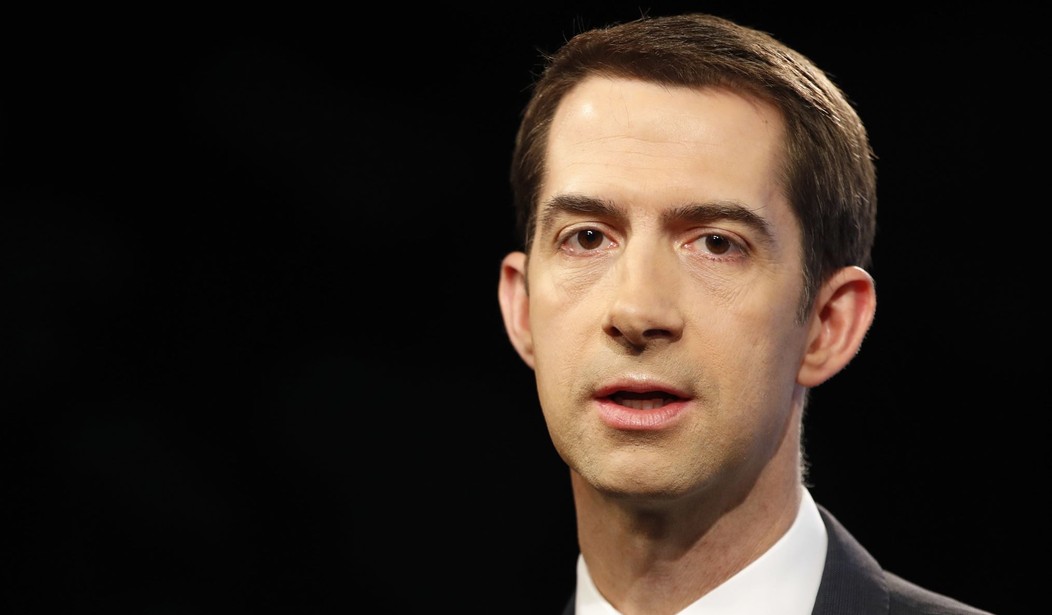
The Washington Post has rebutted its own previous reporting that had criticized Sen. Tom Cotton (R-AR) for spreading a "conspiracy theory" on the possible origins of the Wuhan coronavirus.
During the early stage of the pandemic, Cotton said it was possible COVID-19 originated from the Wuhan Institute of Virology (WIV), a lab that had become China’s first laboratory to achieve the highest level of international bioresearch safety (BSL-4).
In a story published on February 17, the Post labeled it a "fringe theory." The outlet's experts also appeared to have wrongly assumed Cotton thought it was deliberately released:
"In response to Cotton’s remarks, as well as in previous interviews with The Washington Post, numerous experts dismissed the possibility the coronavirus may be man-made.
'There’s absolutely nothing in the genome sequence of this virus that indicates the virus was engineered,” said Richard Ebright, a professor of chemical biology at Rutgers University. 'The possibility this was a deliberately released bioweapon can be firmly excluded."
Vipin Narang, an associate professor at the Massachusetts Institute of Technology, said it is 'highly unlikely' the general population was exposed to a virus through an accident at a lab.
'We don’t have any evidence for that,' said Narang, a political science professor with a background in chemical engineering.
'It’s a skip in logic to say it’s a bioweapon that the Chinese developed and intentionally deployed, or even unintentionally deployed,' Narang said."
In a new story published on April 14, the Post reported, "State Department cables warned of safety issues at Wuhan lab studying bat coronaviruses."
In the new report, it was revealed U.S. embassy officials who had visited WIV several times sent two official warnings back to Washington, D.C. about inadequate safety at the lab, which was conducting studies on coronaviruses from bats two years ago. They were concerned about the potential human transmission of SARS-like virus that could lead to a new pandemic, similar to what the world is experiencing today.
It is important to note Cotton never definitely stated COVID-19 came out of the WIV, intentionally or not, rather he wanted an investigation to determine if the theory was sound, and the media ridiculed him for such a suggestion.

Join the Conversation
VIP members get the ability to comment on articles.