





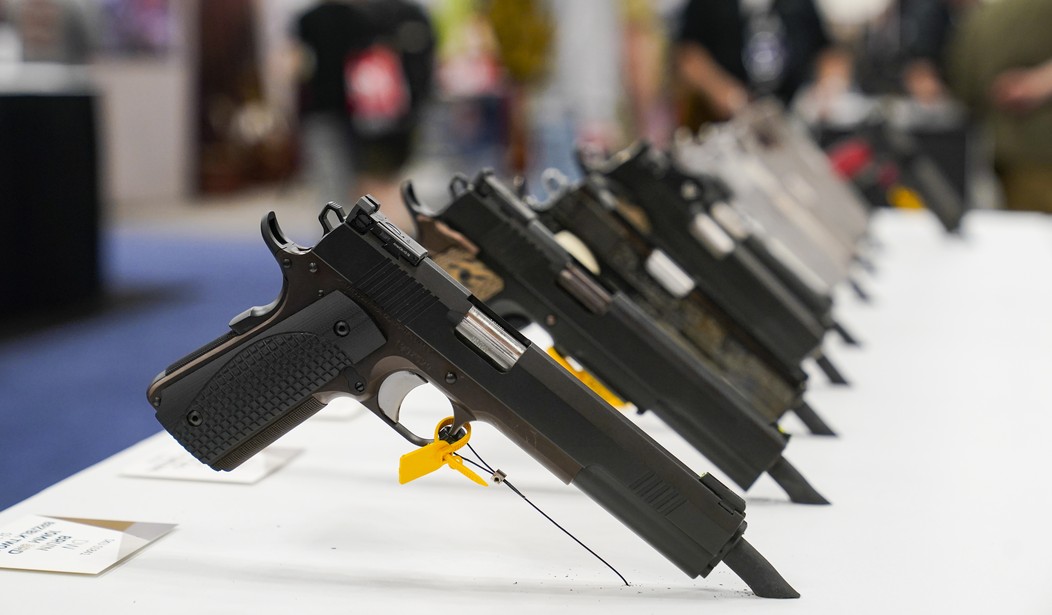
A federal appeals court ruled that a law barring individuals with a felony from owning firearms is unconstitutional on Monday.
Bryan Range was convicted of food stamp fraud about 30 years ago. He was subsequently prohibited from owning a gun due to the severity of his crime.
Range had defrauded the government out of $2,458 by lying on a food stamp application in 1995. He was sentenced to probation and stripped of his Second Amendment rights unknowingly, according to The Tucson Sentinel. He only found out about the restriction when he decided to purchase a firearm and was rejected.
Range only discovered his inability to purchase a firearm after attempting to do so decades later, prompting what has become a yearslong back-and-forth across multiple federal courts.
In 2020, Range filed an as-applied challenge in the Eastern District of Pennsylvania against the U.S. attorney general and Bureau of Alcohol, Tobacco, Firearms and Explosives director. The court dismissed his complaint and Range appealed.
The Third Circuit affirmed the lower court two years later, finding the government had shown that the nation’s historical tradition of firearm regulation justified barring Range from Second Amendment right entitlements. However, Range successfully petitioned for an en banc rehearing, and in 2023 the circuit reversed the lower court.
The Third Circuit Court of Appeals found that the law violated Range’s Second Amendment rights because there is insufficient historical evidence that such a ban could apply to the plaintiff’s situation.
“Because the Government has not shown that our Republic has a longstanding history and tradition of depriving people like Range of their firearms, § 922(g)(1) cannot constitutionally strip him of his Second Amendment rights,” the ruling read.
The Supreme Court’s ruling in New York Rifle & Pistol Association v. Bruen requires gun laws to be in line with the country’s historical tradition of gun laws. It has been used to strike down several similar unconstitutional restrictions on the right to keep and bear arms.
The court’s majority concluded that the Second Amendment protects all Americans, including felons like Range, because it applies to “the people.” However, it acknowledged that state legislatures can remove these rights from certain groups of people if there is sufficient justification.
The state attempted to argue that the law barring Range from owning firearms does have roots in America’s history of gun laws. It argued that “legislatures traditionally used status-based restrictions’ to disarm certain groups of people.”
However, the court majority replied by pointing out that “Apart from the fact that those restrictions based on race and religion now would be unconstitutional under the First and Fourteenth Amendments, the Government does not successfully analogize those groups to Range.”
Government attorney Kevin Soter argued that all felonies are “serious crimes” that should allow the government to strip citizens of their Second Amendment rights. Yet, the court challenged him to define the term “credible threat” in Range’s case, which is now required because of the Supreme Court’s ruling in United States v. Rahimi.
“Let’s say that Pennsylvania decided that jaywalking or failing to return library books is a felony,” said Judge Porter, a Donald Trump appointee. “Would those offenders be permanently disarmed under Rahimi?”
Soter replied that such an offender should be disarmed upon conviction and could seek legal mechanisms such as expungement or a pardon to regain their Second Amendment rights.
“That’s a very steep hill to climb,” one judge muttered.
Peter Patterson, Range’s attorney, lauded the ruling, saying he and his client “are pleased that the en banc Third Circuit has once again held that it is unconstitutional to disarm Bryan Range on the basis of a decades-old, nonviolent offense.”

Join the Conversation
VIP members get the ability to comment on articles.