





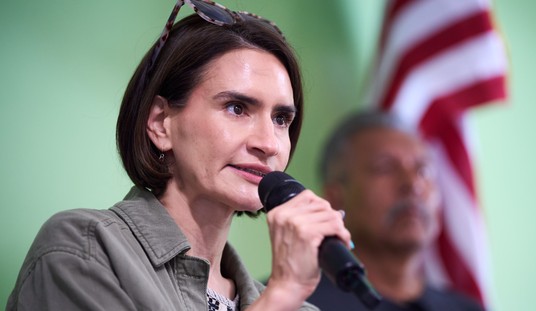
On Sunday's Meet the Press, Republican strategist Matt Gorman made a point about abortion politics that triggered aggressive pushback from several co-panelists, as well as on social media. Gorman's offense was being a man who cited data in order to make a point on an issue about which progressive activists and journalists feel very strongly. Gorman discussed both GOP internal polling, as well as NBC's own network polling, to fortify his argument. Yamiche Alcindor, an activist with a press credential, responded with an anecdote. Former Sen. Claire McCaskill asserted that the statistics recited by Gorman 'infuriate women:'
WATCH: @mattsgorman tells the panel abortion "is not in the top four of issues." @Yamiche and @clairecmc fiercely disagree.@Yamiche: "Abortion comes up 90% of the time" on the campaign trail.@clairecmc: It "infuriates women when they hear that." pic.twitter.com/MR8jHQAnyz
— Meet the Press (@MeetThePress) September 11, 2022
Responses like this came pouring in:
And, "Republican Communicator" wants to double down pic.twitter.com/GWxpT9kvzZ
— Joyce Alene (@JoyceWhiteVance) September 11, 2022
This is tiresome. We've discussed at some length the various ways in which abortion proponents and defenders attempt to disqualify dissenting opinions, thus avoiding meaningful debate. One prominent method of this is to dismiss men's views on the matter (but really only pro-life men's views, naturally). This is a weak and cheap form of argument, which ignores -- among other things -- that a substantial majority of American women favor significant abortion restrictions. Pro-life women, of whom there are tens of millions, are often dismissed as traitors to womanhood or ignored entirely. It's also bizarre to watch certain progressives toggle between asserting that men can't have opinions on abortion (other than pro-choice or pro-abortion opinions), and stating affirmatively that men, too, can have abortions. In the clip above, Gorman is marshaling data to advance an argument. That's not lecturing or 'mansplaining.' Efforts to characterize it as such are designed to sidestep his point, not address it. Those objecting to it on those grounds should consider pretending that a pro-life woman was making the exact same observations. It's not Gorman's fault that pro-life women were not represented on the panel, as is so often the case in such settings.
As for the underlying dispute, both Gorman and the ladies on the panel have a point. Gorman is correct that polling does not reflect abortion being quite the national electoral catalyst that the agenda-driven media and activist class hope it will be. They project their biases on this issue with great intensity. Gorman is right that other questions are far more dominant in voters' minds, overall. But it is also true that fears over abortion bans in the wake of Dobbs (which is how Democrats are framing the issue) have undoubtedly fueled intensity among the Democratic base. That is real. So is movement among certain voters, especially more educated suburban voters, on voting priorities heading into the fall. In some areas, states, and districts, Dobbs backlash -- and concerns over blanket bans -- will help Democrats mitigate an otherwise bleak environment. Quite a few Democratic campaigns are leaning into the issue, too often with little-to-no counter-challenge from Republicans. There's plenty of material to work with (this, for instance, is good), but some in the GOP seem to believe avoiding and ignoring the issue is the best course of action. I'm skeptical that they're right.
Democrats' fortunes appear to have improved over recent weeks for a variety of reasons. In some races, abortion has moved the needle. More broadly speaking, the cost of gasoline has dropped off (it's still high, but not as steep as it was over the summer), and the Mar-a-Lago drama has again thrust President Trump into the center of our political discourse. These factors have helped Democrats, which is why (often hypocritical and cynical) Democrats and the media are eagerly discussing all things Trump as often as possible. The ruling party is in better position than it has been in some time, though I believe the opposition still stands to make major gains in November. I'd currently put the over/under at 235 House seats and 50 Senate seats for the GOP, which would represent a gain of roughly two dozen lower chamber seats, with no net change in the upper chamber. Given the overall environment, Republicans should perform better on both fronts, but some bona fide cross-currents are complicating what once looked like an impending Democratic wipeout. And even though the Senate is looking like a challenge for the GOP, I'll leave you with a few reminders that it's very much a dogfight and a Republican majority is absolutely not off the table:
NEW: Insider Advantage (R) | Fox 5
— InteractivePolls (@IAPolls2022) September 8, 2022
GA Senate
(R) Herschel Walker 47% (+3)
(D) Raphael Warnock 44%
GA Governor
(R) Brian Kemp 50% (+8)
(D) Stacey Abrams 42%
550 LV | 09/06-07 | MoE +/- 4.2%https://t.co/AdIoZuqYYI
?? NEW ARIZONA POLL by Emerson
— InteractivePolls (@IAPolls2022) September 9, 2022
SENATE
(D) Mark Kelly 47% (+2)
(R) Blake Masters 45%
GOVERNOR
(R) Kari Lake 46% (=)
(D) Katie Hobbs 46%
PRESIDENT
(R) Donald Trump 44% (+3)
(D) Joe Biden 41%
627 LV | 09/06-07 | R36/D33/I31https://t.co/LuEcr9cqR4 pic.twitter.com/lthG1bc0Zv
Join the Conversation
VIP members get the ability to comment on articles.