





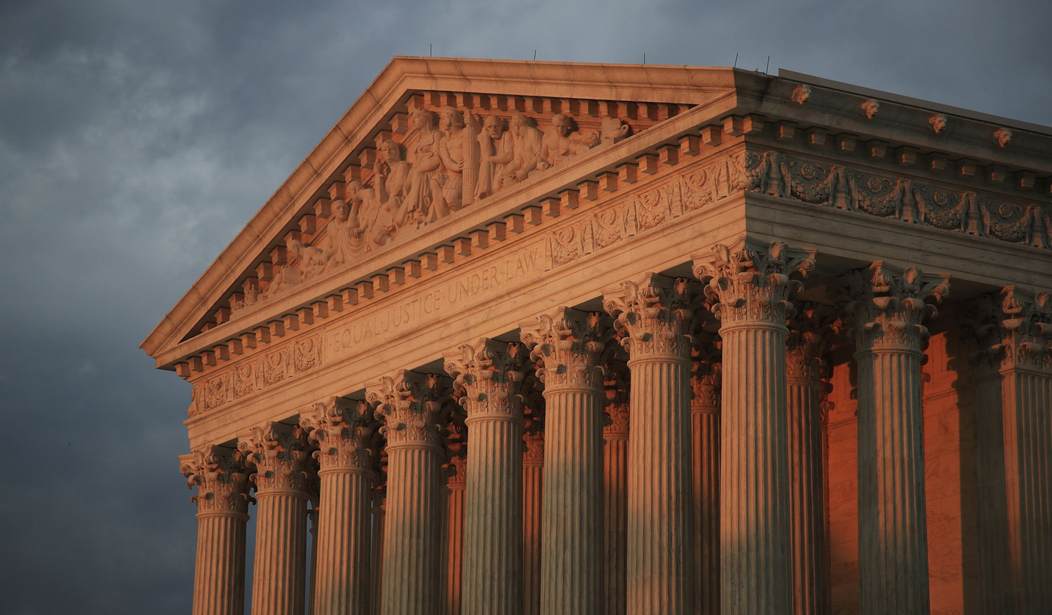
Regardless of how we may feel about the Supreme Court's decision to strike down President Trump's use of tariffs on Friday, the liberal justices’ partial concurrence reveals much about their vision of executive power and their willingness to expand it at every chance.
While they voted to block Trump’s signature economic initiative, his use of the International Emergency Economic Powers Act (IEEPA) to impose tariffs, they declined to join the majority in full, breaking specifically over the application of the “major questions doctrine.”
The lineup itself was unusual. Chief Justice Roberts, along with Justices Coney Barrett and Gorsuch, joined the liberal justices in ruling against Trump’s use of the IEEPA, while Justices Thomas, Alito, and Kavanaugh dissented. Though it was widely expected that the liberal justices would oppose the former president, their refusal to endorse the majority’s reasoning signals a deeper disagreement over how clearly Congress must speak when delegating significant authority to the executive branch.
Chief Justice John Roberts, who authored the majority opinion, relied on the "major questions doctrine," which holds that if a branch of government sought to delegate a significant portion of its power to another branch, it would explicitly name that power rather than dancing around it.
In the example of the IEEPA, Chief Justice Roberts argued that the Trump administration relied on the phrase “regulate… importation” in the IEEPA to justify its use of tariffs. However, he noted that the two words are separated by sixteen other words in the statute, weakening the claim that the law clearly authorizes tariffs. From the IEEPA:
the President may … (B) investigate, regulate, direct and compel, nullify, void, prevent or prohibit, any acquisition, holding, withholding, use, transfer, withdrawal, transportation, importation or exportation of, or dealing in, or exercising any right, power, or privilege with respect to, or transactions involving, any property in which any foreign country or a national thereof has any interest
He further pointed out that Congress explicitly listed several specific ways the president may exercise authority under the statute. Therefore, Roberts contended that if Congress had intended to grant the president the power to impose tariffs, it would have done so directly and unambiguously.
This is precisely where the liberal justices parted ways with the majority in their application of the “major questions doctrine.” If they were to accept that Congress must explicitly and clearly state the authority it intends to delegate to the executive, they would face difficulty defending expansive assertions of executive power. In many instances, such assertions have relied on broad or implied statutory language to justify actions taken by Democratic administrations.
In a recent example, West Virginia v. EPA (2022), the statute in question directs the EPA to determine the “best system of emission reduction” for power plants but does not explicitly authorize the agency to restructure the national power grid or mandate large-scale generation shifting. The conservative majority invoked the “major questions doctrine” to hold that such an economically and politically significant plan required clear, specific authorization from Congress.
The liberal justices, in contrast, argued that Congress’s broad language in “best system of emission reduction” was intentionally meant to give the EPA flexibility to implement powerful, system-wide measures. They contended that interpreting the statute to bar generation shifting ignored the expansive delegation of authority that Congress had intended.
Ultimately, the liberal justices’ partial concurrence in the tariff ruling highlights a fundamental divide over how the Court views executive power. While conservative justices often move to check an overreaching executive, the liberal justices appear more willing to expand executive authority, opposing Republican administrations when convenient, while embracing expansive executive power to advance Democratic priorities.
Editor's Note: President Trump is leading America into the "Golden Age" as Democrats try desperately to stop it.
Help us continue to report on President Trump's successes. Join Townhall VIP and use promo code FIGHT to receive 60% off your membership.


Join the Conversation
VIP members get the ability to comment on articles.