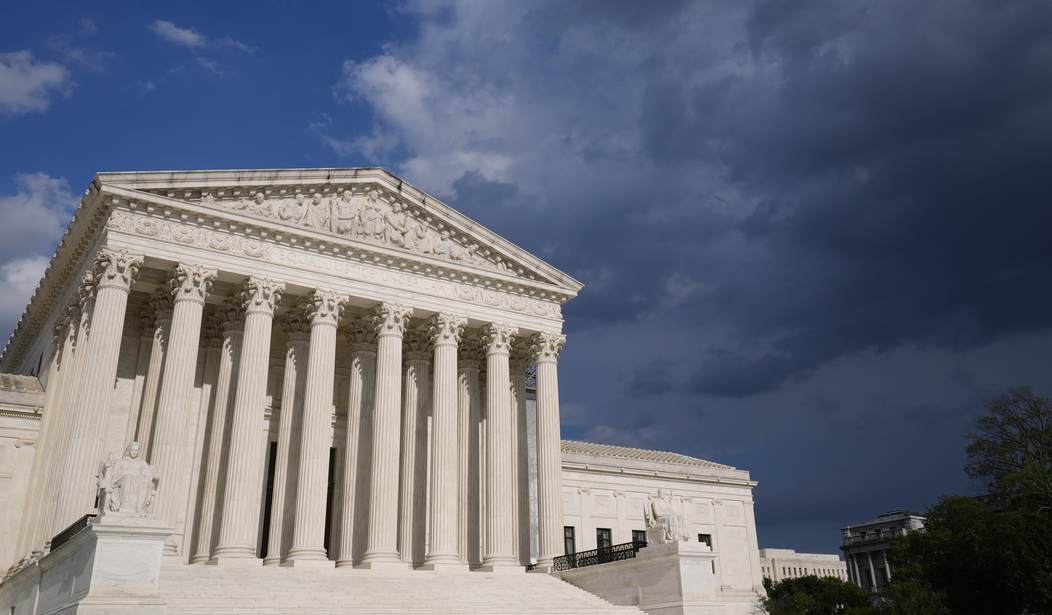

CBS Chief Legal Analyst Jan Crawford slammed the left's narrative that the conservative Supreme Court is corrupt. She accused the left of undermining trust in American institutions, which is not only "false" but "dangerous," as government is unable to function without trust in its basic institutions.
In November, House Minority Leader Hakeem Jeffries described the Corut as dishonorable, saying on CNN that, “We’re committed to driving down the high cost of living, to fixing our broken health care system and, at the same period of time, cleaning up the corruption that exists in Washington, D.C., in the Congress, at the Supreme Court and, of course, with the Trump administration, the most corrupt administration in American history.”
“I just want to be precise,” Wolf Blitzer replied. “You say the Supreme Court has been corrupt? Is that what you’re saying?”
“Yes, what I’m saying is that the outrageous behavior by individual justices like Clarence Thomas and Justice Alito and the failure to have an ethical code of conduct is corrupt. These are the only people in the country who can operate above the law,” Jeffries replied.
“There is a narrative that the Supreme Court is corrupt,” Crawford said on Sunday on CBS News’ “Face the Nation.” “We saw that emerge in the wake of the Dobbs decision that overturned Roe v. Wade. And now we see it, that they’re ‘in the tank for Trump.’ Not only is that narrative overreported, it is patently false, and it is dangerous for the institution and the public’s faith and confidence in the rule of law.”
“This is a conservative Supreme Court,” she stated. “It has been a conservative Supreme Court for 20 years. People can disagree and do disagree with their opinions, but it’s profoundly wrong to call it – or say corruption where there, in fact, is none.”
What’s underreported is any understanding of what this court’s been doing for the past 20 years. Its views of its role, vis-à-vis the other branches. How it sees the law. How it’s trying, in its focus, to restore some kind of accountability and our constitutional structure. Again, this is a court that is functional. It is consistent. They are nine justices. They don’t necessarily see the Constitution the same way by any means or how to interpret federal law. There’s a struggle over the proper way to interpret the Constitution. But that is as it should be. And I think as we approach our 250th anniversary of this country, it’s important to think about the court and their rule of law as the justices are doing, especially if we hope to keep democracy intact.
On @FaceTheNation @JanCBS Crawford scolded the press corps in naming her “under-reported” story of the year: “There is a narrative the Supreme Court is corrupt. We saw that emerge in the wake of the Dobbs decision...and now we see it that they’re in the tank for Trump. Not only… pic.twitter.com/2rPcXbEnvQ
— Brent Baker 🇺🇲🇺🇦 🇮🇱 (@BrentHBaker) December 28, 2025
“That’s a big statement, Jan, if we hope to keep democracy intact,” Margaret Brennan responded. “My goodness.”
“If we lost — if the public loses confidence in the rule of law, I don’t know what that means for democracy," Crawford replied. "And that’s why I think some of the rhetoric about corruption is so, so profoundly irresponsible.”
The lesson Crawford shared with CBS is one the Founding Fathers understood well and wisely built into the framework of the United States.
Institutions can and should be critiqued, but destroying trust in a foundational institution guarantees that citizens lose faith in representative government altogether. Without trust, political participation declines, polarization intensifies, and society becomes primed for chaos.
The American Founders executed what could be called the first “conservative” revolution: they preserved and refined systems that worked instead of dismantling them entirely. In contrast, the French Revolution went so far as to create an entirely new calendar, simply to erase reminders of the monarchy. The American Revolution gave birth to the greatest and freest nation in history, while the French experienced years of bloodshed in Paris before eventually unifying under a dictator, Napoleon.
The left’s constant undermining of institutions, complaining about the ineffectiveness of Congress, pushing to eliminate the filibuster, claiming the Supreme Court is corrupt, and repeatedly labeling Trump a dictator, does little more than encourage support for undemocratic systems, risking tyranny, and disregarding the Founders’ wisdom on separation of powers.
What's the left's solution for the Court?
Nowhere is this clearer than in their proposals for the Supreme Court: court-packing, term limits designed to politicize the bench, and efforts to strip the Court of jurisdiction altogether. These are not reforms aimed at preserving the Court’s constitutional role, but attempts to weaken it until it can no longer serve as a meaningful check on power.
That is why it is so striking, and so telling, when even a CBS legal analyst is forced to say this out loud.