





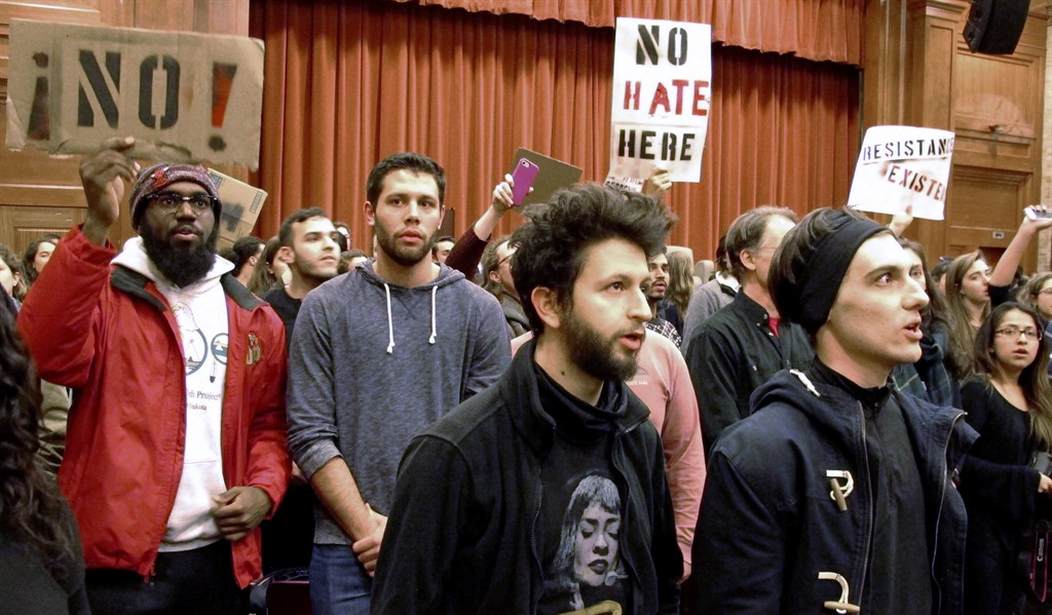
Last school year, Middlebury College, an elite private school in Vermont, attempted to host controversial author and scholar Charles Murray before a mob stepped in and violently ended the event before it could begin. No charges were filed against the student protestors, despite the fact that a professor was left with a serious neck injury and a concussion in the melee. Now, hoping to prevent a repeat of these events, Middlebury has announced a new interim speakers policy: the school will simply cancel all speakers if there's a "credible threat" made against them.
While the first two points of the new policy are fairly standard (three weeks notice for reserving rooms, please make any note of any security concerns), the final four give significant pause. I've highlighted the questionable policies below:
- Requests to schedule an event will be reviewed weekly by staff from Student Activities, Event Management, and Communications to identify any events that are a likely target of disruption, threats, violence, or other acts of intimidation, or are likely to draw unusually large crowds.
- In the event of a credible likelihood, based on prior incidents or current evidence, that an event is likely to be the target of threats or violence, the Threat Assessment and Management Team will conduct a risk assessment of the event, consulting with local law enforcement as needed, in order to advise the administration.
- Representatives from Public Safety/Campus Security and Risk Management will review the risk assessment and determine resources or measures that might be necessary to ensure that the event can proceed without undue risk to the speaker and/or members of the community. This review will include a consideration of Middlebury Emergency Preparedness Plan and Emergency Operations protocols.
- In those exceptional cases where this review indicates significant risk to the community, the president and senior administration will work with event sponsors to determine measures to maximize safety and mitigate risk. Only in cases of imminent and credible threat to the community that cannot be mitigated by revisions to the event plan would the president and senior administration consider canceling the event.
Gee, I can't imagine a scenario where this could backfire, can you? This new policy effectively encourages student groups to make plans to protest and to threaten speakers that they don't want on campus. This is not something that Middlebury should want more of on their campus. While I'm sure Middlebury had the best intentions in creating these policies, this is not behavior that should be egged on.
Former White House Press Secretary Ari Fleischer, who graduated from Middlebury in 1982, described the interim policy as one that will "legitimize heckler's veto."
Heads up to reporters who cover First amendment issues. @Middlebury later today will announce a policy that rewards the heckler's veto.
— Ari Fleischer (@AriFleischer) September 15, 2017
Speakers will not be allowed on campus if groups on campus say they will shut down the speaker. Midd will actually legitimize hecklers veto
— Ari Fleischer (@AriFleischer) September 15, 2017
Instead, the school should crack down on those making the "credible threats" against the speakers, rather than canceling the event altogether. Nobody wins in this scenario. College is a time to be exposed to uncomfortable ideas and to learn new things. (Or, if a person doesn't like the speaker at the event, they could always do something else with their time.) It's absurd for Middlebury--or any college--to seriously propose this kind of policy. It's a disservice to its students.

Join the Conversation
VIP members get the ability to comment on articles.