







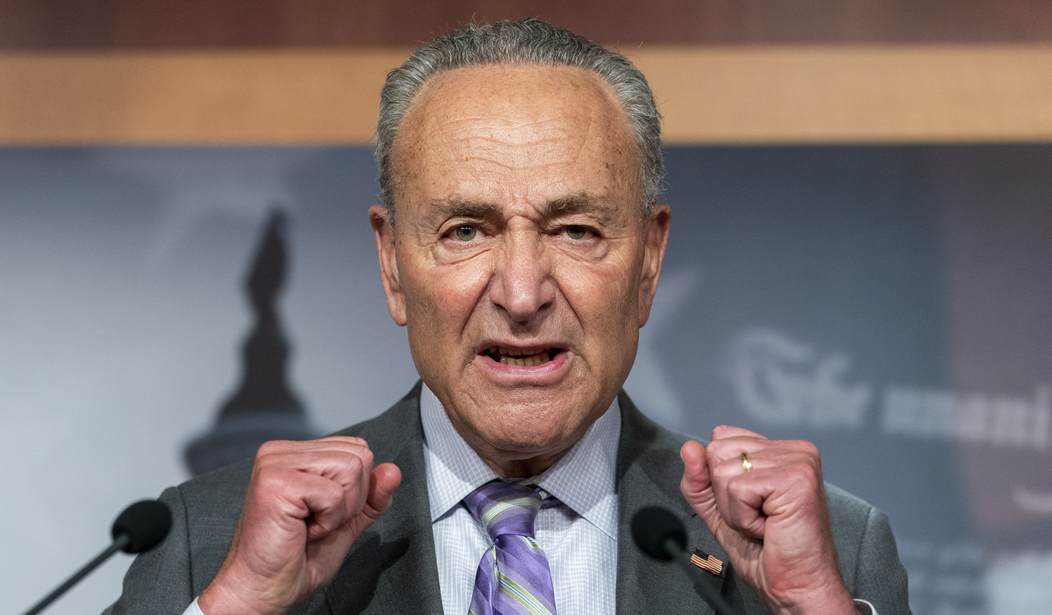
Now that three Republican senators – Mike Lee (UT), Thom Tillis (NC) and Ron Johnson (WI) – have turned up positive for the Wuhan coronavirus, Democrats are changing their narrative on virtual hearings. Back when the pandemic began, Democrats worked overtime to make sure that committee hearings could be done remotely as a means of protecting individual members of Congress.
Senate Minority Leader Chuck Schumer (D-NY) made the argument that holding confirmation hearings for Judge Amy Coney Barrett "endangers the safety" of members and staffers who work on the Hill.
Sen. Schumer: "For Mitch McConnell to go ahead with the hearing endangers the safety not only of senators -- but of staff who work diligently on the hill. And they ought to be delayed." pic.twitter.com/TFNqzPnVWw
— The Hill (@thehill) October 4, 2020
But when virtual hearings (like Zoom) are brought up, Schumer and Senate Judiciary Committee Ranking Member Dianne Feinstein (D-CA), say that's not an option.
Schumer on Barrett: The idea of having virtual hearings where no one is with the witness for the highest court in the land for a life appointment that would have such effect on people's lives makes no sense. A virtual hearing is virtually no hearing at all.
— Chad Pergram (@ChadPergram) October 4, 2020
It’s critical that Chairman Graham put the health of senators, the nominee and staff first – and ensure a full and fair hearing that is not rushed, not truncated, and not virtual. Otherwise this already illegitimate process will become a dangerous one.https://t.co/Q71XlWNGMW
— Senator Dianne Feinstein (@SenFeinstein) October 2, 2020
But who could forget Sen. Amy Klobuchar (D-MN) making virtual hearings a reality (and being proud of it)?
Tell that to Amy Klobucharpic.twitter.com/BiwQpotrdD
— Matt Whitlock (@mattdizwhitlock) October 4, 2020
In fact, Fox News' Chris Wallace questioned Klobuchar about the sudden shift in Democrats' attempts to block Barrett's nomination.
"You could hold a virtual hearing for Judge Barrett, which raises the question again, are you trying to use the fact that there has been this outbreak, at least three Republican senators, to try and block a nomination that, frankly, oppose fiercly?" Wallace asked.
"Absolutely not," Klobuchar replied with a smile. "This is for the highest court of the land and yes, we have had virtual hearings. I helped to put them together. It's important to give senators that option but you want to be able to go back-and-forth with this nominee."
Wallace reminded the senator that they're conducting their interview virtually.
"So why can't you question Judge Barrett virtually?" he asked.
"We believe you should have an in-person hearing. That doesn't mean that a virtual option wouldn't be available," she replied.
WALLACE: In May, when Chairman Graham held a virtual hearing, you very much praised him & thanked him for doing that. So you could hold a virtual hearing for Judge Barrett?
— Senate Republican Communications Center (@SRCC) October 4, 2020
KLOBUCHAR: I helped to put them [virtual hearings] together, it's important to give Senators that option. pic.twitter.com/8nPxHDdYdA
According to Sen. Tim Kaine (D-VA), an in-person hearing has to take place in order for senators to be effective.
"You make the senators less able in their questioning because when we're live, we usually have staff members right behind us who are reminding us, 'Hey, here's what needs to happen or you should ask this,'" Kaine explained. "My staff might send me a text that I may or may not get when I'm talking to a witness."
The Judiciary Committee has been successfully holding hybrid hearings for months.
— Senate Republican Communications Center (@SRCC) October 4, 2020
MSNBC host literally opposes a hybrid hearing for Judge Barrett because protestors can’t interrupt.
Sen. Kaine says he opposes it because staff can’t whisper questions in his ear? pic.twitter.com/eIEDf1FhRO
The Democrats should really try to rein in their messaging if they're going to try and argue against virtual hearings. Kaine made the worst argument for virtual hearings without even trying it. He basically said senators are useless in committee hearings where they have to Skype or Zoom into a call because they don't have staffers running the show.
So which is it? Are virtual hearings something that should take place across the board because they allow senators to continue with business as usual or should they not exist because the senators are incompetent without their staffers?

Join the Conversation
VIP members get the ability to comment on articles.