





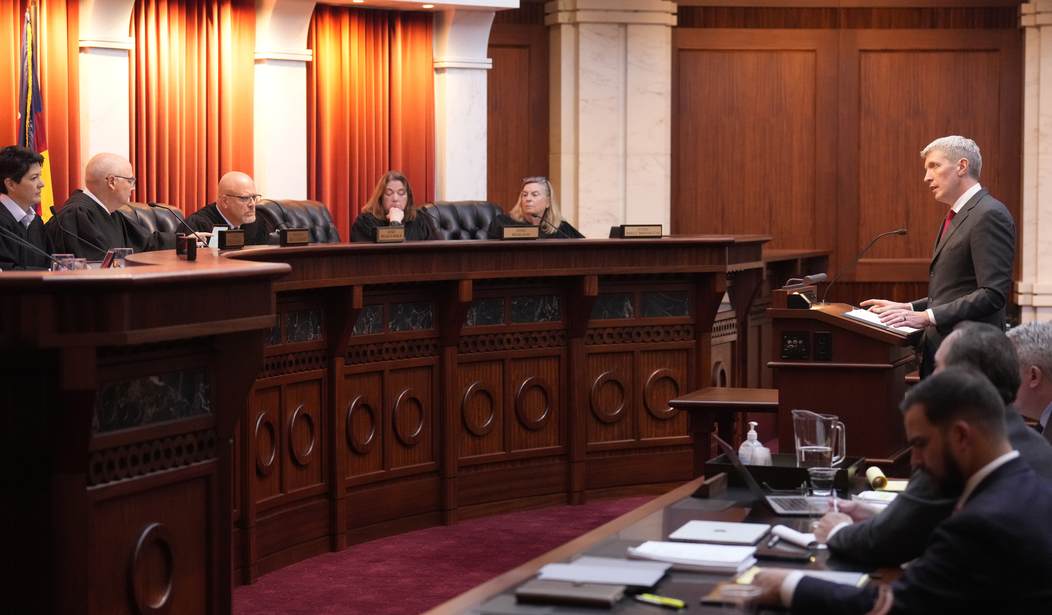
The Supreme Court agreed Monday to hear a case that challenges the constitutionality of campaign finance restrictions. The court will decide whether it is legal for the government to limit the spending of political parties on candidates for federal offices.
The case, National Republican Senatorial Committee v. Federal Election Commission, was appealed to the Supreme Court by the National Republican Senatorial Committee and the National Republican Congressional Committee, on behalf of two Senate Republicans running for election.The appeal argues that enforcing federal limits on campaign spending by political parties violates the free speech protections laid out in the First Amendment of the Constitution.
Former Representative Steve Chabot and JD Vance, prior to his becoming Vice President, were plaintiffs in the original lawsuit.
In the Republican-backed appeal, the petitioners said that spending limits "severely restrict political party committees from doing what the First Amendment entitles them to do: fully associate with and advocate for their own candidates for federal office."
The U.S. Department of Justice has expressed direct support for the National Republican Senatorial Committee as it argues the case. The federal government filed a brief agreeing with the challengers and urging the Supreme Court to hear the case. The filed brief argues that the coordinated expenditure limits “violate core First Amendment rights”.
In direct opposition, the Democratic National Committee, Democratic Senatorial Campaign Committee, and Democratic Congressional Campaign Committee have asked to defend the 2024 decision of the lower appeals court to keep the limits in place, according to Fox News.
The U.S. Court of Appeals for the Sixth Circuit upheld the limits based on the Supreme Court's 2001 decision in FEC v. Colorado Republican Federal Campaign Committee, a narrow five-to-four decision. In writing the majority opinion, Chief Judge Jeffrey Sutton acknowledged the tension of spending money as political speech. He wrote that the only permissible ground for restricting political speech is to prevent “‘quid pro quo’ corruption or its appearance.”
The Federal Election Campaign Act (FECA) has been in effect since 1972 when it was signed by President Richard Nixon. After its amendment in 1974, the act imposed further limits on the funding able to be received by a political party's committees and the party spending allowed on candidates in a federal election.
FECA currently limits baseline individual contributions at $41,300 per year to national party committees. The act also restricts contributions made by party committees to federal candidates, which is limited to $5,000 per election. The petition filed to the U.S. Court of Appeals for the Sixth Circuit details more specific restrictions.
"For presidential, Senate, and House races in states with only one representative, the limits are calculated by multiplying by two cents the voting-age population of the United States or the state, depending on the office. The FEC updates the limits annually based on this formula. For House races in all other states, Congress set a limit of $10,000, which is also increased annually based on the Cost-of-Living Adjustment."
The Supreme Court will hear oral arguments in the fall.
Join the Conversation
VIP members get the ability to comment on articles.