





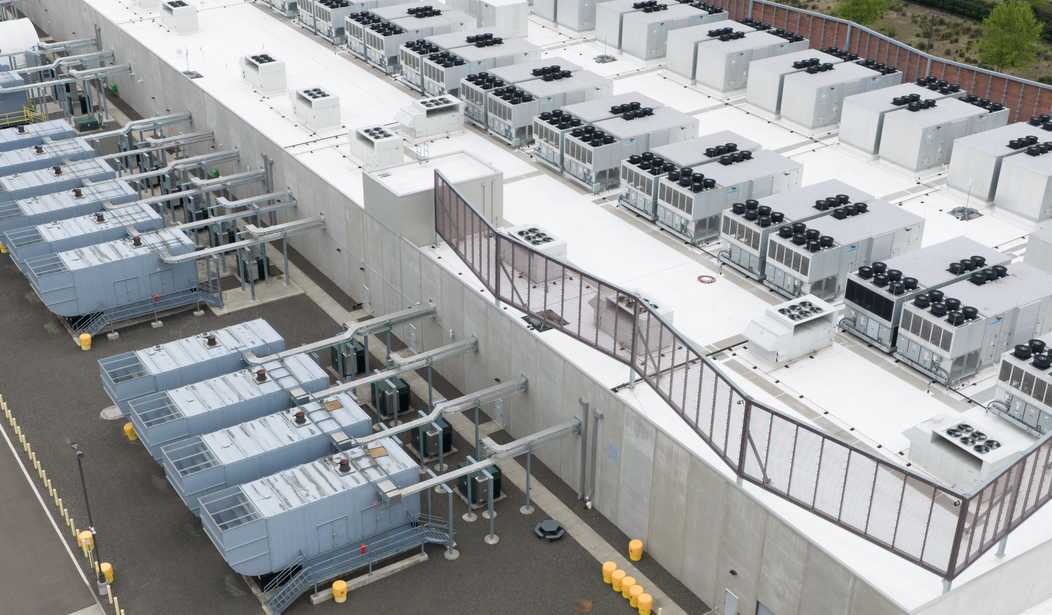
Reports circulated widely yesterday that an Oklahoma data center had sprung a major leak, wasting as much as three million gallons of water, causing a sharp drop in local water pressure, forcing schools and other facilities to close for a time. For critics already eager to portray data centers as an environmental menace, the story seemed to offer perfect confirmation of their worst fears.
At a moment when anxiety over water use has become a central argument against the infrastructure powering artificial intelligence, the headline was almost too convenient. But before Americans allow another viral outrage to become the case against AI development, they should consider the context the headlines leave out. Far from proving that data centers are uniquely reckless, the episode exposes something more familiar: the staggering water waste enabled by poor government management.
An Oklahoma data center using water-cooling technology just wasted over 3 million gallons of water during a massive pipe burst. pic.twitter.com/xfCwkBINbc
— Headquarters (@HQNewsNow) August 31, 2026
First and foremost, the story was in part false. A community note states that the broken water pipe and leak were not from a typical data center, but from an illegal Bitcoin mining facility operating without a certificate of occupancy. The company had been told to halt operations in 2023, and never did. The water line in question was also tied to an unauthorized fire hydrant the operators had installed.
But second, for all of the outrage about a data center's water usage, it's quite telling that very few people are just as outraged over much more obvious waste.
A November 2024 investigation by New York Focus found that New York City “gave away or lost” roughly 15 percent of the water passing through its pipes, amounting to about 155 million gallons every day. That is more than 56 billion gallons a year. Yet it did not become a national referendum on whether New York deserves to exist. Nor is New York alone in its wastefulness.
In 2023, Houston, San Antonio, Dallas, Austin, Fort Worth, and El Paso collectively lost roughly 88 billion gallons of water through leaky pipes, main breaks, meter problems, and other infrastructure failures, which translates to about 241 million gallons per day. That is nearly 80 times the Oklahoma data-center leak.
California offers another reminder that water waste is hardly unique to technology. Researchers estimate the state has about 2.27 million acre-feet of uncaptured urban runoff each year, roughly 740 billion gallons each year, or over two billion gallons a day, that could potentially be captured.
There are a plethora of other examples as well. Golf courses, restaurants, residential upkeep, and the manufacturing behind everything from beef to clothing all demand enormous amounts of water, typically far more than AI data centers ever will. If three million gallons lost at one data center is enough to make AI an environmental villain, then Americans should be prepared to shut down golf courses, abandon water-intensive crops, stop buying beef and clothes, and treat every leaky pipe as a national crisis.
Of course, no one is proposing that. Water use is apparently only unforgivable when it is tied to a new technology.
So yes, the Oklahoma leak was a problem, but it is not an indictment of data centers, artificial intelligence, or private enterprise. If Americans are suddenly serious about conserving water, their attention should begin with the governments and entrenched industries that allow chronic losses through decaying pipes, neglected systems, and wasteful practices year after year. Data centers, by contrast, have every reason to use an expensive resource efficiently: their competitiveness, and their bottom line, depend on it.
Editor's Note: Do you enjoy Townhall's conservative reporting that takes on the radical Left and woke media? Support our work so that we can continue to bring you the truth.
Join Townhall VIP and use promo code FIGHT to receive 60% off your membership.


Join the Conversation
VIP members get the ability to comment on articles.