







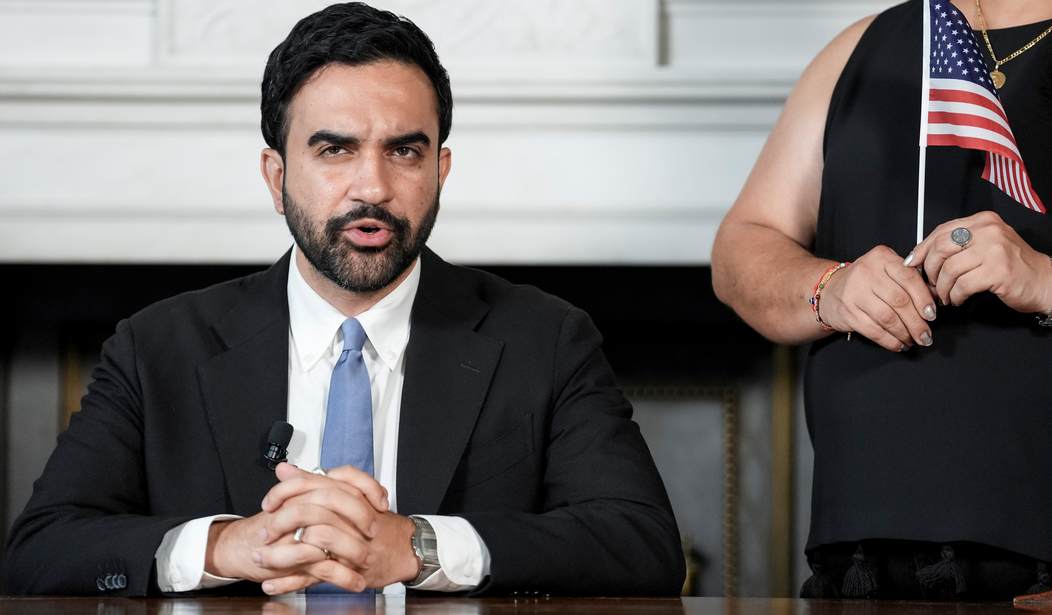
New Yorkers are learning costly lessons about socialist ideas in action.
New York City Mayor Zohran Mamdani made many promises on the campaign trail that excited low-class, working-class, and perhaps even middle-class residents: city-run grocery stores with cheap food, free buses, frozen rents, and free childcare.
The funding mechanism was simple: tax the super-rich.
Now, as Mamdani maneuvers around the limits to his power and authority, his administration is devising creative ways and broader targets to enact his socialist utopia.
Minority communities who assumed they would be the beneficiaries of his redistribution schemes now find themselves as the targets.
As a candidate, Mamdani promised to create a network of city-owned grocery stores with one located in each borough that would sell food at lower prices than bodegas, supermarkets, and other food retailers.
The mayor, a leading member of the Democratic Socialists of America, which is just Communists under another name, just released a few more details about the now $70 million grocery store pilot program this week. And the math does not add up.
Mamdani claimed the pilot program would be funded by redirecting half of existing city subsidies in the FRESH program, a bundle of tax breaks and special regulatory relief to private grocery stores that offer healthy foods to 1.2 million people in food deserts across the city.
Grocery stores have invested $177 million of private funds into the FRESH Program, but actual government expenditures have only been about $3-$4 million a year. It’s still a very small program.
Mamdani counting on the $177 million in private money is an accounting error at best, a tool of deception at worst. Using actual government spending figures means he has a massive funding gap for his grocery store scheme before day one.
Mamdani also trusts government bureaucrats to be more efficient than the private sector, generally a foolish mindset.
In this case, he wants to use the government’s power to exempt itself from the rules the private sector has to play by as an advantage. He plans for the stores to operate at lower costs by avoiding property taxes and skipping rent by building on municipal property. He’s also counting on buying and selling at wholesale prices and forcing a 30 percent discount on some items, as well as centralizing warehousing and distribution.
It may be wise to centralize operations for efficiency, but transportation costs and delays could eat up any savings.
Price controls are a recipe for scarcity. Since there will be no income restrictions for shoppers, it is unlikely that the truly poor will benefit exclusively—or even most—from the supposed lower prices on meat and eggs, but rather the people who get there first.
None of this is fair. Bodegas and private grocery stores don’t get to avoid property taxes or skip rent like these proposed government-run stores would.
That is the argument from a coalition of 50 chambers of commerce representing Asian, African, Caribbean, Hispanic, Middle Eastern, and Jewish business owners who plan to sue the city over the mayor’s grocery store program.
The Multicultural Business Coalition (MBC), an immigrant-led nonprofit group representing local chambers of commerce formed earlier this year, disclosed to the New York Post that it was raising funds to fight the government-owned grocery stores, which will compete directly with bodegas in the very same neighborhood.
Bodegas reflect a mix of cultures: Dominican, Puerto Rican, Yemeni, Egyptian, Korean, Filipino, and more. These grocers are cornerstones of neighborhoods, providing more than just a loaf of bread and a can of soup. They are a source of support to those in need of food and community. Customers who “do not have money for food or diapers, the bodeguero will find a way for them to leave the store with those items,” an Untapped Cities article explained, . “... and if a customer is new to the city, a bodega is a place to create new relationships.”
Even if deemed legal, New Yorkers shouldn’t get too attached to the Mamdani government stores; this failed experiment in other cities suggests they aren’t likely to stay open for terribly long, if they ever open at all.
Baldwin, Florida, opened a town-run store in 2019, and it should have been a success. There were no other grocers in town for the 1,400 residents; the building was municipally owned so didn’t require a rent payment; the employees were on the city's payroll; and the town covered the store's day-to-day expenses. Yet, the Baldwin town-run store struggled to break even, running deficits year after year. It closed five years later.
Today’s Communists/Socialists like Mamdani want to fool people into believing in the warmth of collectivism. However, as minority business and property owners are quickly learning, they will be left out in the cold. Vilifying and targeting hardworking people for the sin of successfully pursuing their American Dream is just the start.
Patrice Onwuka is vice president for economic policy and director of Independent Women’s Center for Economic Opportunity.
Editor’s Note: Do you enjoy Townhall’s conservative reporting that takes on the radical Left and woke media? Support our work so that we can continue to bring you the truth.
Join Townhall VIP and use promo code FIGHT to receive 60% off your membership.


Join the Conversation
VIP members get the ability to comment on articles.