







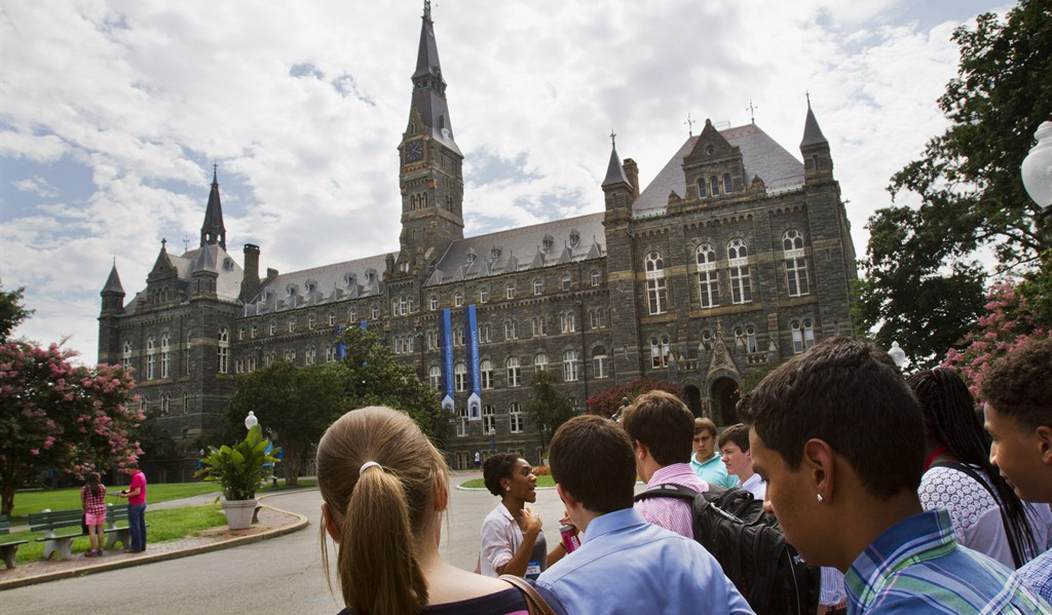
Young students obsessed with "triggers" and safety need to take time for some serious self-reflection, writes Peggy Noonan in a witty and slightly-acerbic Wall Street Journal column. Noonan breaks down this call for caution, sensitivity, comfort, and safety in America's college classrooms. She tells young people they are requiring too much of others and that they need to toughen up or consider therapy. Noonan's overall point is sound, and it certainly applies to many of the young people who are quick to define their essence by their victim status, but I fear her message will be lost completely on the crowd she is criticizing. She does not delve into the root problem: Most young people feel that by protecting others in this way they are doing a great moral and social good.
It does not take many trips to Tumblr or Facebook to pick up on a pattern. Countless young people rush in to call foul on any hint of judgment or criticism directed against their select group of protected categories (this group of categories is constantly changing - the cataloging of it is beyond the scope of this article). Beyond attacking personal criticism, they also seek to ban any content that might cause harm, pain, or discomfort, especially if it's not accompanied by a slew of caveats. Noonan shows this clear pattern through her examples of traditional college texts that students are ready to kick to the curb because they might make some of their classmates uncomfortable.
This impulse to clamp down on free speech seems to have come out of nowhere. How Un-American! Haven't they read the Bill of Rights? Unfortunately, this impulse is rooted in their core moral outlook. They have been taught for years in schools, by the media, and by so many liberal churches, that the greatest moral goods are inclusiveness, diversity, acceptance, and ensuring that all people can discover and live out their own identities. Consequently, the greatest evils are judgment, criticism, and any content, belief, or opinion that will make someone feel imposed upon.
It is no surprise to see where these beliefs are leading so many young people. Given their presuppositions, it is perfectly rational and consistent for them to hold safety and comfort in higher esteem than free speech, the search for transcendent truth, and the freedom to make moral judgments.
They have no other moral rubric. They are largely unchurched and unaffiliated. Schools have taught no other code than inclusiveness and diversity. The American family is continually disintegrating, so they aren't getting a consistent moral message from their parents. And churches are too busy trying desperately to gain members to have the time or faith to preach the Truth of the Gospel message.
Yet all people, and perhaps young people most of all, yearn for a moral cause to champion, a set of principles to fight for, and people to defend. Our young people have encountered few troubles in modern life. They have grown up largely able to think and say what they will. Most do not go hungry. Most do not face a major threat to life or liberty. So what great evil or challenge do they have to fight?
The "evil" they most frequently encounter, quite simply, is "meanness". This meanness may be real or perceived, but it is their most common conflict. You can see their reaction in the rise of the anti-bullying movement. You can see it in the attempts to suppress moral judgments from conservative Christians or other religious groups. You can see it in the language of safety, acceptance, and trigger warnings.
And it's not 100% absurd. The Internet has given rise to perhaps the most omnipresent meanness in Western social discourse in generations, and it's being delivered directly into the phones and laptops of our youngest people. There are millions of legitimately awful, offensive, mean people online, reveling in the bile they seem constantly ready to spill upon any available social media post, forum, or comments section. Social meanness really is a legitimate evil to be fought, but it should not be a defining evil, or the highest evil. Without broader moral context, young people overreact to meanness.
Noonan is right to point out the absurdity of silencing offensive material in the context of higher education, but there is a hopeful tone in her piece, perhaps hinting that these young people might wise up if they just stepped back and recognized their needless victimhood. Sadly, I think the thought pattern is too ingrained to hope for a near-term solution. At best we might see a moderation as they leave college for the workplace, but don't count on it.
More likely we will see the progression of silencing as these young people become more active players in politics and society at large. Think things are looking scary for religious minorities now? Wait until offensiveness, labeled bigotry, hate speech, or triggering, becomes an actual common crime.
These problems won't be solved through young people growing up or toughening up. The younger generation needs a new moral rubric. They will learn eventually, but it may take the complete implosion of their unworkable, stifling, depressing institutions before they reconsider their assumptions. I'm not optimistic that they will abandon them before they destroy free speech and free religion as we know it.

Join the Conversation
VIP members get the ability to comment on articles.