







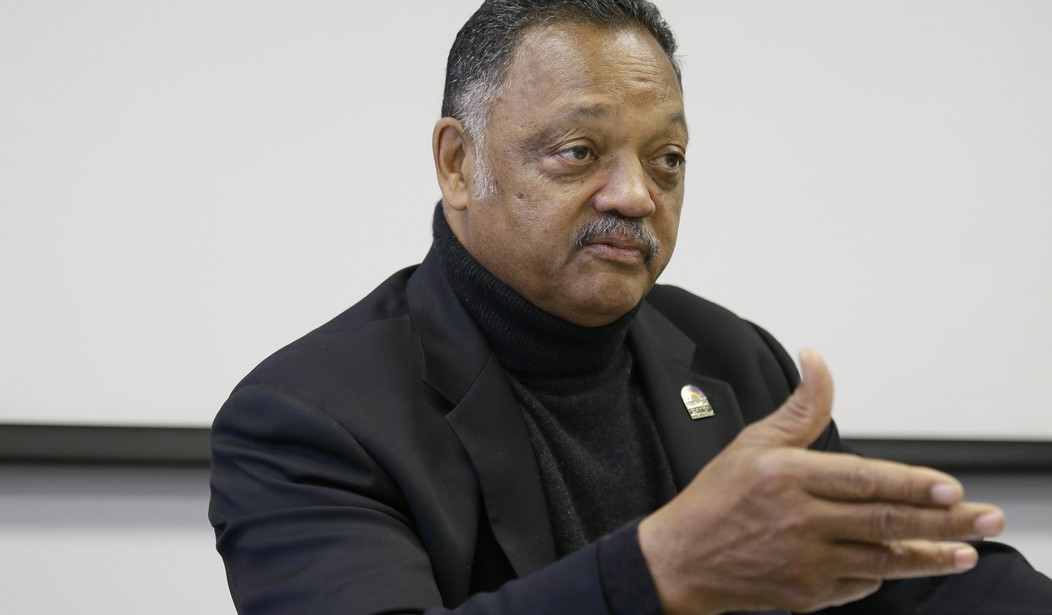
I can’t imagine what it must’ve been like for Jesse Jackson, Jr., his father’s namesake and the last person to see his extremely frail dad in the quiet moments before he died. “I woke up at about 12:35 a.m., I heard a gasp, and that gasp was my father’s final breath,” he said in a CBS interview.
Comparing his father’s accomplishments to his own “worst moments,” Jackson, Jr. admitted, as many celebrity sons do, to feeling the pressure of not quite measuring up.
“That pressure is the inability to live up exactly to who he is, and what he’s been able to accomplish, and I’ve also lived with that my entire life. In fact, when I was born …, my dad was marching from Selma to Montgomery,” he said.
During that historic march, Jackson, 23, was a young man who pushed himself into the thick of things, which forever emblazoned him in the chapters of American history.
At a critical juncture in the centuries-old freedom saga, Jackson helped to write those chapters as heir apparent to Martin Luther King, Jr.
Or was he?
From the moment King died, there was a general sense that Jackson was pushing himself to be “king” of a movement that never bestowed the crown.
“In the confusion after Martin was killed, some people tried to step forward too quickly, without the movement’s consent,” wrote Ralph Abernathy, King’s best friend and closest confidant, in his book, And The Walls Came Tumbling Down. "Jesse was one of them. Jesse was always ambitious, always looking for the spotlight, and sometimes that ambition got ahead of the movement itself,” he wrote.
According to Andrew Young, Jackson was never part of King’s inner circle that worked on the daily strategy. But he was effective in front of the cameras.
“That was his gift,” Young said. “But that was different from how decisions were made inside the movement. … After Dr. King was killed, everybody was trying to figure out what came next. Jesse chose one path. Others chose different ones.”
It’s now clear that Jackson’s path, intentionally or not, did the heavy lifting to make the racial divide in America the irreversible mess it’s become today. It’s metastasized into a race industry only interested in its own survival as a tool for power, not in solving real problems.
Worse, Jackson’s fixation on grievances helped to institutionalize a victim model that, today, is being carbon-copied by a watershed of identity groups, and exploited by foreign actors as a kind of “useful idiot” to undermine America’s moral authority from within.
All said, Jackson used his “gift” and historic connections to build an identity superhighway that is now cluttered with a Star Wars bar full of bad actors who, Machiavellian-style, exploit the miscellaneous “oppressed” to keep power.
I encountered Jackson in the mid-‘80s when I was stationed in Chicago as a Marine doing community relations work, 1984 to 1987.
Barack Obama was a community organizer. Michael Jordan had just joined the Bulls. Oprah joined WLS’s “AM Chicago” in ‘84 and syndicated “The Oprah Winfrey Show” in ’86. Harold Washington, Chicago’s first black mayor, was re-elected in 1987. Due to his rising popularity, Chicago’s Louis Farakkhan appeared on “The Phil Donohue Show” in 1985. Cabrini-Green Homes, a massive public housing complex on Chicago’s near north side, was one of America’s most violent, crime-infested communities.
And the Challenger crashed in January 1986, two days after Mike Ditka’s Bears won the Super Bowl. Jackson gave the eulogy for black astronaut Ronald McNair.
Months before the crash, I put in a request to NASA for Lt. Col. Charles Bolden, a black Marine astronaut, to tour Chicago to help young people visualize how far they could go in the military with math and science … to the moon.
Bolden became the Chicago media’s link to the disaster, but I maintained our pre-Challenger itinerary, including work with the local Montford Point Marines to schedule events targeting black youth.
It was the VP of the Montford Point Marines who invited me to attend a Jackson speech at his then two-year-old Operation Push organization.
With Jackson standing at the podium to the left of a giant MLK photo, I connected the moment to his public history with King – the marches, the looping black-and-white newsreels, and that photo of him smiling beside King before he was shot. Honestly, I was awed.
But Rev. Jackson preached a sermon that, in the end, gave no altar call. Instead, he asked the audience to join him to protest a business for not having enough black executives.
Scratched record.
I wrote in my journal: “I walked away feeling that the white man is my enemy.”
Fast forward.
The man who popularized the term “African-American” and led a movement to ban the “N-word” from the lexicon was caught on a hot mic whispering that “I wanna cut his nuts off” after Obama told an approving black audience that black fathers needed to be more responsible.
That whisper altered Obama’s trajectory as a truth-teller on real problems that even he experienced. Obama’s fear of being a “sellout” – a Clarence Thomas-like pariah – was a squandered opportunity. The one man who could’ve closed America’s racial divide feared that the Jackson-types were waiting in the wings to “cut his nuts off.”
Obama has since lived a public life of being inauthentic to his actual experiences to appear “authentically black” to those who use race as leverage for power. Deep problems languished in favor of rhetorical symbolism that, in effect, excused problems that only grew over time.
Since my Chicago days, Obama became president – twice. Jordan is the world’s richest former athlete.
Oprah is the world’s richest black woman. Farrakhan is Farrakhan. Bolden became a general and later headed NASA before retiring. The Bears could move to Indiana. Cabrini-Green was demolished, which dispersed crime to Chicago’s south and west sides.
And Jesse Jackson is dead.
The same problems that thwarted lagging blacks 40 years ago, rather than being solved, have been fossilized as proof of victimhood.
The lesson of Jackson’s legacy?
In the real world of cause and effect, symbolism and showmanship do not solve problems. Solving problems solves problems – of which, sadly, Jackson never quite measured up.
Editor’s Note: Do you enjoy Townhall’s conservative reporting that takes on the radical Left and woke media? Support our work so that we can continue to bring you the truth.
Join Townhall VIP and use promo code FIGHT to receive 60% off your membership.


Join the Conversation
VIP members get the ability to comment on articles.