





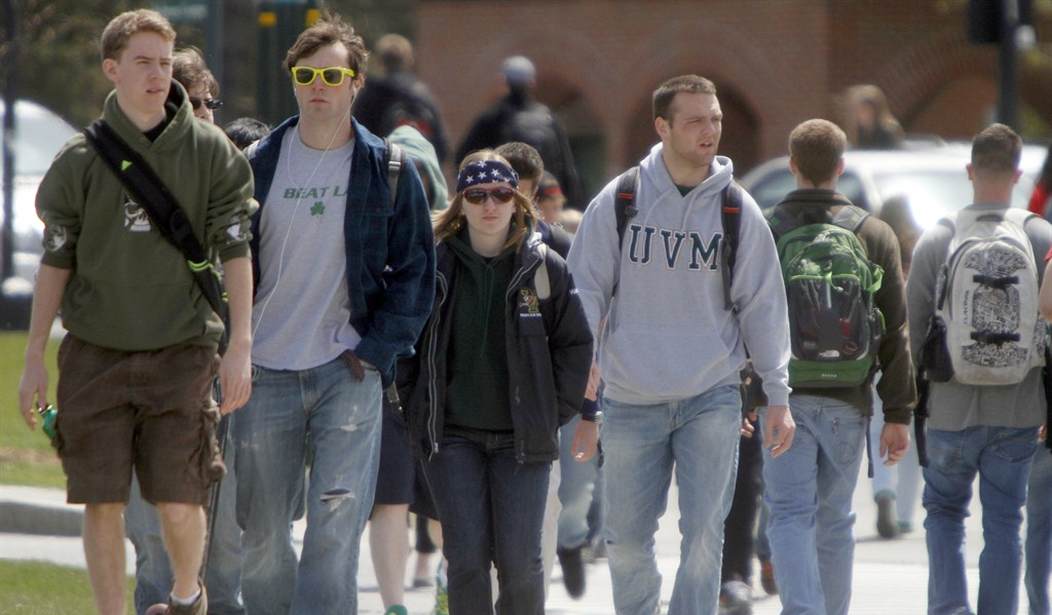
Diversity has become corporatized on American campuses, with scores of bureaucrats and administrators accentuating different pedigrees and ancestries. That's odd, because diversity does not mean any more "variety" or "points of difference," at least as it used to be defined.
Instead, diversity has become an industry synonymous with orthodoxy and intolerance, especially in its homogeneity of political thought.
When campuses sloganeer "celebrate diversity," that does not mean encouraging all sorts of political views. If it did, faculties and student groups would better reflect U.S. political realities and might fall roughly into two equal groups: liberal and conservative.
Do colleges routinely invite graduation speakers who are skeptical of man-made global warming, and have reservations about present abortion laws, gay marriage or illegal immigration -- if only for the sake of ensuring diverse views?
Nor does diversity mean consistently ensuring that institutions should reflect "what America looks like."
If it did, all sorts of problems could follow. As we see in the NBA and NFL, for example, many of our institutions do not always reflect the proportional racial and ethnic makeup of America. Do we really want all institutions to weigh diversity rather than merit so that coveted spots reflect the race and gender percentages of American society?
Does anyone care that for decades the diverse state of California's three most powerful elected officials have been most un-diverse? Rep. Nancy Pelosi, Sen. Barbara Boxer and Sen. Dianne Feinstein are uniformly mature women, quite liberal, very wealthy, married to rich professionals or entrepreneurs, and who once lived within commuting distance of each other in the Bay Area.
Is the University of California, Berkeley, ethnically diverse? If it were, Asian students might have to be turned away, given that the percentage of Asian students at UC Berkeley is about three times as great as the percentage of Asian residents in California's general population.
Gender disparity is absolutely stunning on American campuses. Women now earn about 61 percent of all associate degrees and 57 percent of all bachelor's degrees. With such disproportionate gender representation, do we need outreach offices on campus to weigh maleness in admissions? Should college presidents investigate whether the campus has become an insidiously hostile place for men?
Diversity Inc. is also based on a number of other fundamental shaky assumptions. Race, gender and politics are supposed to count far more in a diverse society than other key differences. Yet in a multiracial nation in which the president of the United States and almost half the Supreme Court are not white males, class considerations that transcend race and gender often provide greater privilege.
Is the daughter of Hillary Clinton in greater need of affirmative action or diversity initiatives than the children of the Oklahoma diaspora who settled in Bakersfield? So-called "white privilege" might certainly refer to the elite networks of insider contacts who promote the scions of Al Gore, Chris Matthews or Warren Buffett. But how about the son of an unemployed Appalachian coal miner? Not so much.
If ethnic, rather than class, pedigrees provide an edge, how do we ascertain them in today's melting-pot culture? Does the one-quarter Latino student, the recent arrival from Jamaica or the fourth-generation Japanese-American deserve special consideration as "diverse"? And if so, over whom? The Punjabi-American? The Arab-American? The gay rich kid? The coal miner's daughter? Or the generic American who chooses not to broadcast his profile?
Does Diversity Inc. rely on genetic testing, family documents, general appearance, accented names, trilled pronunciation or just personal assurance to pass judgment on who should be advantaged in any measurement of diversity?
In such an illiberal, tribally obsessed and ideologically based value system, it is not hard to see why and how careerists such as Sen. Elizabeth Warren and activist Ward Churchill were able to fabricate helpful Native American ancestries.
Diversity came into vogue after affirmative action became unworkable in the 1980s. Given the multiplicity of ethnicities, huge influxes of new immigrants and a growing rate of intermarriage, it became almost impossible to adjudicate historical grievances and dole out legal remedies. So just creating "diversity" -- without much worry over how to define it -- avoided the contradictions.
But diversity is not only incoherent; it is also ironic. On a zero-sum campus short of resources, the industry of diversity and related "studies" classes that focus on gender or racial differences and grievances crowd out exactly the sort of disciplines that provide the skills -- mastery of languages, literature, science, engineering, business and math -- that best prep non-traditional graduates for a shot at well-compensated careers.
Red/blue state divides have never more acrimonious. The number of foreign-born citizens is at a record high. The global status of the United States has never been shakier. To meet all these existential challenges, American institutions -- the university especially -- would be wise to stress unity and academic rigor.
People in the Balkans, Rwanda and Iraq certainly championed their ethnic differences in lieu of embracing concord and ethnically and religiously blind meritocracy.
Tragically, these are also examples of where the logic of privileging differences, and dividing and judging people by the way they look and believe, ultimately ends up.


Join the Conversation
VIP members get the ability to comment on articles.