





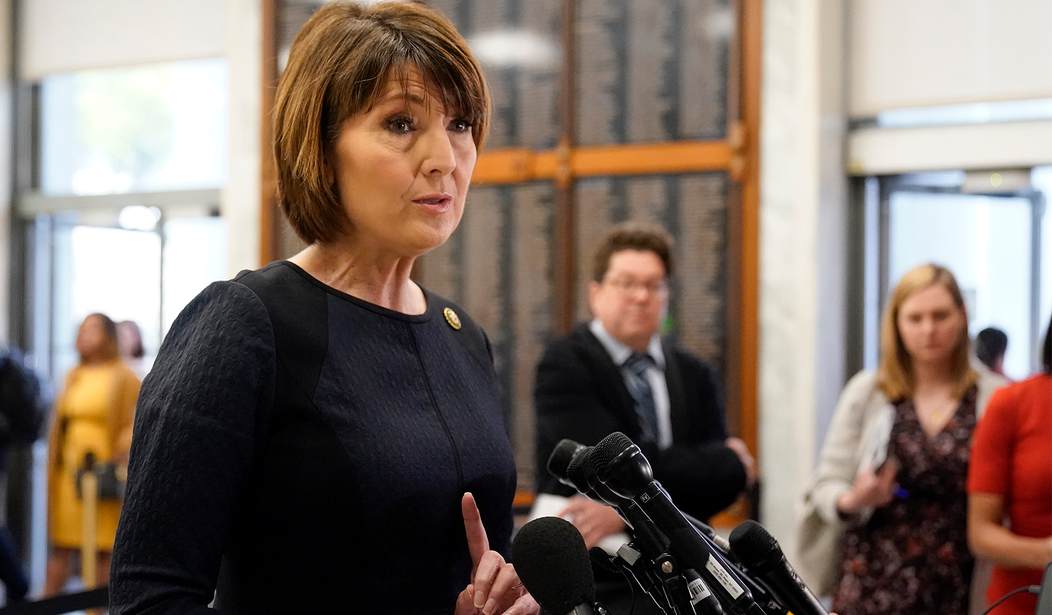
The House Energy and Commerce Committee was slated to mark up the “American Privacy Rights Act” this week, legislation that aims to set a national data privacy standard. At the last minute, the Committee canceled the markup, and APRA’s fate remains uncertain.
This episode illustrates the fundamental tension between Republicans and Democrats on a national privacy law. While Democrats pay lip service to wanting a national privacy standard, their insistence on trial lawyer giveaways and weak state preemption undermine the entire concept of a national privacy standard.
APRA, sponsored by House Energy and Commerce Chair Cathy McMorris Rodgers (R-Wash.) and Senate Commerce Chair Maria Cantwell (D-Wash.), is the culmination of years of bipartisan negotiation. A national privacy standard is a laudable goal: if all 50 states enact separate privacy laws, it will cost the American economy $1 trillion over the next decade. $200 billion of that cost will fall squarely on American small businesses.
However, any legislation worth doing is worth doing the right way. A federal privacy law should create a clear, consistent, national standard for businesses to comply with. APRA undermines this goal by giving trial lawyers new avenues to abuse the American legal system and failing to fully preempt the existing patchwork of state data privacy laws.
The bill contains an expansive private right of action that would enable trial lawyers to descend like locusts on companies for alleged violations of APRA’s various provisions. Trial lawyers routinely launch frivolous lawsuits against large companies, rolling the dice that their target will agree to large settlements to avoid reputational damage.
APRA’s expansive private right of action also thwarts Republican efforts to rein in third-party litigation funding, where well-heeled special interests give trial lawyers billions of dollars in undisclosed funding to launch lawsuits against targeted companies. Foreign firms and governments that have a vested interest in weakening American companies also fund these lawsuits, allowing them to access trade secrets during the discovery process that are more valuable than recouping their financial investment through a settlement.
Adding insult to injury, APRA fails to fully preempt the existing patchwork of state privacy bills. APRA contains carve outs for private rights of action in blue state privacy laws, like California and Illinois. Every time a state judge rules on a case brought under a state privacy law, it creates even more complexity and uncertainty that rapacious trial lawyers will abuse. Forcing companies to play whack-a-mole with a constantly-evolving set of rulings would make compliance a nightmare.
APRA’s ultimate fate is uncertain. House Speaker Mike Johnson (R-La.) and Majority Leader Steve Scalise (R-La.) have both said that APRA will not get a floor vote without significant changes. In a meeting with Energy and Commerce Republicans ahead of the canceled markup, Rodgers reaffirmed her commitment to resolving outstanding issues with the bill. Cantwell may run into similar roadblocks if she tries to move APRA through Senate Commerce. After APRA’s initial release, Senate Commerce Ranking Member Ted Cruz (R-Tex.) said that any bill that “empowers trial lawyers” would be a nonstarter.
The debate over APRA reveals the key philosophical difference between Republicans and Democrats on data privacy.
Republicans want to establish a national “ceiling” that creates a similar, consistent, clear framework for businesses to comply with. Democrats to establish a national “floor” for privacy that blue state governments can build upon with additional regulation. Republicans want one privacy law, Democrats want 51 privacy laws.
Democratic demands for a private right of action and weakened preemption would completely undermine the entire point of a federal privacy standard. For them, more government red tape is always the goal. Maintaining the status quo is in their interest because they want to exacerbate private sector uncertainty.
The 2024 election is right around the corner. According to the RealClearPolitics polling average, former President Donald Trump consistently polls ahead of President Biden. Speaker Johnson is working overtime to grow the House Republican majority, and polling indicates that National Republican Senatorial Committee Chair Steve Daines is poised to flip the upper chamber.
With a Republican trifecta in reach, there is no reason to rush APRA in its current form. As lawmakers head back to the drawing board, they should insist that any new draft of APRA excludes a private right of action and fully preempts state privacy laws. Any bill short of that is an unworthy compromise.
Tom Hebert is Director of Competition and Regulatory Policy at Americans for Tax Reform and executive director of the Open Competition Center.

Join the Conversation
VIP members get the ability to comment on articles.