





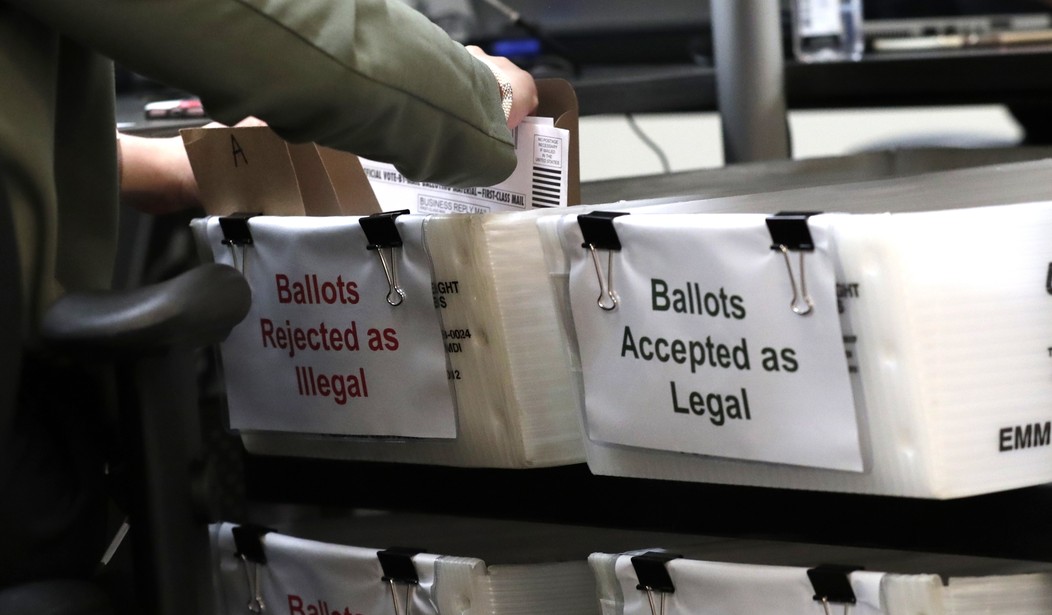
Legislative Republicans in Arizona are advancing a bill to terminate your right to vote…well at least from the “comfort of your kitchen table”, according to Arizona Republic columnist Laurie Roberts. Arizona’s beleaguered voters would instead have to “schlep down” to actual polling places.
But wait – it gets worse! The bill also eliminates the ability to cast your vote anywhere you choose, or it won’t count. Of course, in the real world you would’ve been repeatedly notified of your polling station and if you went to the wrong one anyway, poll workers would helpfully direct you to the correct one.
Why are Democrats motivated to concoct these exaggerated arguments against in-person voting, which has always worked just fine for Americans? It began in the age of Covid when, to prevent unnecessary mingling, voting in-person was discouraged. Voters instead were sent a ballot which they could return at their leisure.
Then, magic happened. Suddenly, Democrats became more likely to win. Close elections turned blue at the last minute, sometimes even after the official account was completed. Underdog candidates, almost always Democrats, begin to eke out victories.
In-person voting came came to be depicted as an onerous infringement on our fictitious right to convenience, much more difficult than a trip to the grocery store or a doctor’s office. Exceptions were readily granted for the elderly, infirm or geographically unavailable. Still, requiring the able-bodied to vote in-person was nothing more than voter suppression, barely more tolerable than Jim Crow.
What difference does it make where you vote? Most Americans don’t realize elections must be rigorously protected from fraud. The election process to a political grifter is like a bank to a thief. Within lies wealth and influence if you can crack it. Every election produces mountains of anecdotal evidence of widespread fraud, although unfortunately no official statistics are kept.
Moreover, all this activity occurs in a system with no systematic method for detecting fraud. When it is sought, the results can be shocking. The multiple irregularities found too late in the 2005 Rossi/Gregoire gubernatorial election in Washington and the ineligible votes cast in Al Franken’s 2010 senatorial election in both cases would have been more than enough to change the outcome.
American elections in the last century have been designed to ensure security of the ballot. On election day, registered voters not claiming a hardship exemption present themselves to a local polling place with a signed photo ID. They are physically protected from inappropriate influence both inside and outside the polling booth. They would drop their completed ballot into a secured receptacle, the contents of which would be delivered to local election officers under strict chain-of-evidence protocols.
With bulk-mail voting, all the precautions vanish. Millions of unsolicited ballots are mailed to poorly maintained lists of voters, many of whom have moved or don’t exist. Nobody knows or can know what happens to the ballots until they are returned by mail. The notably unreliable signature verification process is the lone fraud protection.
Whether the ballot actually reached the intended recipient, who actually filled out the ballot and whether any illegal aid was supplied to the voter are all categorical unknowns.
Up to 80% of Americans doubt our elections are secure. Some are conspiracy kooks fighting the wrong battle at the wrong time. But many others have justifiable concerns about a system increasingly dependent on bulk-mail voting.
Deep doubts about election validity are not healthy in a democracy. Although bulk-mail voting is popular, convenience-loving Americans should rethink their choice. Casting your ballot in person is a small price to pay for ensuring our republic.


Join the Conversation
VIP members get the ability to comment on articles.