





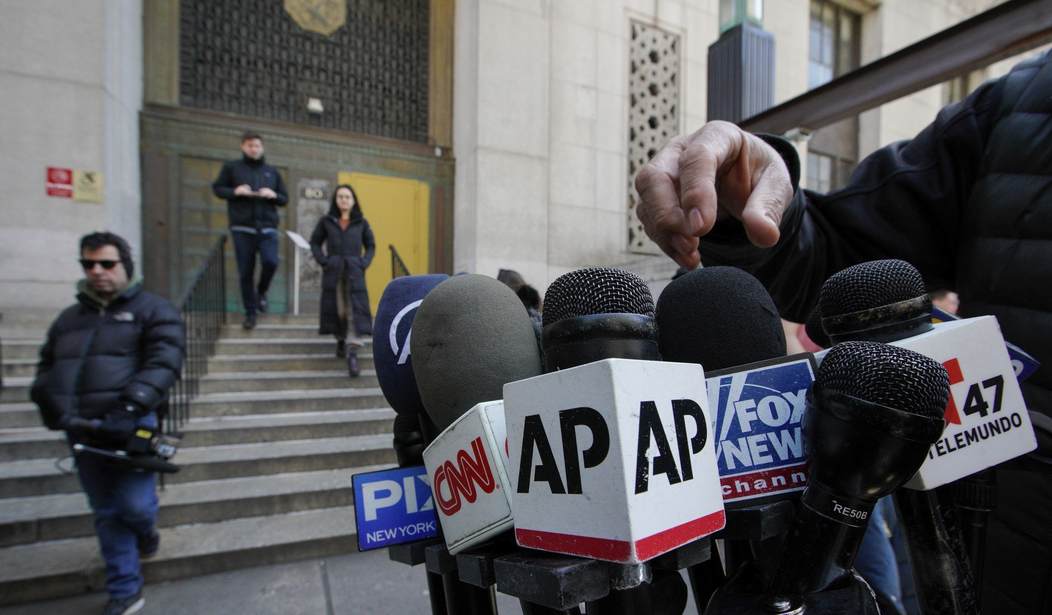
Washington Post media reporter Paul Farhi is the most recent example of a journalist who sounds like his own colleagues are the "professionals" and the writers without the classic Old Media branding are the "non-pros," people who don't have standards.
Farhi began by tweeting: "Someone invented the phrase 'citizen journalism' a few years ago to describe amateurs doing the work of pros. Yes, it occasionally works, but probably no more often than 'citizen cop,' 'citizen attorney' or 'citizen soldier.'"
This quickly became a Twitter beach ball for conservatives. In response to one reply, he qualified it a little: "I'd never argue that professional journalists are flawless. They're not, of course. But they do *try* to adhere to a set of standards. Non-pros are under no such obligation, and frequently don't bother."
Mollie Hemingway at The Federalist pulled out the big "ahem" on this notion: The latest Gallup poll illustrates that almost 40% of Americans have zero trust in the fairness and accuracy of "professional journalists."
She pointed out Farhi offered a similar take in 2016: "Is there any other profession in which more people think they can do the job better than the pros than journalism? Medicine? Teaching?"
The great divide in this debate isn't really between professionals and amateurs. It's between leftist media outlets and conservative media outlets. It's often assumed on the Left that the "professionals" are the "progressives," and the conservatives are a motley collection of partisan hacks. From my experience with Farhi, that's not his point. But that's where the fight is.
For conservatives, the fight can begin with the suppression of the New York Post in the closing weeks of the 2020 presidential campaign. The Post was doing original reporting out of an authentic source. The leftist "professionals" assembled an "intelligence community" warning it was all "Russian disinformation." Then in 2022, Farhi's Washington Post and The New York Times recognized the laptop was authentic.
At that point, which newspapers were right, and which were duped? The Democrat papers were too invested in the election outcome to investigate this story for themselves. They chose instead to suggest the Post was duped by the Bannons and the Giulianis. They played "consider the source."
Hemingway returns to other big stories of the Trump years. The Post and the rest pounded away for years on the unproven (then disproven) thesis that Donald Trump was an illegitimate president who colluded with the Russians to steal the election from Hillary Clinton. Now these same "professionals" claim the conservatives are the "election deniers."
Then there's the sexual-assault allegations lobbed against Supreme Court nominee Brett Kavanaugh. In 2018, Farhi wrote an article titled "Kavanaugh supporters see a conspiracy afoot." His then-boss Martin Baron harrumphed, "We aren't colluding with anyone about anything," which was transparently silly. If someone came forward and said Martin Baron tried to rape him/her, wouldn't he see a conspiracy to ruin him?
Back then, the Post published a vicious allegation that Christine Blasey Ford claimed she was "corralled" by a "stumbling drunk" teenager, Kavanaugh, into a bedroom "one summer in the early 1980s ... at a house in Montgomery County." She didn't have a date or a place. How on Earth was this enough detail to publish? It wasn't.
Denying the obvious -- that leftist journalists were trying to sink the Kavanaugh nomination, not just with Ford's remarkably imprecise claims but with even less plausible accusers -- is what makes people lose trust in the self-proclaimed "professionals." Attempting to destroy reputations for political gain can damage your brand.
Tim Graham is director of media analysis at the Media Research Center and executive editor of the blog NewsBusters.org. To find out more about Tim Graham and read features by other Creators Syndicate writers and cartoonists, visit the Creators Syndicate website at www.creators.com.

Join the Conversation
VIP members get the ability to comment on articles.