





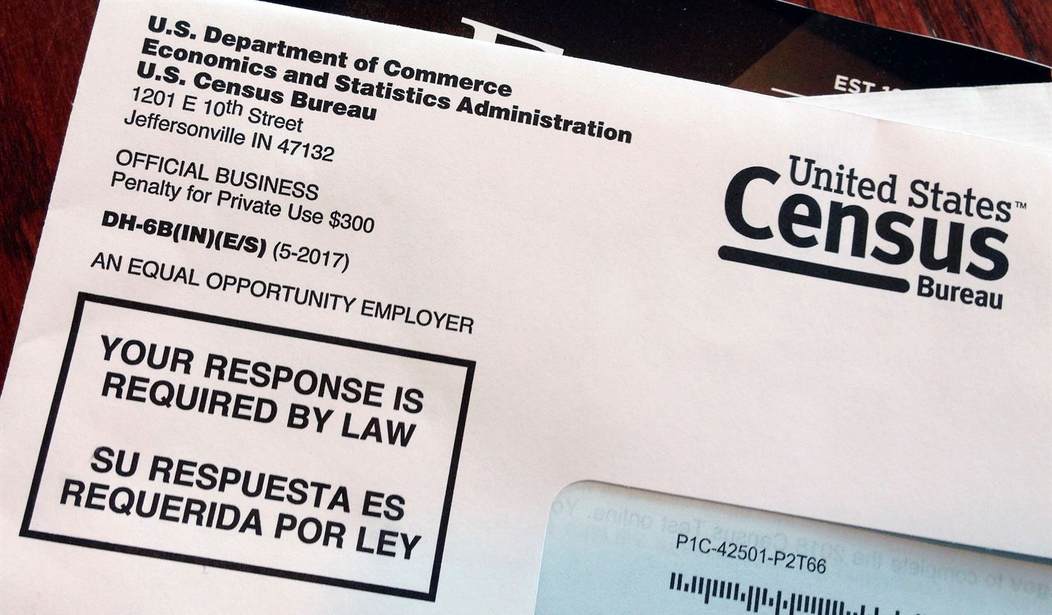
Liberals in the U.S. House of Representatives and various state and local jurisdictions are asking the Supreme Court to join them in making a remarkable prediction: Next year, they argue, unless the court acts now to restrain the Department of Commerce, vast numbers of illegal aliens will violate a U.S. law that has profound constitutional consequences.
This widespread law breaking, they predict, will impact federal elections for at least 10 years.
And, these liberals contend, the bad guys in this situation will not be the illegal aliens violating the law but the federal agency trying to enforce it.
We are talking about the 2020 census.
Nancy Pelosi's House of Representatives summarized the basic constitutional provision at stake in a brief submitted to the court in the case of the Department of Commerce v. New York. The court heard oral arguments on Tuesday.
"The Constitution's Enumeration Clause, as modified by the Fourteenth Amendment," the House said, "confers on Congress the responsibility to conduct every ten years an 'actual Enumeration' of the 'whole number of persons in each State.'"
Based on next year's enumeration, the current 435 House seats will be re-apportioned among the states, with each getting a minimum of one.
The "whole number of persons" cited in the Constitution does not distinguish between citizens and noncitizens or legal and illegal immigrants.
The census is meant to count literally all persons living in the United States.
To carry out this function, as Solicitor General Noel Francisco told the court in his own brief, Congress has enacted laws. One broadly delegates to the secretary of commerce the power to conduct the census "in such form and content as he may determine."
Others place legal responsibilities on U.S. residents.
"Individuals who receive the census questionnaire are required by law to answer fully and truthfully all of the questions, and the government must keep individual answers confidential," Francisco explained, summarizing 13 U.S.C. 9(a) and 221.
Historically, the census has routinely asked demographic questions and, for many decades, specifically asked about citizenship. California Attorney General Xavier Becerra admitted in his own brief that at some point in the past it was constitutional for the census to ask about citizenship -- and could be again someday.
"To be clear," Becerra said, "California does not contend 'that each and every' past census with a citizenship question was 'conducted in violation of the Enumeration Clause,' ... or that such a question could never properly be added to any census in the future."
So, why did California, the U.S. House of Representatives and other governmental jurisdictions around the country decide to argue the issue in court when Commerce Secretary Wilbur Ross decided to include a citizenship question in the 2020 census?
The first premise in their argument is that the citizenship question will cause some people to disobey the law that requires them to answer census questions.
The House put it to the Supreme Court this way: "No logical leap is required here: given the potential immigration consequences of being identified by the government as lacking legal immigration status, common sense explains the reluctance of noncitizens to self-identify on a government form."
The second premise is that if people "lacking legal immigration status" do not complete the census form, certain states and jurisdictions will lose congressional seats and federal funding.
The California state legislature put this candidly.
"California is expected to lose at least one seat in the House of Representatives and possibly more," it told the court.
"Depending on the experts' estimated undercount attributable to the additional question," it said, "that number could be as high as a loss of three seats."
"Because many federal programs are based on population, California and its local jurisdictions will lose significant federal funding," it said.
Harris County, Texas, was blunter.
"Given its raw population growth since 2010 of more than half a million people, Harris County is on track to gain an additional congressional seat," it told the court.
But: "Under any scenario, in the re-apportionment following the 2020 Census Texas will most likely lose a congressional seat in Congress it otherwise deserves under the Enumeration Clause if the citizenship question is added. Indeed, Harris County alone has enough undocumented people to populate an entire congressional district."
Put bluntly: Harris County told the Supreme Court it stands to gain power in the U.S. Congress because of the large number of illegal aliens living within its borders.
The administration argued to the court that those who brought the case against the citizenship question do not even have standing to do so.
"[T]heir asserted injuries are not fairly traceable to the Secretary's decision to reinstate the citizenship question," Francisco told the court. "None of the respondents' alleged injuries will materialize if individuals completely and truthfully answer the census questionnaire, as required by federal law. The alleged injuries thus depend not just on third-party action, but on third-party action that is unlawful."
Whether or not the court allows Commerce to ask the citizenship question, this case illuminates a fundamental point about illegal immigration.
Those pushing this suit believe their political interests are advanced by making sure all illegal aliens are counted. By the same logic, their political interests would also be advanced by increasing the number of illegal aliens in their jurisdictions.
If all of the illegal aliens in the United States were to suddenly obey the law and go home, California would lose congressional seats.
Harris County would lose one, too.
Does that help explain why some politicians in Washington, D.C., do not want to secure the border or enforce the immigration law?

Join the Conversation
VIP members get the ability to comment on articles.