






Beltway politicians like to pretend that smaller spending increases amount to spending “cuts.” As Dan Mitchell has pointed out numerous times (see here for one example), that’s baseline budgeting baloney. Now that the 2011 Budget Control Act’s spending caps are in place, politicians are making an even more ridiculous claim: the so-called “cuts” have already occurred.
The caps apply to spending over ten fiscal years – the last year being 2021. We are obviously not in the year 2021, so it’s impossible for the so-called “cuts” to have already been implemented. Yet here are two examples from a recent Politico article where politicians suggest that to be the case:
“There are people that think we need to cut more,” House Armed Services Committee Chairman Buck McKeon (R-Calif.) acknowledged in an interview. McKeon said he’s been pushing back against budget hawks in the GOP conference by pointing to the nearly $600 billion in spending cuts that the Pentagon has already absorbed in recent years — and that’s before sequestration would even begin.
…
“I think there’s spending that can be taken out of all departments,” said freshman Rep. Ted Yoho (R-Fla.). “And I’ve talked to people from the Pentagon. There’s just areas that, yeah, we can pull back a little more, even though they did their $470 billion already. They said it hurt, but we possibly could.”
I’ll cut Rep. Yoho a little slack because the article indicates that he’s open to cutting defense. Rep. McKeon, on the other hand, deserves no such leniency. (Why McKeon said $600 billion and Yoho $470 billion I have no idea.)
The following chart illustrates why it is ridiculous to act as if smaller future increases in projected spending amount to realized spending cuts. The chart shows the Congressional Budget Office’s August 2001 baseline estimate of defense spending from 2002 to 2011 versus the actual outlays:
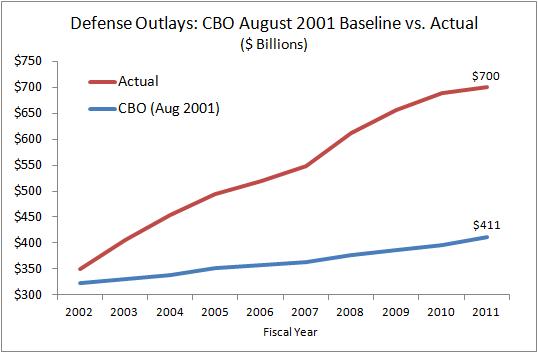
The combined difference turned out to be $1.8 trillion.
But, you might respond, those estimates were published a month before the attack on September 11th, 2001, so of course they turned out to be way off!
And that’s my point. With the exception of Keynesian economists, no one can predict the future. All it will take is another major terrorist attack or another war and it’s adios spending caps. I would argue that such unfortunate scenarios are a distinct possibility given the Beltway crowd’s love for empire, but I’ll leave that topic to Cato’s foreign policy experts.



Join the Conversation
VIP members get the ability to comment on articles.