





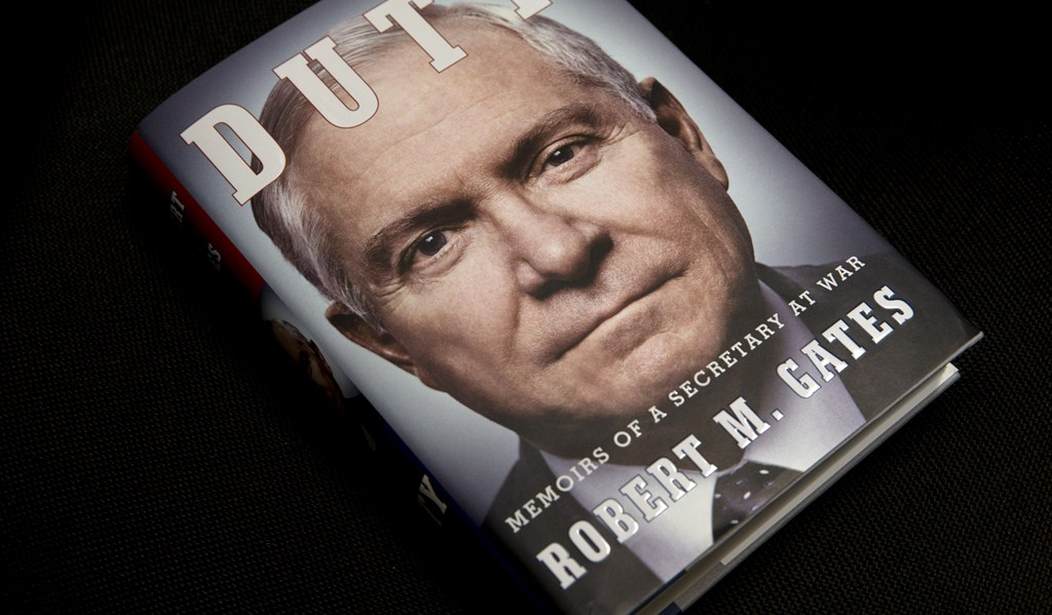
Robert Gates may be the only CIA director or defense secretary who ever took part in peace demonstrations during the Vietnam War. In his 1996 memoir -- the one nobody noticed -- he says that in 1970, as a young CIA employee and Air Force veteran, he marched in Washington to protest the U.S. invasion of Cambodia.
"I and virtually all of my friends and acquaintances in CIA were opposed to the war and to any prolonged strategy for extracting us," he recalls, with no evident regret.
Gates has been a durable pillar of the U.S. national security apparatus, serving under eight presidents. Heading the Pentagon under George W. Bush and Barack Obama, he had the task of bringing success out of stalemate in military engagements someone else started, and he did his best. But under his hawkish exterior, the antiwar impulse has never gone away.
If you're circulating a petition to invade this country or bomb that one, don't bother asking Gates. In his new book, "Duty," he has little good to say about most past or prospective decisions to initiate hostilities.
Despite his Republican credentials and service under Bush, he shows little enthusiasm for his crusading foreign policy. "I thought Bush's freedom agenda as publicly presented was too simplistic," he writes. The administration's goals in Afghanistan were "embarrassingly ambitious (and historically naive) when compared to the meager human and financial resources committed to the task."
Gates, who acknowledges supporting the 2003 Iraq invasion, harbors an abundance of second thoughts. Lamenting its "huge costs" in money and lives and the chaos it produced, he says it also "resulted in a significant strengthening of Tehran's position in the region -- and in Iraq itself."
He argues that the Iraq war undermined our efforts in Afghanistan by diverting resources and attention. He concludes that it "will always be tainted by the harsh reality that the public premise for invasion -- Iraqi possession of chemical and biological weapons as well as an active nuclear program -- was wrong."
Gates was equally dubious when, under Obama, he heard calls for other wars. He lobbied against the 2011 intervention in Libya, believing its civil war "was not a vital national interest of the United States. I opposed the United States attacking a third Muslim country within a decade to bring about regime change. ... I worried about how overstretched and tired our military was, and the possibility of a protracted conflict in Libya." He often asked his colleagues, "Can I just finish the two wars we're already in before you go looking for new ones?"
Even though the air campaign succeeded, he says of Libya, charitably, "Problems abound there." The best U.S. response to change in the Arab world, he believes, is to "stop pretending to ourselves that we can predict (or shape) the outcome."
Gates does not welcome the prospect of a nuclear Iran, but he sounds even less open to launching a preemptive attack. Second to his concern about the Iranian program was his determination to restrain the Israelis. If Israel were to bomb Iran, he writes, the result for the U.S. could be "a war possibly more widespread and terrible than those in Iraq and Afghanistan."
When Bush raised the option of a U.S. strike with his national security advisers, Gates argued it would "strengthen the most radical elements, unify the country behind the government in their hatred of us, and demonstrate to all Iranians the need to develop nuclear weapons."
The Iranian government, he said, "would retaliate, putting at risk Iraq, Lebanon, oil supplies from the (Persian) Gulf" and killing any Israeli-Palestinian peace process. He notes that Vice President Dick Cheney promptly "disagreed with everything I had said."
Gates reserves his highest regard for a president he didn't serve: Dwight Eisenhower, himself a former general. As president, he had to deal with the Soviets getting the hydrogen bomb, China building nuclear weapons, a communist victory over the French in Vietnam, an Arab-Israeli war, Castro's revolution in Cuba, and uprisings in Eastern Europe. But after he ended the Korean War in 1953, marvels Gates, "not one American soldier was killed in action during his presidency."
All he wants is for the U.S. to stay out of unnecessary wars of the sort American presidents are so prone to undertake. When the next war of choice begins, Gates won't be among those marching to protest. But his heart might just be with them.



Join the Conversation
VIP members get the ability to comment on articles.