





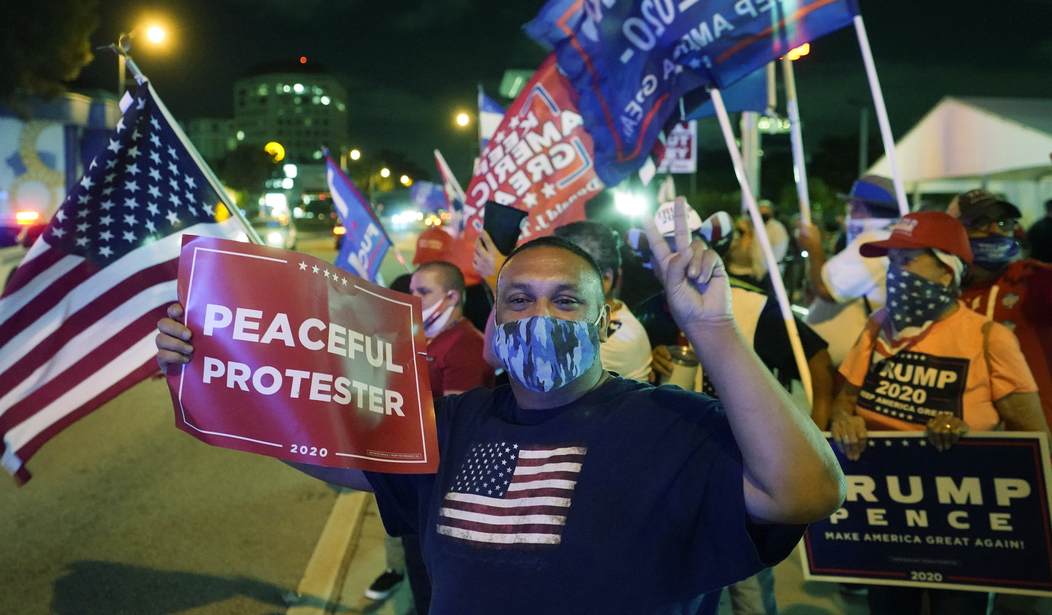
Big questions remain about what exactly happened in the 2020 election.
I've been looking over history, compiled on the Statista website, of total votes cast in presidential elections compared with the number of eligible voters. 2020 seems very, very odd.
The number of votes reported in 2020 exceeded the total number of votes cast in 2016 by 22 million. This is larger than the population of Florida, the nation's third-most-populous state, and almost as large as the population of Texas, the second-most-populous state.
According to Statista, votes of 66.5% of eligible voters were recorded in 2020. In 2016, 59.2 percent of eligible voters voted. In 2012, 58 percent voted. And in 2008, the election with America's first black presidential candidate nominated by a major party, 61.6 percent voted.
What accounts for the highly unusual surge in votes recorded in 2020?
Gallup polled voter enthusiasm just prior to the election, asking, "Compared to previous elections, are you more enthusiastic than usual about voting, or less enthusiastic?"
This year, 69 percent said they were "more enthusiastic." But in 2008, 68 percent said they were "more enthusiastic."
Gallup also asked voters whether they think "the stakes in this presidential election are higher than in previous years."
In 2020, 77 percent said yes. But in 2008, 76 percent said yes.
Voter enthusiasm in 2020 and 2008 was hardly different. Yet, in 2020, 22 million more votes were recorded compared with the 2016 election, and in 2008, there were 9 million more votes compared with the previous election. In 2020, voter turnout was 7.2 percentage points higher than in the previous election, compared with a 1.5 percentage point increase from 2004 to 2008.
Regardless of where things go in court challenges to what happened in the 2020 election, the tens of millions of votes that seem to have emerged out of nowhere need explanation.
The American people should demand an audit of the 2020 election and not settle until there are clear answers.
Meanwhile, taking the results of the election as a given, another big question remains for Republicans.
Why was it so close?
In September, Gallup asked voters whether they and their families were "better off now" than they were four years ago. Fifty-five percent said yes.
When the same question was asked in 1984, when then-President Ronald Reagan was running for reelection, 44 percent said yes. Yet Reagan went on to win by a landslide, winning 49 of 50 states.
One reason President Donald Trump did not run away with the election as Reagan did is what I have been writing about for years: the changing demographics of the country.
In the 1984 election, 84 percent of voters were white. In this election, 67 percent of voters were white.
What would the results have been if every racial/ethnic group had voted as they did in 2020 but 84 percent of the voters were white, like in 1984, rather than 67 percent?
President Trump would have won 52 percent of the popular vote and would have been victorious by a margin of 9.7 million votes.
The fact that Trump made gains among blacks and Hispanics in 2020 is meaningful. It shows that these groups can change their voting behavior. Voting liberal and Democratic is not genetic.
But Republicans are going to have to continue to make strong gains among non-white Americans, or they will be overwhelmed by the ethnic changes of the country. The white percentage of the American electorate that delivers most Republican votes will continue to shrink.
There should be zero tolerance of voting irregularities. But Republicans will be vulnerable to them as long as elections remain on a razor's edge.
Republicans must continue the hard work of convincing non-white Americans that a strong economy -- only possible with low taxes; low regulation; parental choice in education; private ownership, rather than government programs; and strong traditional moral principles -- is where their future lies.
Star Parker is president of the Center for Urban Renewal and Education and author of the new book "Necessary Noise: How Donald Trump Inflames the Culture War and Why This is Good News for America." Readers can respond to Star's column by emailing star-parker@urbancure.org.


Join the Conversation
VIP members get the ability to comment on articles.