





In March 2020, the Supreme Court will rule on the constitutionality of Louisiana's new abortion law, which requires that physicians doing abortions have admitting privileges at a hospital within 30 miles of the clinic.
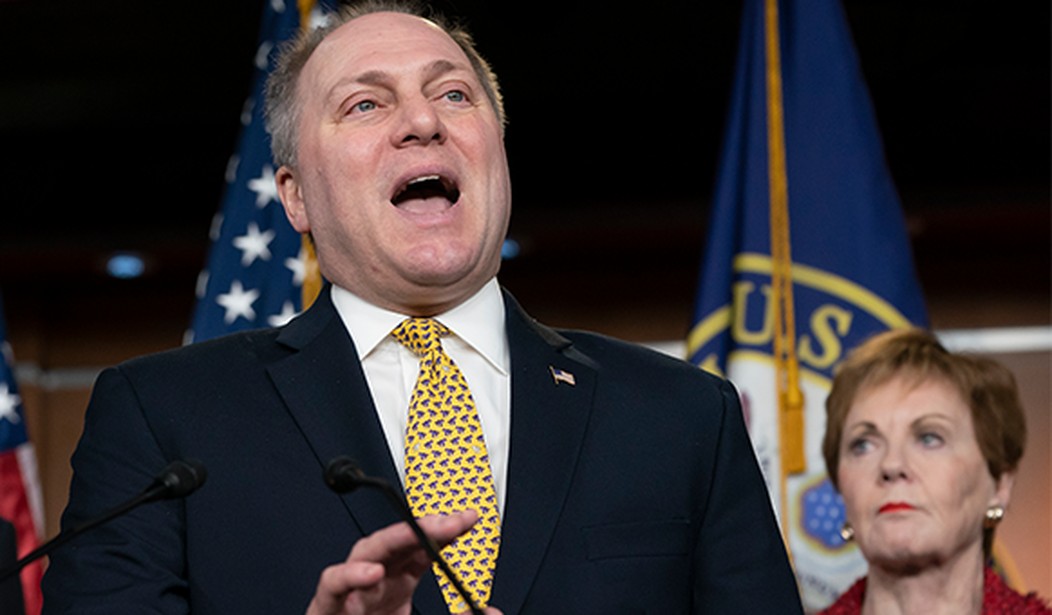
Under the leadership of House Minority Whip Steve Scalise, an amicus -- "friend of the court" -- brief supporting the law was just filed, signed by 207 members of Congress, 39 senators and 168 House members.
A press release from Scalise summarizes the arguments made and lists a number of conservative organizations supporting the brief, one of which is my organization -- the Center for Urban Renewal and Education.
What makes this filing particularly interesting is not just the sheer volume of congressional signatories -- almost 40% of the Senate and House combined; it's also the fact that it goes further than just arguing support for the constitutionality of the Louisiana law to suggest that the widespread confusion regarding abortion law ties directly to the confusing basic premises under which abortion was found constitutional in the 1973 Roe v. Wade and the 1992 Planned Parenthood v. Casey decisions.
The brief urges the Supreme Court to cast new scrutiny on these two landmark decisions that have defined the abortion legal landscape.
Asking the Supreme Court to reconsider Roe v. Wade is provocative, to say the least. But it is also courageous and on target.
How can we possibly function as a nation when an issue as critical as abortion defies consensus as to its constitutional pedigree as well as its morality?
Can there be any better evidence of this confusion than recalling the famous interchange in August 2008 when Pastor Rick Warren asked then-presidential candidate Barack Obama, "At what point does a baby get human rights, in your view?"
Obama, a Harvard-educated lawyer who would go on to be twice elected president, replied lamely, "answering that question ... is above my pay grade."
Yet despite his candor about his inability to clarify the biological and legal status of the unborn child, he didn't hesitate to be the first sitting American president to address the national meeting of Planned Parenthood, the nation's largest abortion provider, and tell them, "God bless you."
There is a well-known expression from the world of computing that says, "garbage in, garbage out."
Faulty premises will produce faulty results and output.
This is a pretty good summary of what has been happening to American culture since the Roe v. Wade decision.
Once sanctity of life and its legal protections became ambiguous, our entire culture began to unravel.
The percentage of American adults married since Roe v. Wade has dropped by one-third. The percentage of children in households with married parents is down 15%, and the percentage of babies born to unwed mothers up over 300%.
The last decade, according the Census Bureau, is estimated to have the slowest 10-year growth in the U.S. population since the first census was taken in 1790.
The Census Bureau forecasts that by 2034, for the first time, there will be more Americans over age 65 than under 18.
And, of course, we cannot overlook the damage our national soul has incurred by looking away as 61,628,584 babies have been destroyed in the womb since 1973, as the Guttmacher Institute reports.
In the latest Gallup polling, 49% identified as pro-life and 46% as pro-choice. Fifty percent say abortion is "morally wrong," and 42% say it is "morally acceptable."
For the 47th time, hundreds of thousands will arrive in Washington for the March for Life, noting the anniversary of the Roe v. Wade decision, Jan. 22, 1973.
There is growing appreciation for the notion that what's driving a sense that something is wrong in our nation is ambiguity regarding the sanctity of life.
Let's pray that the court heeds these 207 members of Congress and starts rethinking the Roe v. Wade decision.
Star Parker is president of the Center for Urban Renewal and Education and author of the new book "Necessary Noise: How Donald Trump Inflames the Culture War and Why This is Good News for America," available now at starparker.com.


Join the Conversation
VIP members get the ability to comment on articles.