





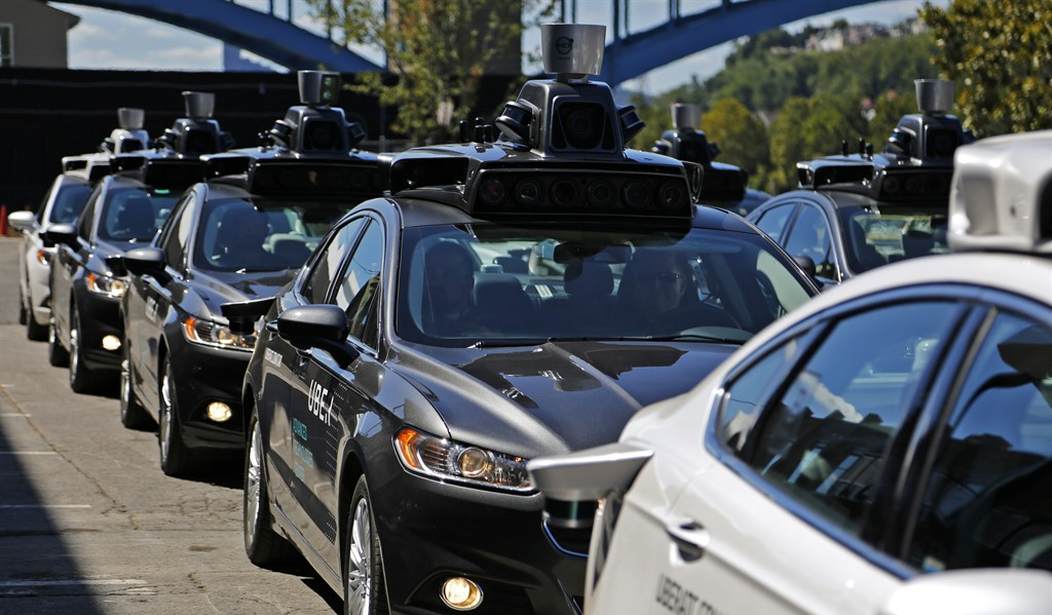
In recent years, some people have become convinced that the digital revolution will lead to mass unemployment. The solution, they say, is to provide a Universal Basic Income so that every American receives enough money to live on whether they work or not. The hope of some UBI dreamers is that many people will use this freedom for intellectual and artistic pursuits.
For most people, however, it is the fear of automation that drives discussion of the idea of a guaranteed income. And, make no mistake about it, automation is already reshaping the workforce on a daily basis. The next wave will be especially disruptive of entry-level positions and more. Research conducted by the Oxford Martin School estimates that 86 percent of food service jobs are at high risk of being automated by 2030. So are 75 percent of transportation and warehousing jobs; 67 percent of real estate, rental, and leasing jobs; 67 percent of retail jobs; and 62 percent of manufacturing jobs.
What is lost in the discussion, however, is that we've been through this before. During the 20th century, 10 million farm jobs were lost due to technology and other innovations. It may not seem high-tech today, but replacing horses and mules with gas-powered tractors had a devastating effect on the job prospects for farm laborers. In 1910, fully one-third of Americans worked on a farm. That fell to just over 1 percent in the year 2000.
Despite this destruction of farm jobs, the U.S. economy thrived in the 20th century, creating far more jobs and an unprecedented standard of living.
But, in mid-century, the saga continued. A 1961 article in Time magazine reported that a rise in unemployment "raised some new alarms around an old scare word: automation." The article noted that, while the causes of the increased unemployment were not clear, "many a labor expert tends to put much of the blame on automation." At the time the article was written, 54 American workers had jobs. That number jumped to 71 million within a decade.
The story of a free economy destroying some jobs and replacing them with others is older than the United States. Nearly 500 years ago, Queen Elizabeth I refused to provide patent protection for an automated knitting machine. Why? The Queen said she had "too much regard for the poor women and unprotected young maidens who obtain their daily bread by knitting to forward an invention which, by depriving them of employment, would reduce them to starvation."
Despite the Queen's resistance, automated knitting machines took off. That's also part of the ongoing story. The technology and the culture will always find a way around the political obstacles. It's true that jobs will be lost and the transition will be difficult for many. This is a serious problem not to be ignored.
But the answer is not to fantasize about giving everyone a Universal Basic Income. The answer is to recognize that the new wave of services and possibilities will create many more jobs than are lost during the transition.


Join the Conversation
VIP members get the ability to comment on articles.