





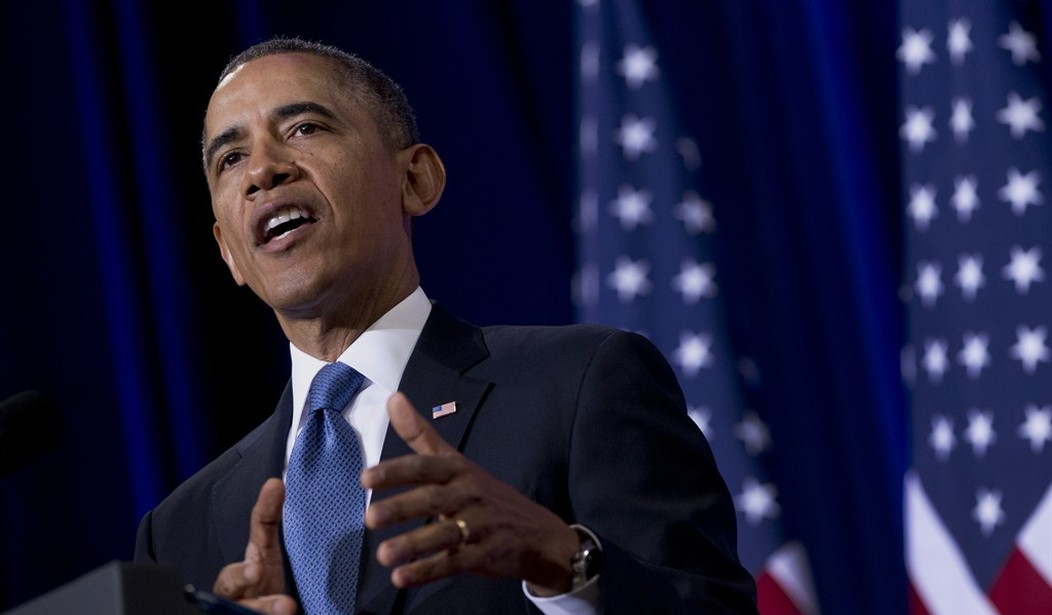
In the build up to Tuesday night's State of the Union address, Obama administration officials had increasingly referenced the president's intention to utilize a "pen and phone" strategy to pursue his liberal agenda, relying on executive orders in place of the often difficult process of negotiating with congress.
Mr. Obama, obviously frustrated by his administration's inability to fully accomplish its legislative objectives, had sought to cast Republicans as the sole impediment standing between his policies and a flourishing economy.
What he had failed to acknowledge, however, was his own inability to build support for his legislative priorities among either members of congress or the American people.
In his State of the Union address, Mr. Obama made little mention of the need for working across the aisle to engage his ideological adversaries.
Instead, Obama asserted that, when he deemed necessary, he would bypass the legislative process and instead utilize the seemingly ever expanding power of the executive pen.
Obama said, “America does not stand still – and neither will I. So wherever and whenever I can take steps without legislation to expand opportunity for more American families, that’s what I’m going to do."
The president's movement toward enhancing the power of the executive at the expense of congress has angered many. Senator Ted Cruz (R-TX) lamented, "The Obama administration has been so brazen in its attempts to expand federal power that the Supreme Court has unanimously rejected the Justice Department's efforts to expand federal power nine times since January 2012.”
Mr. Obama's pivot away from the constitutional prerogatives of congress in favor of a more unilateral approach to managing government is not the first such effort on the part of a chief executive to wrest control from a separate but co-equal branch of government.
Next week marks the 77th anniversary of the announcement of Franklin Roosevelt's proposed Judiciary Reorganization Bill. Frustrated by the Supreme Court having invalidated multiple elements of his signature New Deal, FDR sought to pass legislation through the heavily Democrat-controlled congress that would allow him to fundamentally alter the makeup of the Supreme Court and pack the Court with judges more sympathetic to his New Deal endeavors.
The plan called for allowing the president to appoint an additional justice to the Supreme Court for every sitting justice over the age of 70. Given the makeup of the Supreme Court at the time this would have allowed Roosevelt to appoint an additional 6 justices.
As the constitution made no provision for the number of justices on the Supreme Court, Roosevelt's scheme was not seen as overtly unconstitutional. It was, however, seen a brazen attempt to circumvent the constitution's inherent system of checks and balances and it was met with immediate criticism.
Jeff Shesol, author of Supreme Power: Franklin Roosevelt v The Supreme Court, stated that upon learning of FDR's plan, even members of his own administration reacted with incredulity. "John Nance Garner, who was Roosevelt's vice president, went back with him to Capitol Hill, stood in the well of the Senate and, as the plan was read aloud to the senators, Garner held his nose and gestured thumbs down,” said Shesol.
As debate over FDR's court packing scheme intensified in the ensuing months, the public grew increasingly unsupportive of his idea. Although personally popular, FDR’s attempt to pack the court with political cronies was seen as far more offensive than was the court having invalidated many of FDR’s legislative undertakings.
In an article for the American Political Science Review, author Gregory Caldeira wrote that the central debate had less to do with the specifics of New Deal legislation, rather, "FDR's proposal forced the public to choose between the widely approved policies of an extremely popular president and the institutional integrity of a controversial Supreme Court."
The public ultimately supported the maintenance of governmental checks and balances and soured on FDR’s attempt to inflate the power of the presidency at the expense of the judiciary.
Following a series of influential events that included the retirement of Justice Willis Van Devanter as well as the Court’s validation of the Wagner Act, a significant piece of Roosevelt’s New Deal, an amended version of the Judiciary Reorganization Bill was passed on August 26, 1937, having been stripped of its most contentious elements, including the increase in Supreme Court justices.
President Obama, himself enjoying far less public support than FDR in his day, ought take a hard look at history and consider a renewed attempt at building consensus through leadership rather than opting for the imperious approach of governing through executive fiat.
Pens and phone calls may allow for the easier implementation of Mr. Obama’s agenda but it would be inconsistent with the Founder's intent of a government predicated upon, among other things, the separation of powers.
Understandably, the public at times becomes frustrated by warring factions in Washington but it will always opt on the side of maintaining institutional integrity over the whims of a frustrated executive. Mr. Obama should accept that reality and understand that leading a divided government often requires conciliation, not an aggrandized executive.



Join the Conversation
VIP members get the ability to comment on articles.