





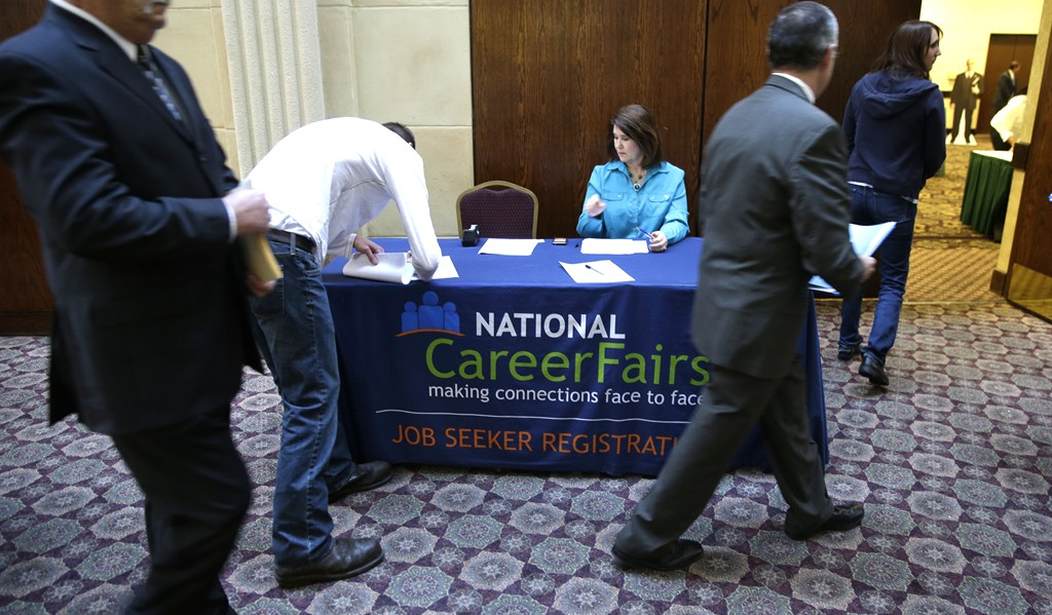
The economy created 288,000 jobs in April, up from 203,000 in March. That’s the second best showing of the Obama recovery but still less than what is needed each month to raise employment to prerecession levels.
Those results are consistent with an economy recovering from its winter slump but performing well below full potential—4 to 5 percent GDP growth and 400,000 to 500,000 jobs a month.
Construction, manufacturing, retail and wholesale trade, business and professional services, finance, health care, leisure and hospitality, and government employment were all up. Information technology registered a small loss.
Hourly earnings made no gain, indicating the economy is still creating too many low paying jobs.
Autos and broader retail sales have been improving; however, the housing sector is yet to take off. An odd combination of constrained demand, caused by higher mortgage interest rates and heavy college debt among young buyers, and short supplies of skilled trades, such as framers and carpenters, in some markets are dampening a much anticipated takeoff in residential construction.
The energy boom has absorbed a lot of the skilled construction labor, leaving residential builders, which traditionally pays less than commercial developers, scrambling in some markets.
Global growth is rebalancing from Asia to the Atlantic community, as Europe begins a slow recovery and growth slows a bit in China and Japan. Much of China’s miracle has been premised on financial gimmicks—an undervalued currency and overly generous credit. As Japan demonstrated in the 1980s, those tactics have limits.
Unfortunately, the effects of currency manipulation on the U.S. economy—along with self- imposed restraints on oil and gas development and the manifest inefficiencies imposed by dysfunctional management and profiteering in health care, higher education and finance—have lowered U.S. annual growth to 1.7 percent since the turn of the century from the 3.4 percent pace accomplished during the Reagan-Clinton era.
Consequently, jobs creation lags population growth. The unemployment rate, which fell to 6.3 percent in April from 6.7 percent the prior month, wholly masks the extent of the problem. The percentage of adults seeking employment dropped precipitously. One out of six men between the ages of 25 and 54 are without jobs, and many have given up looking for work and are not counted in the jobless rate.
Factoring in adults on the sidelines who say they would seek employment if conditions were better and part-timers desiring full-time work, the jobless rate becomes 12.3 percent.
Remedies to slow growth and unemployment challenge the hardened ideological position of both the Obama-Pelosi wing of the Democratic Party and the conservative wing of the GOP.
Neither President Obama nor Speaker Boehner accepts the urgency—or at least has the stomach—of addressing Chinese and Japanese currency manipulation and other protectionist practices.
Democrats act as if shutting down U.S. energy development would reduce environmental risks, when it merely exacerbates those by increasing dependency on production in developing economies where hazards are less well managed. Meanwhile, the GOP sees few risks from shale gas development, and would like to export the commodity to countries that refuse to develop their own resources and share in environmental risks.
Regulating banks has failed to the point that Attorney General Holder is shy about prosecuting Wall Street institutions that are now dubbed “too big to jail.” Meanwhile, Republicans won’t embrace structural remedies—in particular separating government insured deposit taking institutions from the casinos and breaking up the largest banks to encourage competition and increase small business lending.
Germany enjoys health care costs about one-third lower than the United States by running an all must play insurance system but with genuine price controls, recognizing the monopoly power near universal coverage affords drug companies and other providers. Still it’s tough to find a politician or policy analyst in Washington who wants an honest discussion about that.
So it goes. Ideology bordering on idolatry reigns in the nation’s capital, the economy grows too slowly, and Americans go jobless or suffer sinking wages.
Peter Morici is an economist and business professor at the University of Maryland, national columnist and five-time winner of the MarketWatch best forecaster award. He tweets @pmorici1


Join the Conversation
VIP members get the ability to comment on articles.