





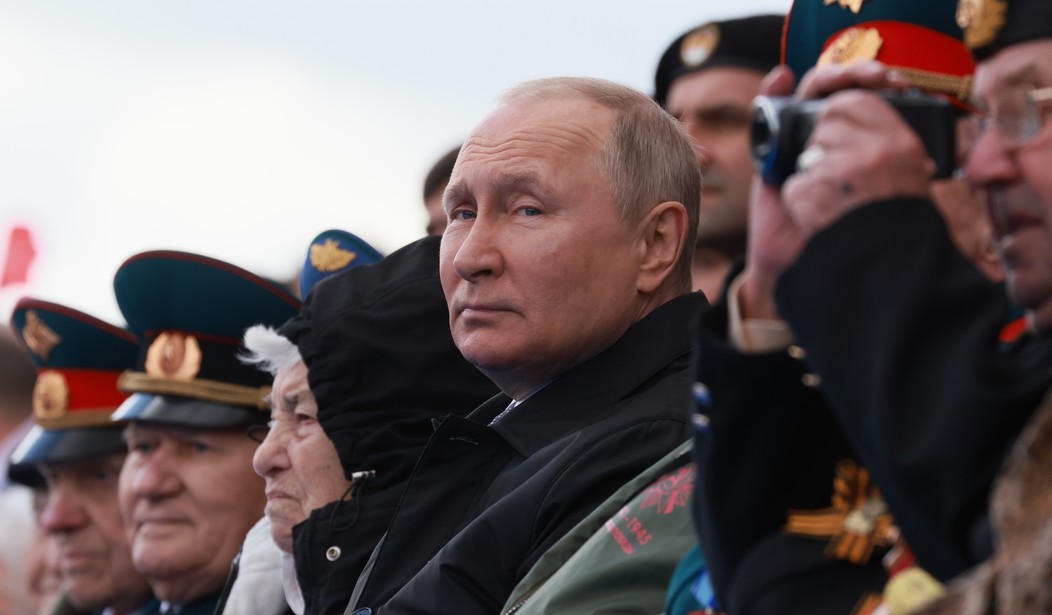
"The demise of the Soviet Union was the greatest geopolitical catastrophe of the century," said Russia's new ruler Vladimir Putin in his 2005 state of the nation address.
"As for the Russian people," Putin went on, "it became a genuine tragedy. Tens of millions of our fellow citizens and countrymen found themselves beyond the fringes of Russian territory."
From Putin's standpoint, the statement was then and remains today understandable.
Consider. When Putin entered his country's secret service, Berlin was 110 miles deep inside a Soviet-occupied East Germany. Poland, Czechoslovakia, Hungary, Romania and Bulgaria were member states of the Warsaw Pact.
Lithuania, Latvia and Estonia were republics of the USSR. Ukraine was the most populous and ethnically closest of the Soviet republics to Russia itself.
And today? Berlin is the capital of a united, free and democratic Germany, a member of NATO, that is beginning a rearmament campaign triggered by Putin's invasion of Ukraine.
Poland, the Czech Republic, Slovakia, Hungary, Romania and Bulgaria are members of the U.S.-led North Atlantic Treaty Organization.
Former Soviet republics Lithuania, Latvia and Estonia are also members of that Western alliance established to contain Russia.
Sweden and Finland, neutral through the Cold War, are applying for membership in NATO.
Ukraine, backed by the U.S. and NATO, is fighting a war to push the Russian army out of its territory, a war that has the support of almost every country on the continent of Europe.
Even the falls of the British and French empires at the end of World War II do not match as geo-strategic disasters the collapse of the Soviet Empire and breakup of the Soviet Union since the end of the Cold War.
How goes the Russian war in Ukraine launched on Feb. 24?
Russia has enlarged the territory it controls in Crimea and its Luhansk and Donetsk enclaves in the Donbas. And now, with the fall of Mariupol, Moscow controls the entire Sea of Azov and has completed its land bridge from Russia to Crimea.
But Russia has failed to capture and been forced by the Ukrainian army to retreat from Kyiv and Kharkiv, the largest cities in Ukraine, and Putin has seen his forces humiliated again and again.
Yet, withal, Russia today remains a great power.
The largest nation on earth with twice the territory of the U.S., Russia has the world's largest nuclear arsenal and exceeds the U.S. and China in tactical nuclear weapons. It has vast tracks of land and sits on huge deposits of minerals, coal, oil and gas.
But Russia also has glaring weaknesses and growing vulnerabilities.
While Putin has built up impressive forces in the Arctic, the Baltic Sea, with Finland and Sweden joining the Western alliance, is becoming a NATO lake. Russian warships sailing out of St. Petersburg to the Atlantic have to traverse the coastal defenses of 11 present or future NATO nations: Finland, Estonia, Latvia, Lithuania, Sweden, Poland, Germany, Denmark, Norway, Britain and France.
Among the questions that Russia, shrunken in so many ways from the great U.S. rival of the Cold War it once was, must answer is, "Quo Vadis?"
Where does Mother Russia go from here?
Bitter at their losses in the Cold War and post-Cold War years, many Russian nationalists are urging the regime to align with today's great power antagonist of the United States, Xi Jinping's China.
This is a recipe for a Second Cold War, but how would that war avail the Russian nation and its people?
In any Russia-China alliance, there is no doubt who will be senior partner. And it is not the U.S. that covets and wishes one day to control the resources of Russia from Novosibirsk to the Bering Sea.
China's population of 1.4 billion people is 10 times Russia's. East of the Urals, China's population is 50 to 100 times the size of Russia's in Siberia and the Far East.
What of a U.S.-Russia detente as Moscow's future rather than Cold War II?
During some of the coldest days of the Cold War, U.S. presidents like Dwight Eisenhower, Richard Nixon and Ronald Reagan sought to find common ground on which to stand with Russia to avoid conflict.
Ike invited the "Butcher of Budapest," Nikita Khrushchev, for a 12-day U.S. visit in 1959. Nixon initiated a "detente" with Leonid Brezhnev, who had ordered the Warsaw Pact to crush the "Prague Spring" in 1968. Reagan and Mikhail Gorbachev negotiated the dismantling of an entire class of nuclear weapons in the 1987 Intermediate-Range Nuclear Forces treaty.
Given the hostility Putin has generated by his invasion of Ukraine, Western leaders may be unable to bring Russia in from the cold. But if we isolate Russia, push it out of the West, Moscow has only one direction in which to go -- east, to China.
In 230 years, the United States has never gone to war with Russia. Not with the Romanovs nor with the Stalinists, not with the Cold War Communists nor with the Putinists.
U.S. vital interests dictate that we maintain that tradition.

Join the Conversation
VIP members get the ability to comment on articles.