







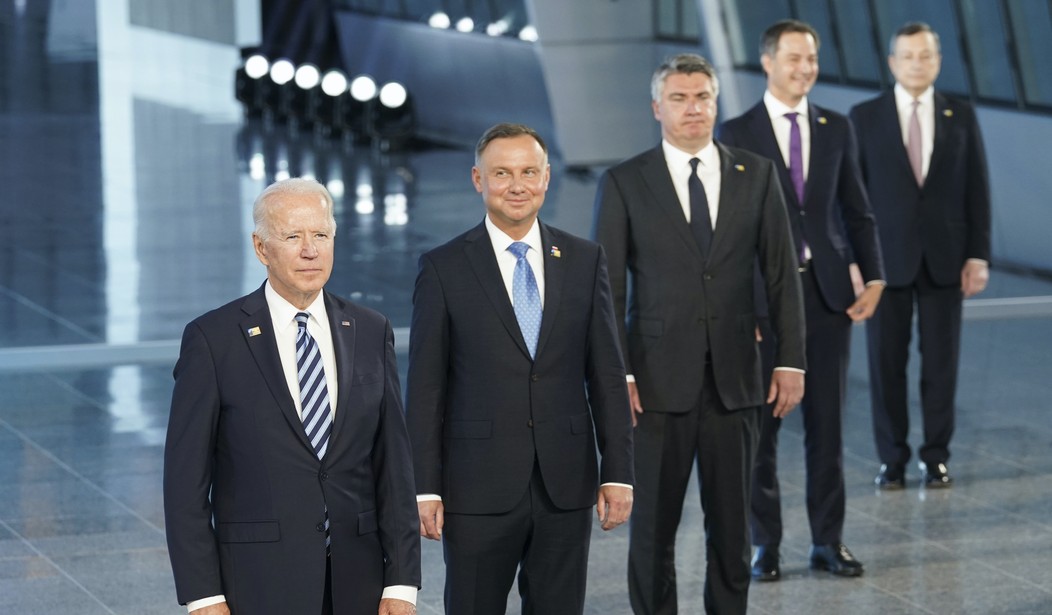
Is the territorial integrity of Ukraine a cause worth America's fighting a war with Russia?
No, it is not. And this is why President Joe Biden has declared that the U.S. will not become militarily involved should Russia invade Ukraine.
Biden is saying that, no matter our sentiments, our vital interests dictate staying out of a Russia-Ukraine war.
But why then does Secretary of State Antony Blinken continue to insist there is an "open door" for Ukraine to NATO membership -- when that would require us to do what U.S. vital interests dictate we not do: fight a war with Russia for Ukraine?
NATO's "open door policy" is based on Article 10, which declares that NATO members, "may, by unanimous agreement, invite any other European State ... to accede to this Treaty."
Moreover, membership is open to "any other European State in a position to further the principles of this Treaty and to contribute to the security of the North Atlantic area."
Note that NATO admission requires "unanimous" consent of all 30 present members.
Blinken has often stated this as U.S. policy: "From our perspective, NATO's door is open and remains open, and that is our commitment."
What Blinken is saying is this: While America will not fight for Ukraine today, America remains open to Ukraine's accession to NATO, in which event we would have to fight for Ukraine tomorrow, were it attacked by Russia.
What the U.S. needs to do is to say with clarity that while Ukraine is free to apply to NATO, NATO is free to veto that application, and the enlargement of NATO beyond its present eastern frontiers is over, done.
In this crisis, we need to recall how and why NATO was created.
In 1949, the year China fell to Mao Zedong and Joseph Stalin exploded an atom bomb, we formed NATO as a defensive alliance to prevent a Russian drive west, from the Elbe to the Rhine to the Channel.
Of the original 12 members of NATO, the U.S. and Canada were on the western side of the Atlantic. Iceland and the U.K. were islands in the Atlantic. France and Portugal were on the Atlantic's eastern shore.
Denmark, Belgium, Holland and Luxembourg were astride the avenue of attack the Red Army would have to take to reach the Channel.
Norway was the lone original NATO nation that shared a border with the USSR itself. Italy was the 12th member.
Clearly, this was a defensive alliance to prevent a Soviet invasion of Western Europe such as Hitler had executed in the spring of 1940, when Nazi Germany overran Denmark, Norway, Belgium, Holland, Luxembourg and France, and threw the British off the continent at Dunkirk.
Nations that joined NATO during the Cold War were Greece and Turkey in 1952, Germany in 1955, and Spain in 1982.
But, with the end of the Cold War, the dissolution of the Warsaw Pact, the overthrow of Soviet Communism, and the breakup of the USSR into 15 nations by 1991, NATO, its goal -- the defense of Central and Western Europe -- achieved, its job done, did not go out of business.
Instead, NATO added 14 new members and moved almost 1,000 miles east, into Russia's front yard and then onto Russia's front porch.
The Czech Republic, Hungary and Poland joined in 1999. Bulgaria, Estonia, Latvia, Lithuania, Romania, Slovakia and Slovenia became NATO nations in 2004. Albania and Croatia joined in 2009, Montenegro in 2017, and North Macedonia in 2020.
Understandably, Russian President Vladimir Putin asked himself: To what end, and for what beneficent purpose, was this doubling in size of an alliance that was formed to contain us, and, if necessary, fight a war against Mother Russia?
Alliances, which involve war guarantees, commitments to fight in defense of the allied nations, invariably carry costs and risks as well as rewards and benefits in terms of strengthened security.
But when we brought Lithuania, Latvia and Estonia into NATO, what benefits in added strength did we receive to justify the provocation this would be to Russia, and the risk it might entail if Moscow objected and, one fine day, walked back into these Baltic states?
If we will not fight for the independence and territorial integrity of Ukraine, the second largest nation in Europe with a population of over 40 million people, why would we go to war with a nuclear-armed Russia over Estonia, a tiny and almost indefensible nation with a population of 1.3 million?
Besides Ukraine, two nations have been considering membership in NATO: Finland and Georgia. Accession of either would put NATO on yet another border of Russia, with the usual U.S. bases and forces.
While this would enrage Russia, how would it make us stronger?
Perhaps, instead of adding new nations on whose behalf we will go to war with a great power like Russia, we consider reducing the roster of NATO and restricting the number of nations for whom we must fight to those nations that are vital to our security and bring added strength to the alliance.

Join the Conversation
VIP members get the ability to comment on articles.