





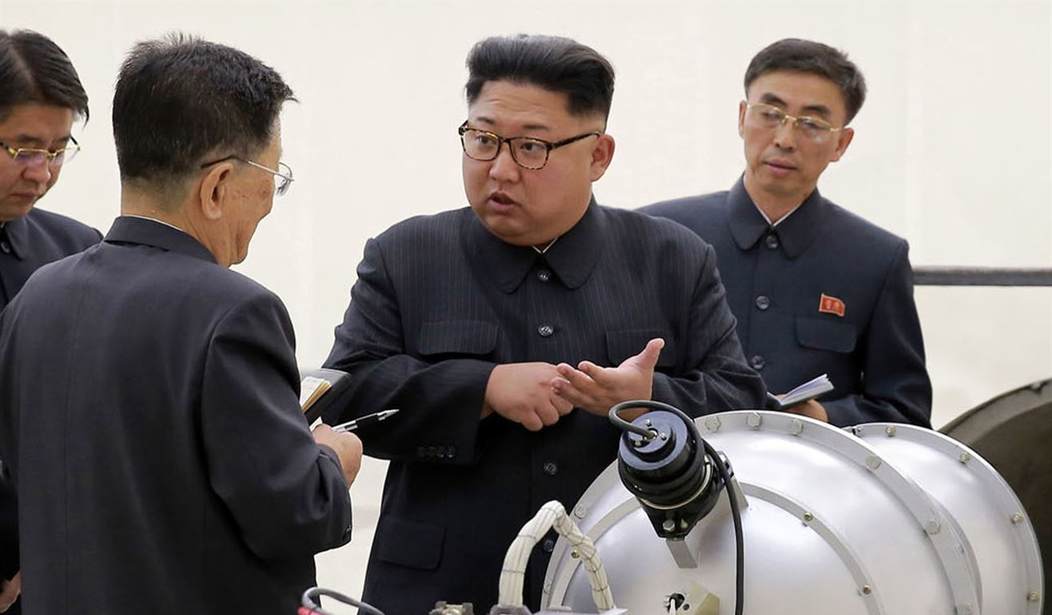
A major goal of this Asia trip, said National Security Adviser H. R. McMaster, is to rally allies to achieve the "complete, verifiable and permanent denuclearization of the Korean peninsula."
Yet Kim Jong Un has said he will never give up his nuclear weapons. He believes the survival of his dynastic regime depends upon them.
Hence we are headed for confrontation. Either the U.S. or North Korea backs down, as Nikita Khrushchev did in the Cuban missile crisis, or there will be war.
In this new century, U.S. leaders continue to draw red lines that threaten acts of war that the nation is unprepared to back up.
Recall President Obama's, "Assad must go!" and the warning that any use of chemical weapons would cross his personal "red line."
Result: After chemical weapons were used, Americans rose in united opposition to a retaliatory strike. Congress refused to authorize any attack. Obama and John Kerry were left with egg all over their faces. And the credibility of the country was commensurately damaged.
There was a time when U.S. words were taken seriously, and we heeded Theodore Roosevelt's dictum: "Speak softly, and carry a big stick."
After Saddam Hussein invaded Kuwait in August 1991, George H.W. Bush said simply: "This will not stand." The world understood that if Saddam did not withdraw from Kuwait, his army would be thrown out. As it was.
But in the post-Cold War era, the rhetoric of U.S. statesmen has grown ever more blustery, even as U.S. relative power has declined. Our goal is "ending tyranny in our world," bellowed George W. Bush in his second inaugural.
Consider Rex Tillerson's recent trip. In Saudi Arabia, he declared, "Iranian militias that are in Iraq, now that the fight against ... ISIS is coming to a close ... need to go home. Any foreign fighters in Iraq need to go home."
The next day, Prime Minister Haider al-Abadi responded:
"We wonder about the statements attributed to the American secretary of state about the popular mobilization forces. ... No side has the right to intervene in Iraq's affairs or decide what Iraqis do."
This slap across the face comes from a regime that rules as a result of 4,500 U.S. dead, tens of thousands wounded and $1 trillion invested in the nation's rebuilding after 15 years of war.
Earlier that day, Tillerson made a two-hour visit to Afghanistan. There he met Afghan officials in a heavily guarded bunker near Bagram Airfield. Wrote The New York Times' Gardiner Harris:
"That top American officials must use stealth to enter these countries after more than 15 years of wars, thousands of lives lost and trillions of dollars spent was testimony to the stubborn problems still confronting the United States in both places."
Such are the fruits of our longest wars, launched with the neo-Churchillian rhetoric of George W. Bush.
In India, Tillerson called on the government to close its embassy in North Korea. New Delhi demurred, suggesting the facility might prove useful to the Americans in negotiating with Pyongyang.
In Geneva, Tillerson asserted, "The United States wants a whole and unified Syria with no role for Bashar al-Assad ... The reign of the Assad family is coming to an end."
Well, perhaps? But our "rebels" in Syria were routed and Assad not only survived his six-year civil war but with the aid of his Russian, Iranian, Shiite militia, and Hezbollah allies, he won that war, and intends to remain and rule, whether we approve or not.
We no longer speak to the world with the assured authority with which America did from Eisenhower to Reagan and Bush 1. Our moment, if ever it existed, as the "unipolar power" the "indispensable nation" that would exercise a "benevolent global hegemony" upon mankind is over.
America needs today a recognition of the new realities we face and a rhetoric that conforms to those realities.
Since Y2K our world has changed.
Putin's Russia has reasserted itself, rebuilt its strategic forces, confronted NATO, annexed Crimea and acted decisively in Syria, re-establishing itself as a power in the Middle East.
China, thanks to its vast trade surpluses at our expense, has grown into an economic and geostrategic rival on a scale that not even the USSR of the Cold War reached.
North Korea is now a nuclear power.
The Europeans are bedeviled by tribalism, secessionism and waves of seemingly unassimilable immigrants from the South and Middle East.
A once-vital NATO ally, Turkey, is virtually lost to the West. Our major Asian allies are dependent on exports to a China that has established a new order in the South China Sea.
In part because of our interventions, the Middle East is in turmoil, bedeviled by terrorism and breaking down along Sunni-Shiite lines.
The U.S. pre-eminence in the days of Desert Storm is history.
Yet, the architects of American decline may still be heard denouncing the "isolationists" who opposed their follies and warned what would befall the republic if it listened to them.

Join the Conversation
VIP members get the ability to comment on articles.