





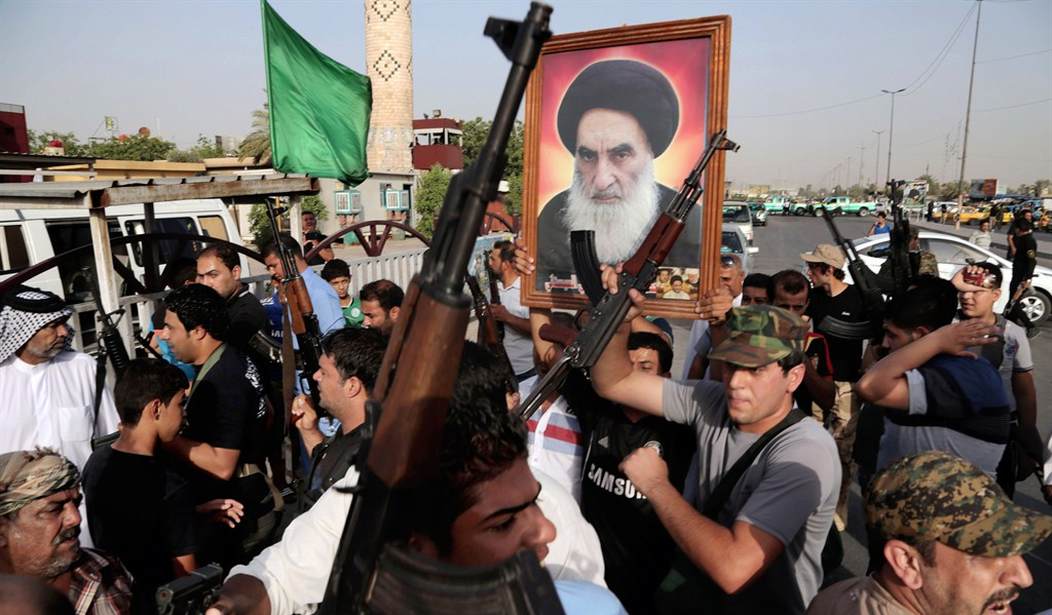
The panic that engulfed this capital after the fall of Mosul, when it appeared that the Islamist fanatics of ISIS would overrun Baghdad, has passed.
And the second thoughts have begun.
"U.S. Sees Risk in Iraqi Airstrikes," ran the June 19 headline in the Washington Post, "Military Warns of Dangerous Complications."
This is welcome news. For if it is an unwritten rule of republics not to commit to war unless the nation is united, America has never been less prepared for a Mideast war.
Our commander in chief is a reluctant warrior who wants his legacy to be ending our two longest wars. And just as Obama does not want to go back into Iraq, neither does the U.S. military.
The American people want no new war, and Congress does not want to be forced to vote on such a war.
Our foreign policy elites are split half a dozen ways -- on whether to bomb or not to bomb, on who our real enemies are in Syria and Iraq, on whose support we should and should not accept, on what our strategic goals are, and what are the prospects for success.
Consider the bombing option.
Undoubtedly, U.S. air power could blunt an attack on Baghdad. But air power cannot retake Mosul or the Sunni Triangle that Baghdad has lost, or Kirkuk or Kurdistan. That will take boots on the ground and casualties.
And nobody thinks these should be American boots or American casualties. And why should we fight to hold Iraq together? Is that a vital interest to which we should commit American lives in perpetuity?
When did it become so?
No. Bombing cannot put Iraq together again, but it may tear Iraq further apart.
The Islamic State of Iraq and Syria has succeeded in northern Iraq because it has allied with the same militias, Baathists and tribal leaders who worked with Gen. David Petraeus in the Anbar Awakening.
And if we use air power in Sunni provinces that have seceded from Baghdad, we will be killing people who were our partners and are not our enemies. Photos of dead Sunnis, from U.S. air, drone, and missile strikes, could inflame the Sunni world.
Upon one thing Americans do agree: ISIS and al-Qaida are our enemies. But are bombing ISIS and killing Sunnis the way to destroy ISIS? Or does bombing martyrize and heroize ISIS for the Sunni young?
And if destroying ISIS is a strategic imperative, why have we not demanded that the Gulf states and Saudi Arabia cease funneling arms and aid to ISIS in Syria? Why have we not told the Turks to stop permitting jihadists to cross their border into Syria?
Why are we aiding and arming the Free Syrian Army to bring down Bashar Assad, when Assad's army is the only fighting force standing between ISIS and the conquest of Syria?
If ISIS is our mortal enemy, why have we not persuaded the Turks to seal their border and send their NATO-equipped army into Syria to annihilate ISIS?
Turkey's Kemal Ataturk ended the old caliphate and put the caliph on the Orient Express to Europe. Prime Minister Recep Tayyip Erdogan could be the man who strangled the new caliphate in its crib.
U.S. policy in Syria and Iraq today add up to incoherence.
Iran is consistent. She wants to see the Shia regimes survive in Damascus and Syria, and has put blood and treasure on the line.
The Saudis and Gulf Arabs are consistent, while playing a dangerous game. Seeing the Shia regimes in Damascus and Baghdad as alien and hostile, they are helping extremists to overthrow them.
Only the Americans seem conflicted and confused.
In Iraq we are on the side of the Shia regime fighting ISIS. In Syria we are de facto allies of ISIS fighting to overthrow the Shia regime.
"Take away this pudding," said Churchill, "it has no theme."
Washington believes that the fall of Baghdad would be a strategic defeat and disaster. Have we considered what the fall of Damascus would mean? Who rises if Bashar Assad falls?
Who goes to the wall if the al-Nusra Front and ISIS prevail in Syria? Would Americans be welcome in that new Syria?
If we help bring down Assad's regime and a radical Sunni regime takes its place, like the terrorist-welcoming Taliban of yesterday, would we then have to go in on the ground to oust it?
This is not an academic question. The use of U.S. air power in Iraq could cause ISIS to turn back to its primary target -- Damascus.
And there are reports that part of that stockpile of U.S. arms and munitions ISIS captured in Mosul is already being moved across the border into Syria for a fight to the finish there, rather than in Iraq.
This new civil-sectarian-secessionist war in Syria and Iraq looks to last for years. How have we suffered by staying out of it?

Join the Conversation
VIP members get the ability to comment on articles.