







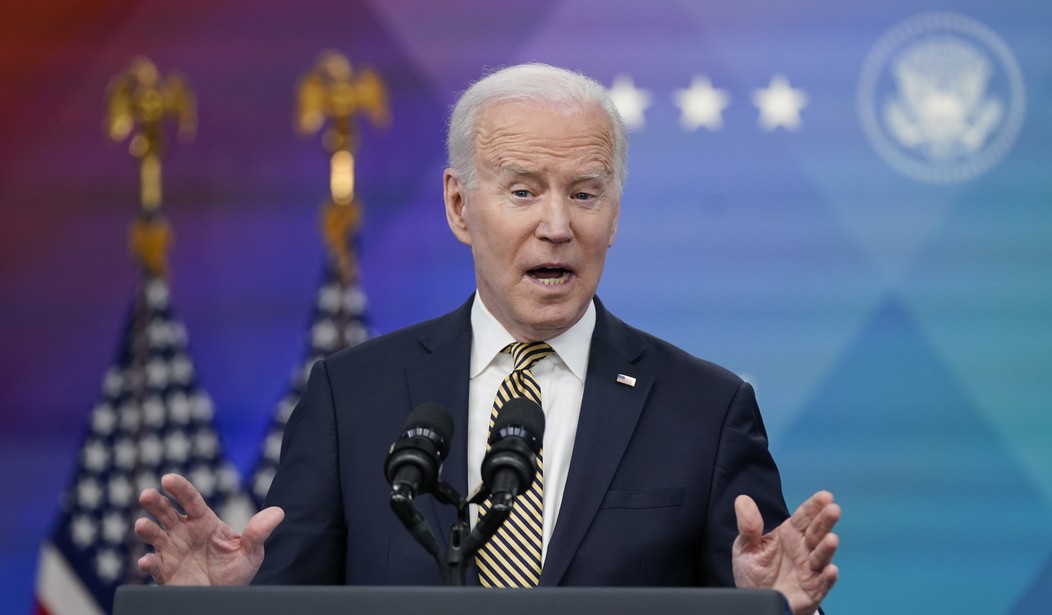
"The language people speak in the corridors of power is not economics or politics. It is history." So says former Secretary of Defense Ashton Carter, quoted in a column on Ukraine by historian Niall Ferguson.
Thus Democratic insiders and sympathetic journalists liked to describe President Joe Biden as another Franklin Roosevelt, even though Biden in 2021 didn't face an economic collapse or have overwhelming partisan majorities as Roosevelt did in 1933.
But few politicians warrant comparison with the few universally recognized great presidents. The relevant comparison may be to what I call the partisan hack presidents.
Understand, please, that "partisan hack" is not meant as an insult. Any democratic political system needs a certain number of dependable and dogged party loyalists. Sometimes one will rise to the top job and compile a more creditable record than most people predicted.
The problem is that, historically, partisan hack presidents' policy successes have ended up hurting hurt their party. My examples are four partisan hack presidents -- two who succeeded to the office from the vice presidency and two who were "dark horse" candidates chosen after the ninth and 10th ballots at party national conventions.
My first partisan hack president was James K. Polk, a 20-year veteran Jacksonian Democrat elected in 1844. He successfully accomplished all four of his partisan policy goals: a lowered tariff, an independent treasury, peaceful acquisition of the Oregon Territory, and acquisition of California and the Southwest after victory in the Mexican War.
But that last success raised the issue of slavery in the territories, which split the Democratic Party and produced the election of Abraham Lincoln in 1860. That led to the Civil War and to Republicans holding the White House for 44 of the next 52 years.
Next on the list is Chester A. Arthur, collector of the Port of New York (a lucrative patronage job) before becoming James A. Garfield's vice president. Like other Stalwart Republicans, Arthur was from a modest background and strongly supported equal rights for black people -- a stand well-born Republicans such as Henry Adams and Republican-appointed Supreme Court justices sniffed at.
Becoming president after Garfield was assassinated by a frustrated office-seeker, Arthur sponsored civil service reform, dislodging patronage politics from much of the federal government and relegating it to the usually Democratic big cities. That eroded the institutional base for equal rights policies and ensured Republican acquiescence in Southern Democrats' imposition of racial segregation.
The often-disparaged Warren G. Harding, a solidly Republican newspaper editor and Ohio politician who stuck with William Howard Taft when Theodore Roosevelt ran against him, was nominated in the legendary smoke-filled room and elected by a 60% to 34% landslide in 1920. As president, he hired a first-rate Cabinet (comparing favorably to Woodrow Wilson's or Franklin Roosevelt's), lowered taxes, created the Bureau of the Budget, pushed through the Washington Naval Treaty, spoke out in Alabama for civil rights and restored civil liberties after Wilson's prosecutions of wartime protesters.
Popular journalists of the day and New Deal historians blamed him retrospectively for the Depression of the 1930s, though he was actually responsible for the prosperity of the 1920s. They played up the routine Teapot Dome scandal and his personal life, which was far less lurid than, say, John Kennedy's.
After 25 years in Congress, Gerald Ford was looking to retire as House minority leader when he became vice president after the resignation of Spiro Agnew in 1973 and president after the resignation of Richard Nixon in 1974. A supporter of balanced budgets, civil rights legislation and bipartisan foreign policy, he backed Henry Kissinger's opening to China and detente with Russia. His pardon of Nixon hurt him in polls, but he came close to winning a full term in 1976.
But he didn't set the future course for his party, which won fewer House seats in 1974 and 1976 than it has won ever since. Ronald Reagan embraced the Kemp-Roth tax cut and resulting deficits, increased the defense budget and worked successfully to end the Soviet "evil empire."
Biden, like Polk, Arthur, Harding and Ford, is an intelligent man and a strong partisan with beliefs not contemptible in his times. He's been in office far longer: 44 years as a Democratic senator and vice president. He sounded like a centrist when Delaware was a swing state and, like his party, has moved left since it became safe Democratic in the 1990s. He was a dark horse candidate in 2020 until Rep. James Clyburn's endorsement gave him a decisive victory in South Carolina's majority-black primary.
As president, he has faithfully embraced party priorities, with some policy successes. But his job approval slipped under 50% after the chaotic Afghanistan withdrawal, and with inflation, illegal immigration and violent crime raging out of control, it has sagged to 41%.
Biden's response to Ukraine, or some other emerging issue, may raise his standing and even enable him to win reelection as he approaches age 82. But at the moment, he risks doing damage to his party as his four party hack predecessors did to theirs.
Join the Conversation
VIP members get the ability to comment on articles.