







Since taking office, President Trump has announced on two occasions that Iran is in compliance with its 2015 nuclear agreement terms. These assessments seemingly conflict with his campaign-trail fervor over the “worst deal ever negotiated,” but his foreign policy team has reportedly pressed that maintaining the status quo better suits our allies. Regardless, following the most recent certification in July, the White House announced plans for a comprehensive review of Iran policy. Now, this review nears completion with miraculously impactful timing.
By October, the Trump administration is expected to announce its new stance – a less forgiving policy that allows for proportional responses to provocative gestures, like the Revolutionary Guard's ballistic missile tests. As the October congressional deadline approaches, the administration has seemingly set the stage for Iran’s decertification as far as the nuclear agreement is concerned. Further, the Trump administration is evidently prepared to counteract not just the Islamic Republic’s nuclear violations, but many others.
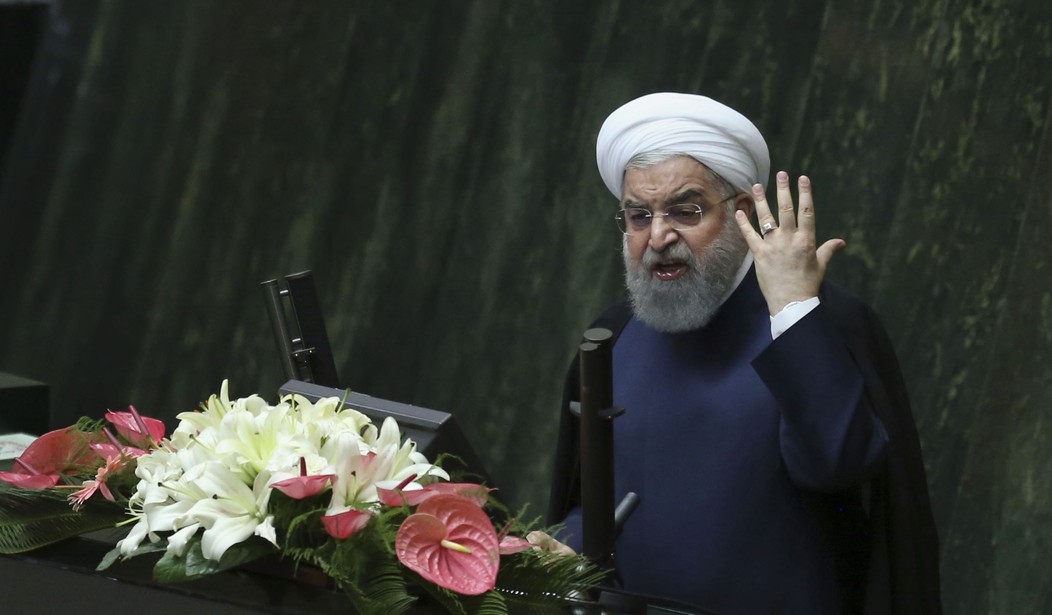
The White House will issue this news not long after Iranian President Hassan Rouhani’s September 20th UNGA speech. Not breaking with previous visits, Rouhani’s international peers have responded to his participation at this year’s assembly with undue enthusiasm and unwarranted support. And so it goes, as this speech marks the fifth consecutive UNGA speech where Rouhani will undoubtedly undermine his “moderate” image by either responding with silence, or outright support, for his Republic’s shamelessly frequent violations and atrocities.
Just like his presidential predecessors, under Rouhani, there is virtually no limit to the types of decisions “delegated” to the judiciary. Even decisions within his immediate purview, like cabinet appointments, Rouhani cannot make independently, without first consulting with the Supreme Leader Ali Khamenei. It is no surprise the outrage that ensued when Rouhani proceeded to appoint only men to his cabinet, and “upgraded” Justice Minister Mostafa Pourmohammadi, with an identically bloody and corrupt record, Alireza Avayi.
Mostafa Pourmohammadi, head of the Justice Ministry throughout Rouhani’s first term, became the subject of serious domestic and international pressure in 2017, due to publicity around his prominent role in the 1988 massacre of nearly 30,000 political prisoners.
Last year, a 1988 audio recording was leaked featuring Hossein Ali Montazeri, the then heir-apparent to Khomeini’s leadership. He broke from the regime following his opposition to the massacre, and in the recording, Montazeri predicts that history will condemn Pourmohammadi and other officials responsible for the massacre. This has proven true in many ways, but it is also true that neither Pourmohammadi nor his accomplices are standing trial for those murders.
In response to the outrage that followed the leak, Pourmohammadi proclaimed he was proud of his role in the massacre, fulfilling “God’s command” for the People’s Mojahedin Organization of Iran (PMOI), the leading pro-democracy opposition group that the majority of victims belonged to. While this bolstered Pourmohammadi’s infamy, Rouhani responded by merely reassigning him to a different power position. He rebuffed critics by appointing Avayi Justice Minister, who had served on his own death committee in 1988, in Khuzestan.
Rouhani certainly won’t address any of this, though, when he speaks at the UNGA. Neither will he call any attention to the 3,000+ executions Iran has seen since he was elected President, not to mention the innumerable public hangings, amputations, and execution of minors at the time of alleged offenses.
These are some of the urgently critical reasons why new U.S. policies should also focus attention on the human rights crises that have been erupting since the birth of the Islamic Republic. As such, it is a mystery why our government doesn’t use the General Assembly as an opportunity to directly challenge Rouhani and the Iranian regime over these crimes, or, in the very least, condemn the presence of Iranian officials among the ranks of legitimate American allies.
Regardless, on September 20, when Rouhani arrives in New York, thousands of expatriates and activists will be vocalizing this “direct challenge.” Mass protests have been organized to coincide with Rouhani’s visit, including reenactments of 1988 massacres, which will be performed at the UN’s European headquarters in Geneva.
If the White House is listening, the international reach of these protests should be loud and clear. Activists urge the US to follow suit and help shape international understanding of Iran’s abysmal human rights record – a strategy absent during the Obama administration, yes, but that does not dismiss the fact that Trump’s foreign policy approach to Iran is equally ambiguous and absent, thus far. The world anxiously yet patiently waits for the Administration to make their move. Until then, we continue to hope.
Sadeghpour is the political director of the Organization of Iranian American communities (OIAC)
The UN General Assembly: Will New American Policy Finally Challenge Iran?
Opinion
The opinions expressed by columnists are their own and do not necessarily represent the views of Townhall.com.
Advertisement
Advertisement
Join the Conversation
VIP members get the ability to comment on articles.