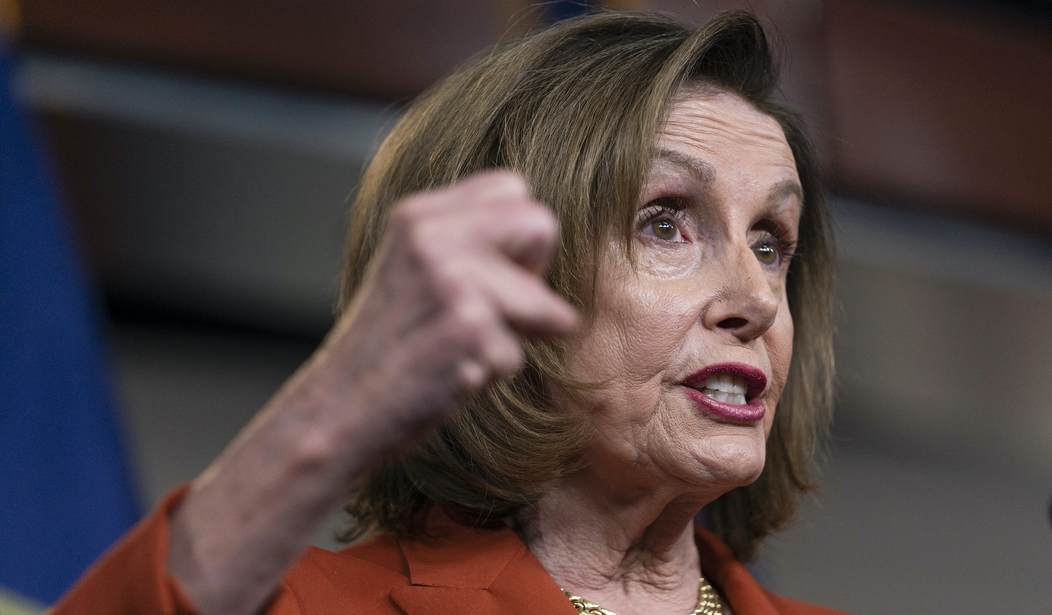

In the weeks since San Francisco Archbishop Salvatore Cordileone announced that Speaker Nancy Pelosi should no longer present herself for communion lest she be denied by priests under his jurisdiction, the ignorant response from the media and political activists has been maddening for those of us with merely a basic knowledge of Catholic doctrine, practices, and history.
The most inane response has been the "you shouldn't politicize the Eucharist" argument.
First off, it's Pelosi, President Joe Biden, and other apostate Catholics who are politicizing the Eucharist by proclaiming they are devout and observant Catholics while simultaneously flouting one of the most important moral teachings of our Church.
The politicization of the Eucharist begins when a politician uses their membership in the Church to gain support, votes, and donations while actively opposing the very heart of what the Church stands for in the first place.
Furthermore, it is incumbent on Pelosi and Biden to not present themselves for Communion if they are in a state of mortal sin which they surely are by advocating and supporting the sinful act of abortion. And by denying that their sin is a sin, they are compounding their problems with the Church by presenting false doctrine and misrepresenting the Church's teachings for their own political purposes.
Cordileone's actions are hardly unprecedented in the long history of the Church. Just ask Henry VIII about politicizing the Eucharist. He plowed through several wives in his sign of defiance to the Vatican.
And here in America, we've had other bishops who have taken courageous stands for the Church and her doctrine against misguided individuals.
In the 1950s, the landmark Brown v. Board of Education decision banning racial segregation in America's public schools had a watershed effect on the nation's Catholic schools as well. In New Orleans, Archbishop Joseph Rummel announced that his Archdiocese would follow suit and desegregate in the pews and in the parochial schools.
His letter of 1953 entitled "Blessed are the Peacemakers" laid out his policy in the most pastoral terms:
Ever mindful, therefore, of the basic truth that our Colored Catholic brethren share with us the same spiritual life and destiny, the same membership in the Mystical Body of Christ, the same dependence upon the Word of God, the participation in the Sacraments, especially the Most Holy Eucharist, the same need of moral and social encouragement, let there be no further discrimination or segregation in the pews, at the Communion rail, at the confessional and in parish meetings, just as there will be no segregation in the kingdom of heaven.
That letter began a nearly ten-year struggle with parishioners who insisted on maintaining racial segregation in New Orleans.
As John Smestad Jr. writes at Loyola University of New Orleans:
The reaction from prominent segregationist Catholics was predictable. With outrage at the archbishop's forthrightness with his plans, some in the Louisiana Legislature introduced more bills seeking to maintain segregation in the parochial school system. A writer in Catholic World stated that "It is to be hoped that these Catholics of Louisiana will wake up to the gravity of what they are planning to do. They are cooperating with a plan... whereby the State can interfere in the Church's mission of education" (Sheerin 4). In response to accusations of abuse of power "State Representative E.W. Gravolet, Jr., one of the Roman Catholic backers of the proposed segregation bill, promptly announced that 'we intend to go ahead with it, certainly'" ("Archbishop's Way" 80). Rummel in turn threatened to take drastic action: excommunication.
By 1962, the segregationists still continued to defy their Bishop, even after a plea to Rome. Pope Pius XII responded to the petitioners by proclaiming racism a "major evil" and he supported his Archbishop.
Smestad continues...
With growing opposition, Rummel and Archbishop-Coadjutor John P. Cody sent out letters to the most vocal opponents warning them of excommunication, Most of those who received warnings ceased their activities. However, Leander Perez, Jackson G. Ricau, secretary of Citizens Council of South Louisiana, and Mrs. B.J. Gaillot, Jr., president of Save Our Nation, Inc., became even more vocal in their opposition to Archbishop Rummel. On April 16, 1962, Rummel excommunicated all three for continuing "to hinder his orders or provoke the devoted people of this venerable archdiocese to disobedience or rebellion in the matter of opening our schools to all Catholic children" ("Church" 1). They were barred from the Mass and sacraments as well as Catholic burial.
Rummel went far beyond merely withholding the Eucharist, he excommunicated the segregationists (all Democrats, by the way.)
Today, there are schools named after Archbishop Rummel, signifying his courage, steadfastness, and righteous position. He was "on the right side of history" by standing up against corrupt politicians and standing for what was right in the face of outrage in his community.
He also had the solid backing of the Bishop of Rome.
What about Archbishop Cordileone? Will history judge him fairly? Will we have schools named after him in the future?
Forget about the future... what about today? Will Cordileone at the very least get the kind of support from Pope Francis that Rummel got from Pius XII? So far, Rome has been shamefully silent.