





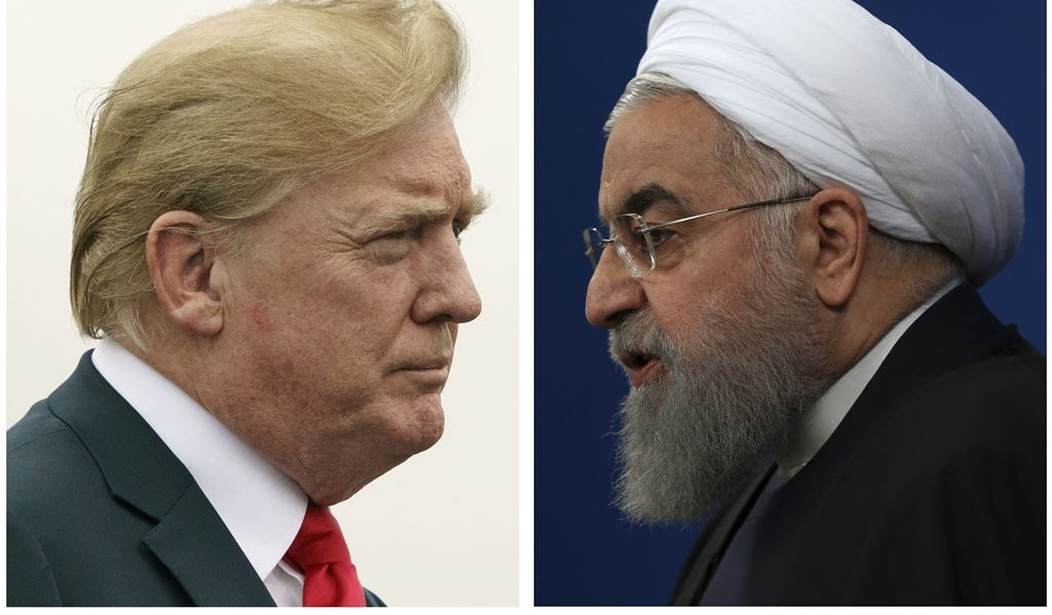
The Iranian regime has become more brazen in its foreign policy. The Islamic Revolutionary Guard Corps (IRGC) recently attacked commercial vessels in the Gulf, and seized others, including a British tanker. It also launched missiles against Saudi oil infrastructure in September. This is in addition to its aggressive policies in Syria, Iraq, and Yemen.
The regime's recent actions cannot simply be interpreted as a response to rising levels of pressure from the US. Its abuses both at home and abroad have been getting worse for quite some time. And they have done so not because of newfound foreign pressure but because of the predictable absence thereof.
In July, Maryam Rajavi, the head of the National Council of Resistance of Iran (NCRI), said: “Granting impunity to the regime’s leaders and turning a blind eye to their crimes are the very reason they have become emboldened in exporting terrorism and in warmongering.”
In 1988, the regime's former supreme leader issued a fatwa declaring opponents of the fledging theocracy to be at war with God himself. In the summer of that year, “death commissions” were established throughout the country for the purpose of interrogating political prisoners over their political beliefs.
Those who refused to disavow the main Iranian opposition, the Mujahedin-e Khalq (MEK), were summarily sentenced to hanging. The “trials” sometimes lasted as little as a minute, and the victims were executed in groups before their bodies were transported to secret mass graves. The death commissions were merciless, passing capital sentences on young teenagers and even pregnant women. After just a few months, 30,000 people had been put to death.
At an international conference in July, an extensive exhibition detailed not only the context and scope of the killings themselves, but also the shameful silence exhibited by the international community. Mrs. Rajavi’s speech at the event pointed to some of the efforts that the NCRI had made to bring attention to what was happening and to urge a response from Western governments. “However,” she explained, “they maintained their silence because they had just initiated their policy of appeasement.”
America is known to be the foremost defender of human rights around the world and has taken on the scourge of terrorism head-on. Human rights abuses and terrorism are the two pillars of the clerical regime’s strategy for survival.
The 1988 massacre tested the limits of what Tehran could do without facing serious consequences on the international stage. And today, the regime is applying that lesson to its shameless support of war crimes in Syria, to its belligerent confrontations with regional and Western adversaries, and to public rhetoric that seems to be setting the stage for war. Washington cannot remain silent.
As long as Tehran is not held directly accountable for more than 30,000 deaths, the regime will be emboldened to carry out more violations with impunity. Why would Tehran see any reason to scale back its malign activities, unless the U.S. leads the way by making it clear that its standards for regime behavior have changed?
The only way to do this is by revisiting the regime’s past and demanding accountability. No single aspect of that past has been more overlooked than the 1988 massacre. Human rights groups like Amnesty International have described the killings, in no uncertain terms, as a crime against humanity.
What message can Tehran be expected to take from the resulting silence other than one of American tolerance for the regime’s violent repression and its use of terrorism as a form of statecraft? And how can that regime be expected to moderate its behavior, either in domestic or in foreign policy, without first being informed that malign acts have specific and definite consequences?
The policy of "maximum pressure" is a step in the right direction, but economic sanctions alone are not enough. The regime's criminals must be held accountable on a larger scale. As Mrs. Rajavi has said, “The time has come for referring the dossier of human rights violations in Iran, particularly the executions of the 1980s and the 1988 massacre, to the UN Security Council.”
A proper investigation of the massacre will undoubtedly lead to a conviction in the International Criminal Court for a number of high-ranking Iranian officials, including the current Justice Minister and the current judiciary chief. The U.S. should clearly send a message that Iranian officials are not immune from their wrongdoing. The Iranian people will see that the world supports them as never before and will rise up to demand, once and for all, a new, democratic government. The American administration needs to bring Tehran's human rights violations into focus to force the regime to rethink its aggression.


Join the Conversation
VIP members get the ability to comment on articles.