







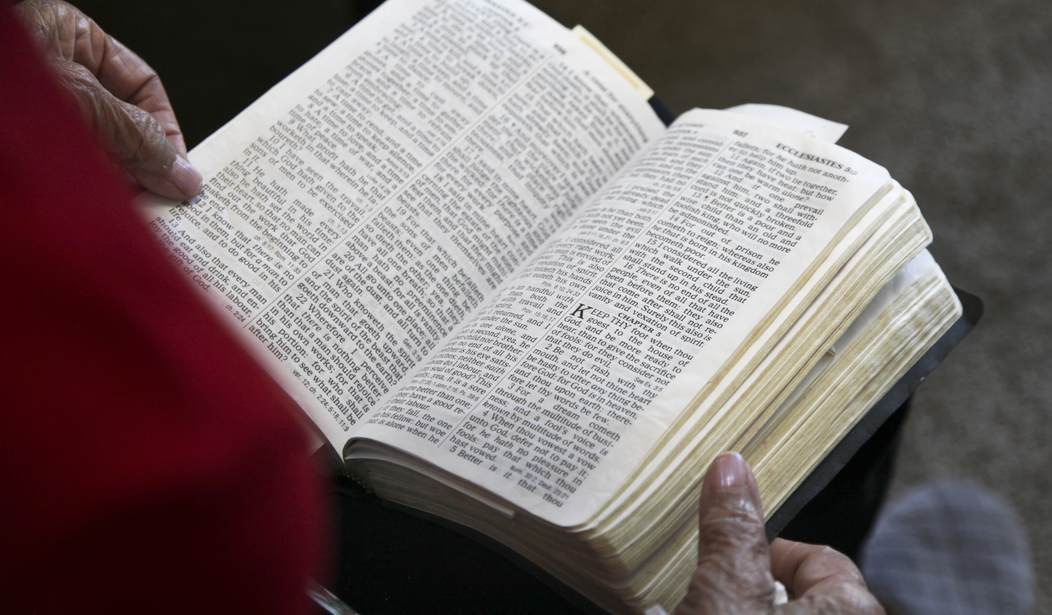
A poet is suggesting that God, in a sense, raped Mary. But to do so takes away her agency – her choice. A radical woman’s voice.
On May 18, award-winning poet Danez Smith cited a poem by Tyree Daye, a teaching assistant professor at UNC-Chapel Hill, that appeared to accuse God of raping Mary, or placing “a baby” in her “without her permission.” Thousands of people reacted to Smith on Twitter – many of whom emphasized the Virgin Mary’s consent to a Baby Jesus in Scripture: “May it be.” But that didn’t satisfy Smith.
The debate started when Smith quoted one of Daye’s poems in a tweet: “I knew God / was a man / because he put / a baby in Mary / without her / permission.”
Featured by media including the New York Times and PBS, Smith is a self-described “Black, Queer, Poz writer & performer” from Minnesota. Smith was raised Baptist – but today considers Christianity the “dominant and most violent religion in this here country.”
Daye “had no business telling the truth this loud,” Smith commented on the poem, “and I think about it often.”
It’s a strong accusation to make – against God, no less – without evidence. Smith didn’t appear to research the background, the culture, the tradition, or the timing.
Here’s what Christians know.
In the Bible, Luke 1:26–38 details the story of the Annunciation, when the Angel Gabriel reveals to Mary that she “will conceive in [her] womb and bear a son” to be named Jesus. The choice of language is telling: the angel says she “will” conceive – not she “has” conceived.
Instead of being a passive listener, the Mother of God questions the angel. “How can this be,” she wants to know, “since I have no relations with a man?”
Gabriel responds with language, again, referring to the future: the “Holy Spirit will come upon you, and the power of the Most High will overshadow you.”
He doesn’t leave until after Mary consents.
“Behold, I am the handmaid of the Lord,” she responds. “May it be done to me according to your word.” Then – and only then – “the angel departed.”
The only other gospel to mention the Annunciation is Mark, which confirms that Mary “was found with child through the holy Spirit.”
The reason Luke is so detailed, many theologians believe, is that he heard from Mary herself.
“The key is in Luke 2:51,” wrote Nicholas Senz, a faith formation director in Texas, for Aleteia in 2018. Luke writes of Mary on a personal level: “His mother treasured all these things in her heart.”
The Bible doesn’t detail everything, and how the three other gospels record or don’t record the Annunciation proves as much. But in Luke, Mary’s consent is, in a word, radical. It should be an action Smith acknowledges – and celebrates.
“So with Mary's words of ‘let it be,’ we have what just might be the first recorded instance of verbal consent in human history,” wrote Karen Swallow Prior, an English professor at Liberty University, for the Atlantic in 2012. “And considering the times—ancient Middle Eastern cultures were not known for their justice toward women—this verbal consent to being the bearer of the Christ child is quite remarkable indeed.”
But Smith had another concern. When one tweeter asked what Smith didn’t understand about Mary’s consent, the poet responded: “The part where she was 13 and he was God.”
Looking at Jewish law and tradition, experts predict that girls entered into engagements between the ages of 12 and 15. Mary could have been an exception – as she was in so many other ways. But the truth is, no one knows how old she was.
Another Twitter user asserted no one can “really” consent to God.
“[B]eing told that this thing is happening to you bc God's got it all set up… and you're a believer, you don't even think of refusing,” the person wrote.
Smith warned, “Don’t say that part to[o] loud. Unquestioning believers can’t compute that God might equal bad or wrong.”
But plenty of people have told God “no.” Besides Mary, there was one other woman who began her life without original sin (a state of deprivation of original holiness and justice that leaves humanity with an inclination toward sin). Eve didn’t hesitate to disobey God – even though God told her it meant death.
Mary, often considered the “new Eve,” was extraordinarily free to give her consent, the Catholic Church teaches.
For “Mary to be able to give the free assent of her faith to the announcement of her vocation, it was necessary that she be wholly borne by God's grace,” the Church catechism reads. As such, she was free from original sin and “of every personal sin.”
The angel Gabriel confirms this when he greets Mary as “full of grace.”
“Espousing the divine will for salvation wholeheartedly, without a single sin to restrain her, she gave herself entirely,” the catechism adds.
Mary herself says more. Following the Annunciation, she visits her cousin, Elizabeth. At Luke 1:45, Elizabeth greets Mary with the words, “blessed is she who believed that there would be a fulfillment of what was spoken to her from the Lord.”
What follows is Mary’s Magnificat prayer, which sounds like “enthusiastic consent” rather than “a woman who believes she’s been violated,” as Beth Stoneburner described for the Friendly Atheist in 2018.
“My soul proclaims the greatness of the Lord, my spirit rejoices in God my Savior for he has looked with favor on his lowly servant,” Mary begins [emphasis added]. “From this day all generations will call me blessed: the Almighty has done great things for me, and holy is his Name.”
Those are not the words of a woman who conceived a baby “without her permission.”
Smith – and Daye – aren’t original or unique. They join a horde of professors, comedy shows, and media that accuse or imply that God is guilty of rape. This position isn’t without consequence: it distorts a faith that millions profess while misinforming those who don’t.
The evidence suggests that Mary chose. It’s a choice that shouldn’t be taken from her.


Join the Conversation
VIP members get the ability to comment on articles.