







Last week's surprise forced resignation of Jeff Sessions as attorney general of the United States set in motion a series of events that will soon resonate in all corners of the Department of Justice.
President Donald Trump has been steamed at Sessions ever since Sessions removed himself from supervision over the DOJ's investigation into whether a conspiracy existed between Russian agents and the Trump campaign in 2016 for the Russians to provide assistance to the campaign -- a felony.
Sessions' recusal was perfectly rational and ethically required; he had been a high-ranking official in the campaign and would probably be interviewed as a witness in the investigation. Because ethics rules prohibit DOJ officials from being witnesses in cases that they supervise, Sessions passed the case to his deputy, Rod Rosenstein, who promptly appointed former FBI Director Robert Mueller as special counsel to head the investigation.
When the special counsel began flexing his prosecutorial muscles a little too close to Trump Tower and the Oval Office for Trump's comfort, Trump's blood pressure rose, and he asked Sessions to sign and deliver an undated letter of resignation, which Sessions did. On Nov. 7, the day after the midterm elections delivered the House of Representatives comfortably to the Democrats, Trump released the still-undated letter, and Sessions was out of a job.
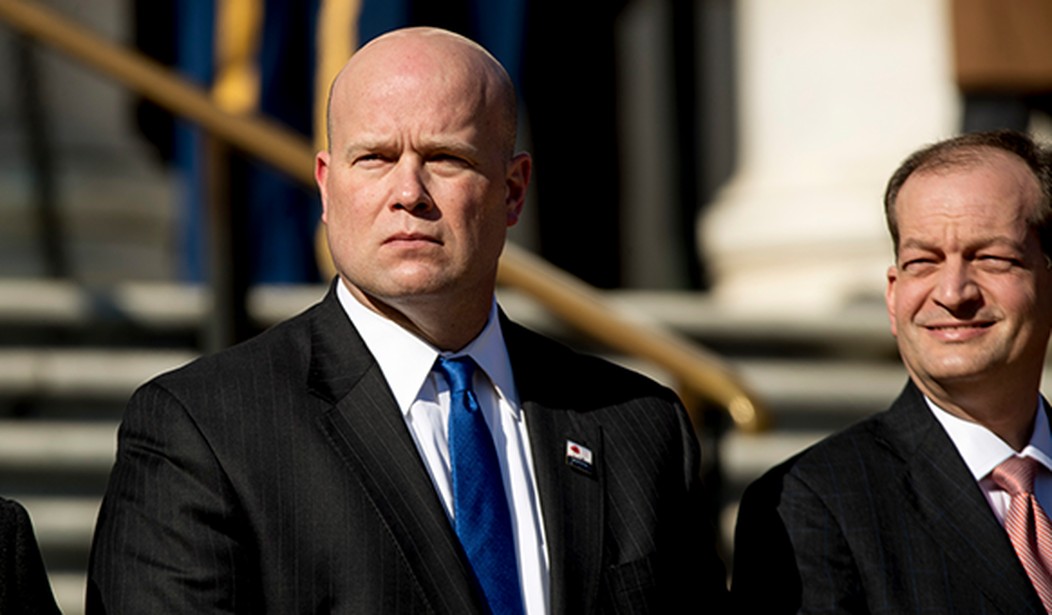
Then Trump began another legal firestorm by naming Sessions' chief of staff, Matthew Whitaker, acting attorney general. He did this even though the federal statutes governing succession in the DOJ state that upon a vacancy in the office of attorney general, the deputy attorney general -- in this case, the same Rod Rosenstein -- shall become the acting attorney general.
In bypassing Rosenstein for Whitaker, Trump has added to the woes he will face when the Democrats take control of the House in early January. That's because of lingering and now public doubts about Whitaker's professional qualifications for office and clear statutory language that makes him legally ineligible to be acting attorney general.
Here is the back story.
Every federal executive department, from Defense to Treasury to Justice, has a principal officer -- usually called the secretary but called the attorney general for Justice -- and a deputy. Neither position can be occupied without a presidential appointment and a Senate confirmation.
The main purpose of the deputy is to be ready to fill in for the principal when that office becomes vacant. Congress created the office of deputy attorney general for the express purpose of having a presidentially appointed and Senate-confirmed person in the wings should the attorney general's office fall vacant. On Nov. 7, the office fell vacant.
Should the president wish to bypass the deputy attorney general, he may do so, but he may only designate a person who already occupies a DOJ position that is presidentially appointed and Senate-confirmed. Whitaker, Sessions' former chief of staff, was not in a presidentially appointed or Senate-confirmed job at the time Trump named him acting attorney general.
Whoever runs the DOJ has such vast power over its 90,000 employees, including the FBI -- not to mention that he or she is seventh in the presidential line of succession and has the unchecked power to commence criminal investigations, seek and obtain indictments, and terminate criminal investigations already begun -- that Congress passed statutes to ensure that no one could hold that job who has not been scrutinized by the rigors of Senate confirmation.
In Whitaker's case, that scrutiny -- if it were to happen -- would show a person whose legal thinking is so far outside the mainstream as to create material doubt about his professional qualifications. He recently offered public comments questioning the equality of the three branches of the federal government and challenging the constitutional power of the courts to engage in judicial review.
By saying the courts "are supposed to be the inferior branch" of the government, he has denied a fundamental principle of the Constitution -- a truism, if you will -- namely, that all three branches (Congress, the president and the judiciary) are coequal. And by questioning the power of the courts to review and void the unconstitutional behavior of Congress, the president and state and local governments, Whitaker has revealed an attraction to legal thinking that is profoundly at odds with 215 years of consistent American jurisprudence.
This is why you should care about who runs the Department of Justice. This is why the Constitution and federal law require that whoever is picked to run the DOJ be confirmed by the Senate. Because the Senate confirmation process is so rigorous, it exposes legal thinking on the part of the nominee, and if that thinking is at odds with basic American legal principles, the process gives senators the opportunity to challenge it.
Without the constitutionally and statutorily required Senate confirmation, a president could put any political hack he likes in charge of the DOJ and the FBI -- and thus all federal prosecutions and criminal investigations -- wreaking havoc on the rule of law.
Add to this, Whitaker will supervise the special counsel, whose current job is to investigate the president for potential criminal wrongdoing or impeachable offenses. It is contrary to the rule of law that the subject of a criminal investigation -- which Donald Trump currently is -- could select his own prosecutor.
The whole purpose of the rules and procedures of the special counsel is to keep that office insulated from the political process, immune from the political power of the people the office is investigating, and substantially within the professional judgment of politically independent prosecutors at the DOJ.
Litigation has been filed to remove Whitaker from the office he claims to hold. The courts have not done this before. The president should save them from this unpleasant but necessary task. Once Whitaker is removed, all of his official work will be void. Try putting that toothpaste back into its tube.

Join the Conversation
VIP members get the ability to comment on articles.