







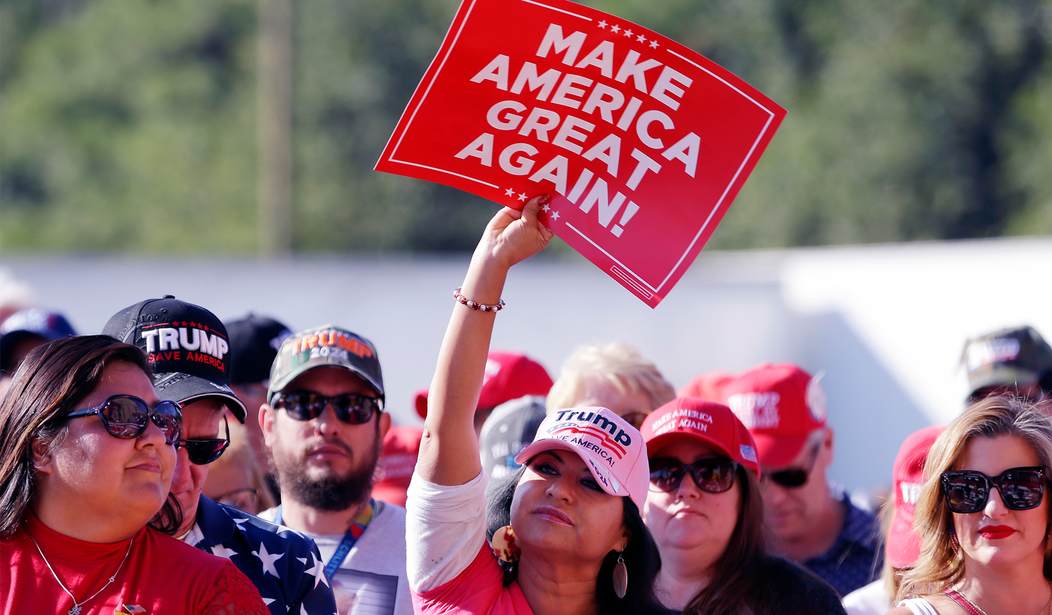
In a previous post, I argued that the reason why our society is so polarized is not because we are deeply divided over any particular set of public policies. Instead, we have evolved into tribes whose dislike for each other has grown over time.
Under tribalism, public debates quickly devolve into attacks on the personality of people in the other tribe, instead of facilitating rational discussion about an issue.
Yet, although issues are not what divides us, what does divide us can spill over and affect how we think about issues.
A recent Fox News poll found that the idea of not taxing tips is quite popular – with twice as many people favoring as opposing the idea. But once people were told that the proposal was made by Donald Trump, support for it among Democratic voters dropped 40 points.
That’s a remarkable outcome. If it holds for other issues, that implies that who proposes an idea is far more important than the idea itself.
Take the field of health policy.
In the last two decades, there have been two very significant changes in our health care system. More than 32 million Medicare beneficiaries are now enrolled in private health insurance plans as part of Medicare Advantage. And more than 21 million people who have obtained their own insurance are enrolled in private plans through the (Obamacare) marketplace exchanges.
On paper, these two programs look very similar. Each has an annual enrollment period; enrollees choose among competing private plans; there are significant government subsidies for the buyers; and there can be no discrimination based on health condition.
Importantly, these two programs look the same because their intellectual roots are the same.
However, the Medicare Advantage program – although originally a bipartisan reform – evolved to be thought of as a Republican program. In fact, Barack Obama campaigned against it in his 2008 bid for the presidency. Conversely, Obamacare is clearly thought of as a Democratic program, and Republicans have been bashing it ever since.
Now, as a practical matter, Medicare Advantage works much better than the Obamacare exchanges. That’s because Medicare Advantage was designed and significantly improved over time with a great deal of care. Obamacare, by contrast, was rushed through Congress at the last minute, after making unfortunate concessions to a lot of special interests.
Had the Democrats been smarter, in designing Obamacare they would have simply copied the blueprint established by Medicare Advantage. Even today, the most sensible way to improve Obamacare is to make it look a lot more like Medicare Advantage. And since MA plans have lower costs and higher quality than traditional Medicare, the best way to reform the latter is to make it look more like the former. Yet outside of a small group of economists I work with, these ideas are rarely discussed.
The field of health policy is heavily dominated by people whose political views are left-of-center. That includes academics, policy analysts, government employees, newspaper reporters and journal editors.
That may explain why – especially during the Biden presidency – there has been a slew of government agency reports and academic journal articles critical of MA plans – but none that are critical of traditional Medicare or Obamacare – which have far worse problems.
A Google search shows the same pattern among newspaper stories. About the only articles you will find on Obamacare describe its success in insuring more people. There are virtually no stories about Obamacare’s high deductibles, narrow networks and huge out-of-pocket exposure for people with large medical bills.
In other words, the vast bulk of people who are writing and evaluating health care programs reveal a bias based on which party designed the program, not on how well it works relative to other programs.
Health Savings Accounts (HSAs) are usually thought of as a Republican idea, and by law plans that offer HSAs they must include a high deductible. Through the years, the left has been generally critical of HSAs in general and high deductibles in particular. However, the highest deductibles in the entire health care system right now are found in the Obamacare exchanges. The average for an individual is currently $5,101, and that is without any HSA. By contrast, the average in employer plans last year was $1,735.
For the last decade, you would be hard-pressed to find a news article describing how folks with Obamacare coverage are having trouble affording health care. You do see an occasional poll asking people whether they have failed to fill a prescription or see a doctor because of cost, and the numbers are quite high. But this problem is almost never connected to Obamacare.
The biggest problem with tribalism is this: It is in the self-interest of politicians to come up with new solutions to persistent problems; but once an idea is proposed, the knee-jerk reaction is for everyone in the other party to dismiss it– no matter how good the idea is.
As long as that is the state of affairs, our most serious public policy problems will never be solved.

Join the Conversation
VIP members get the ability to comment on articles.