





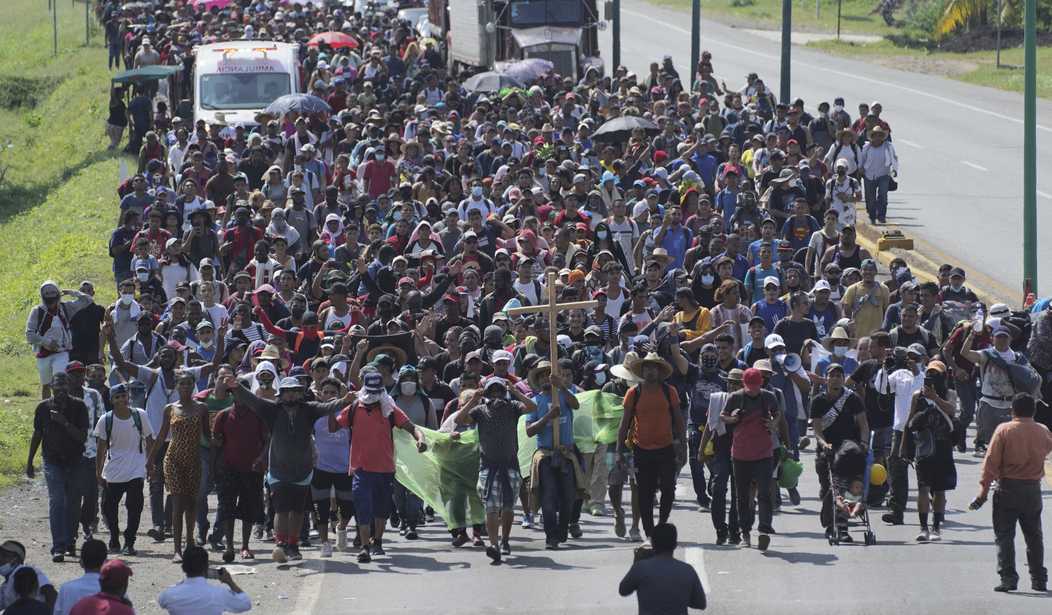
We are constantly told that immigration policy is about compassion.
Protect the vulnerable. Help people fleeing poverty, violence and instability. Give people a chance at a better life.
Those are worthy goals.
But there is a question that too often gets left out:
What happens when policies designed to protect some people create new dangers for others?
I know what that question looks like because I buried my daughter.
Katie was 20 years old when she was violently killed on the streets of sanctuary Urbana, Illinois, while visiting friends at the University of Illinois.
Katie was vulnerable too.
Her life mattered too.
And that is where this conversation becomes much bigger than immigration policy. It becomes a question about what government owes the people it serves and what happens when an ideology becomes so focused on protecting one group that it loses sight of the human beings who may bear the cost.
Maybe these are blind spots. Maybe they are something worse. But when the harm is known and innocent people continue to bear it, the distinction matters less than the failure itself.
Compassion cannot be selective.
If vulnerability matters when the person in need is an immigrant or foreign national, it must also matter when the person harmed is an American citizen.
A government cannot measure the success of a policy solely by the people it intended to help. It also has to confront those who may be harmed along the way.
That is part of the social contract. Government has many responsibilities, including humanitarian ones. But among those responsibilities is a fundamental duty to protect the people who live under its laws and depend on it for their security.
That is not a declaration that some lives matter more than others. It is a recognition that responsibility has to begin somewhere.
A government can care about suffering beyond its borders without making its own citizens absorb every risk created by problems it cannot solve.
And that raises a question we rarely ask: Are we addressing the conditions that cause people to flee, or are we simply managing the fallout after they leave?
If poverty, violence, corruption and institutional failure drive people from their homes, what happens when the primary response is to help people escape rather than help strengthen the places they are leaving?
Who remains to rebuild those institutions?
What happens when the people with the skills and determination to change those countries are among those most capable of leaving them?
And what incentive remains to fix a broken system when its people can simply leave and its failures become someone else's burden?
I am not arguing that immigration causes poor governance. I am arguing that we should be honest about incentives and unintended effects.
If we continually respond to failed governance by moving people out rather than helping address what made them desperate to leave, are we solving the problem or simply managing it?
A government cannot be the answer to every human problem on earth. When it tries to become that answer, it can lose sight of the people and responsibilities directly entrusted to it.
We should be asking how we can help strengthen the institutions, economies and security of the places people are fleeing so that people have a genuine choice to build their lives where they were born.
America can help. We should help. But America cannot become the world's escape hatch.
And this is where we have to confront an even more fundamental question:
Can we make a nation better by accepting the suffering of people its government is supposed to protect?
I don't think we can.
A nation does not become more humane by making some lives visible while others disappear from the calculation. It does not become stronger by ignoring the people who bear the price of its choices.
And then there is the argument that statistics somehow settle this question, including claims about lower crime rates among undocumented immigrants.
I don't accept that proposition, and the underlying data is far less definitive than those claims suggest. Most jurisdictions and law-enforcement agencies do not systematically record immigration status for people who are arrested, convicted or incarcerated. The federal government also does not collect citizenship information for everyone held in state and local facilities, where the vast majority of incarcerated people are held.
That should lead to a simple principle: if government wants to make sweeping claims about public safety, the underlying data should be transparent enough for the public to test those claims.
If jurisdictions believe immigration status has no meaningful bearing on crime or public safety, then collect the data. Publish it. Let the public see it.
Transparency should be the default, not an obstacle to inconvenient questions.
But even beyond the data problem, the argument misses the larger point.
You don't tell a family whose loved one was killed by a drunk driver that drunk drivers represent only a tiny percentage of all drivers. That statistic doesn't tell you whether that particular driver should have been on the road, whether his history was known or whether someone had a duty to intervene before tragedy occurred.
People are not percentages.
Government cannot see the future. But it can investigate the past. It can establish identity. It can determine whether someone has a lawful right to remain. And when the law provides grounds for action, it can act.
That isn't cruelty.
It is responsibility.
This is where policies can begin working at cross-purposes. A government can genuinely want to protect people while adopting policies that expose others to new dangers. An intention can be compassionate while the result is still harmful.
That is why intentions cannot be the only measure of a policy.
If the goal is to make people's lives better, then the lives harmed along the way cannot simply disappear from the equation.
Which brings me back to Katie.
Every policy choice carries a price. Every decision creates risks that someone eventually bears.
So who decides whose risk is acceptable?
Katie didn't.
I didn't.
Her mother didn't.
Her friends didn't.
No one asked us whether Katie's safety could become part of an ideological calculation.
She became one of the people who paid the price of decisions made far away by people who never knew her.
I don't believe anyone woke up intending for Katie to die.
But government doesn't get to measure its morality solely by what it intended.
It has to look at what its decisions produce.
Katie was not an abstraction.
She was not a statistic.
She was not an acceptable cost of someone else's ideology.
She was a daughter.
America can help vulnerable people. We can welcome people through lawful humanitarian programs. We can provide assistance. We can work with other countries to strengthen the conditions that allow people to live safely and successfully where they are.
But we cannot save the world by abandoning the people entrusted to our own government.
Because if our attempt to make the world better requires innocent people to bear burdens they never agreed to carry, then we have to ask whether we are actually advancing human dignity or simply deciding whose suffering is acceptable.
Katie bore that burden.
And no ideology should ever make that acceptable.
You cannot save the world by sacrificing your own.
Editor’s Note: Thanks to President Trump, illegal immigration into our great country has virtually stopped. Despite the radical left's lies, new legislation wasn't needed to secure our border, just a new president.
Help us continue to report the truth about the president's border policies and mass deportations. Join Townhall VIP and use promo code FIGHT to receive 60% off your membership.


Join the Conversation
VIP members get the ability to comment on articles.