







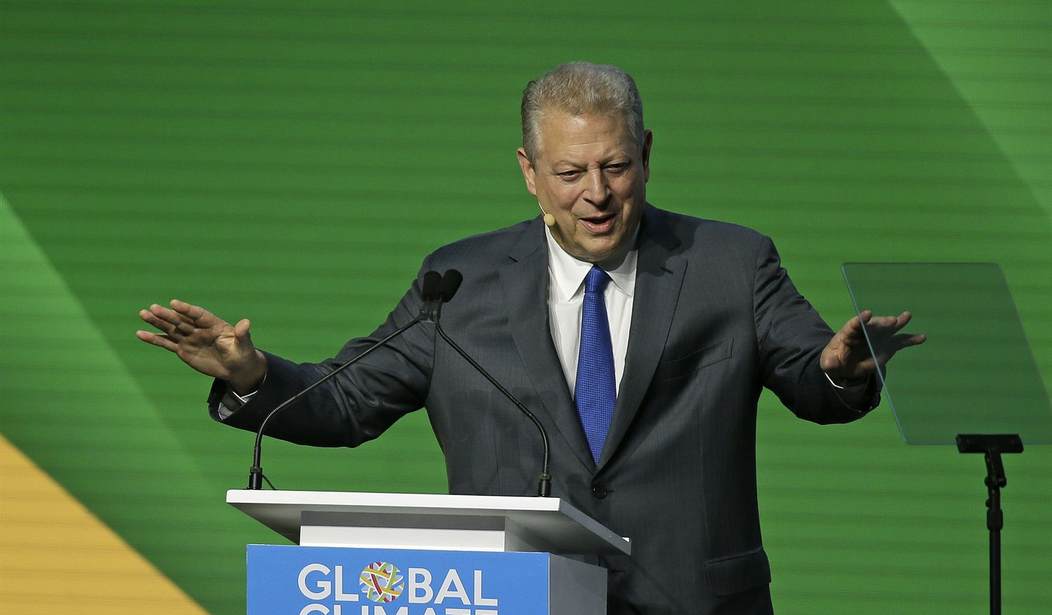
With the aggregate age of first-time parents continually rising, 34 years is roughly the span of a generation these days. This June marks the 34th anniversary of Al Gore’s bestseller, Earth in the Balance. Gore deserves credit for raising consciousness about the importance of preserving our environment. Yet, the years have shown that his approach was questionable.
While many climate criticisms focus on Gore's film, An Inconvenient Truth (for which he won an Oscar!), his seminal 1992, internationally acclaimed book, Earth in the Balance, has since faced strong rebukes. Scientists, researchers, and even economists contend that Gore resorted to alarmism rather than more balanced perspectives and measured policy solutions. Here are but a few instances where he was off the mark.
Historical and Scientific Claims
Gore asserted that retreating glaciers were a new phenomenon, while ignoring wholesale, voluminous historical records that indicate that glaciers have been receding since at least 1850 and even earlier. This process began long before industrial emissions were a significant factor.
He overemphasized the potential for rises in sea level. Melting snows in Antarctica and Greenland, he claimed, would raise sea levels by as much as 20 feet in the near future. Scientists have since clarified that this would occur in centuries, not merely years. He also said that Arctic summer sea ice might completely disappear by 2015 or so. This did not happen, and the amount of ice has stabilized.
Among Gore’s notable predictions was that the snows of Kilimanjaro, Africa's highest mountain, would be gone by 2016. In 2026, significant snow cover remains. He pointed to rapidly warming areas of Antarctica and asserted that this represented a looming catastrophe. Gore overlooked the fact that most of the continent, however, had been cooling for decades.
Exaggerated or Extreme Views
Mr. Gore alleged that polar bears in the Arctic were literally drowning due to diminishing ice flows. Today, 34 years later, polar bear populations are stable and actually increasing in well-monitored regions.
He warned about accelerated hurricane severity, linking the intensity and frequency of highly destructive hurricanes directly to human-induced global warming. Current data from the Intergovernmental Panel on Climate Change, as well as other organizations, reveal that hurricane activity is a highly complex phenomenon, and thus far, the data does not indicate a clear, long-term, upward trend.
Gore’s prediction of extreme heat was off the mark. His published timelines predicted an imminent, chaotic climate collapse. This warning, however, did not measure up to the gradual scale of real-world temperature increases.
Gore focused intensely on the apocalyptic consequences of global warming, while omitting any discussion of the agricultural and environmental benefits of a warmer climate. He claimed that weather-related disasters were entirely unprecedented, but he failed to acknowledge an important fact that historical mortality rates due to extreme weather events actually declined during the 20th century.
Policy and Economic Missteps
Earth in the Balance fails to cite the crucial role of fossil fuels in extending human lifespans, alleviating global hunger, and lifting some nations out of poverty. The book only tangentially examines increasing safe nuclear energy, which is a vital, high-output, zero-carbon tool. In fact, Gore underrepresented nuclear energy while touting less reliable alternatives.
He also favored complex regulatory and carbon-trading maneuvers, a darling ploy of the Left, which invariably lead to the rise of special-interest groups who thrive on inducing the public to be fearful. And, while calling for immediate fossil-fuel reduction, he ignored the alternative of investing in local infrastructures to better adapt to climate shifts.
Global environmental funds could, perhaps, save more lives when addressing immediate crises, such as preventable diseases (HIV, malaria) or the issue of access to clean drinking water. Instead, Gore treated climate mitigation as essentially the sole global priority.
In managing climate interventions, he routinely favored broad-brush, stringent approaches over localized, cost-benefit models. As a case in point, his emphasis on global treaties (such as the Kyoto Protocol, another Lefty favorite) distracted from market-driven, localized mechanisms that would organically achieve reduced emissions.
Rhetoric of Ghosts Past
Gore borrowed extensively from older, environmental doom-and-gloom books such as Our Plundered Planet, instead of embracing contemporary scientific consensus. Worse, he delved into hyperbolic allusions. He compared the failure to act on his climate solutions to the 1930s rise of the Nazis, who were directly responsible for 17 million deaths through forced labor, institutionalized "euthanasia" programs, starvation, and genocide.
Gore's personal and family lifestyle, which included constant travel on private jets and ownership of enormous, high-energy-consuming homes, fundamentally contradicted the dutiful conservation lifestyle he advocated for everyone else.
For Al Gore, and for contemporary Leftists in general, it has been a matter of “Do as I say, not as I do.”
Editor’s Note: Do you enjoy Townhall’s conservative reporting that takes on the radical Left and woke media? Support our work so that we can continue to bring you the truth.
Join Townhall VIP and use promo code FIGHT to receive 60% off your membership.


Join the Conversation
VIP members get the ability to comment on articles.