





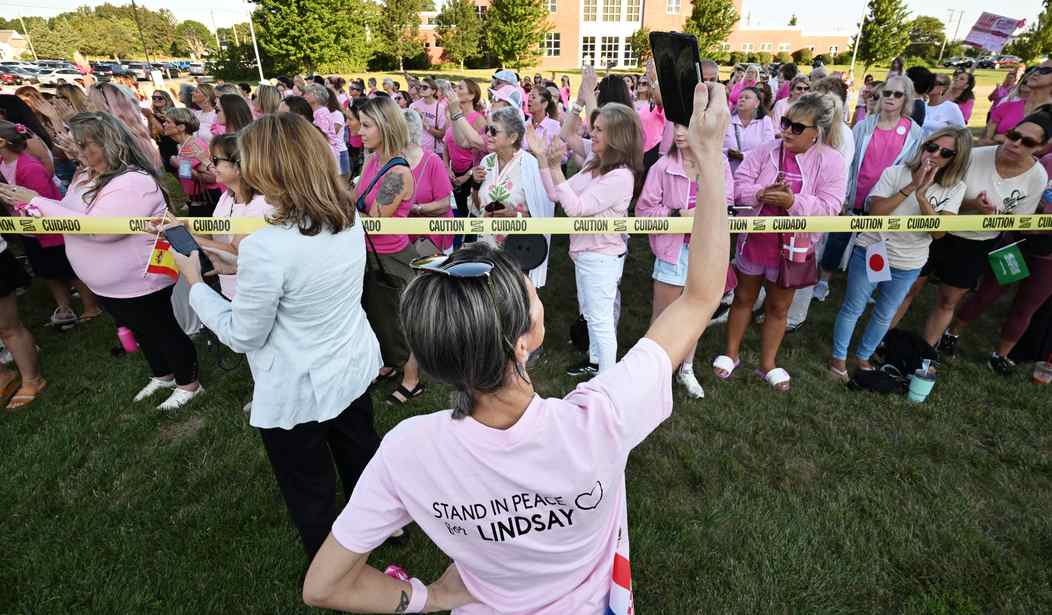
Last week outside a Massachusetts courthouse, roughly 400 people, most of them women dressed in pink, rallied in support of a mother on trial for strangling her three children. Some wore buttons reading "standing with Lindsay." Others carried signs telling a woman charged with killing an 8-month-old, a 3-year-old, and a 5-year-old that she's a good mom.
I understand postpartum psychosis is real, rare, and devastating, and that a jury, not a crowd outside a courthouse, should decide whether it applies here. What I don't understand is how several hundred people end up in matching pink cheering for a defendant in a triple homicide before a single juror has spoken. You get there through isolation. Not physical isolation. Ideological isolation, the kind where everyone you talk to already agrees with you, so group solidarity starts to feel like moral clarity.
That isolation has a data trail. Politically liberal women, who align overwhelmingly with the Democratic Party, report far less life satisfaction and far more loneliness than their conservative peers. Researchers using the 2024 American Family Survey found that 37 percent of conservative women call themselves completely satisfied with life. Among liberal women, the figure is 12 percent. About half that gap traces back to two things: marriage and church attendance. Conservative women are married at rates 20 points higher, and they attend church weekly at more than four times the rate of liberal women.
The other half of the gap is harder to graph but easy to see. Gallup's own trend data shows young women have moved sharply to the left over the past decade while young men have barely moved at all, now a 15-point gap among adults under 30. The result is a generation of women whose social and romantic pool has narrowed just as their political circle has tightened. When your friends, your feed, and your dating prospects all draw from the same slice of the electorate, you stop hearing anything that challenges you. That isn't community. It's an echo chamber with a wine bar attached.
This is usually where I'd pivot to elections and policy, but the more interesting casualty here is generational. The women in that isolated bracket are, statistically, the ones raising the next generation of American girls, or failing to, since marriage and birth rates in that same cohort are falling, too. And girls growing up without a mother, aunt, coach, or teacher who models something other than group solidarity are increasingly finding their sense of identity somewhere else entirely: a friend group, an app, an influencer.
Journalist Abigail Shrier documented exactly this vacuum in “Irreversible Damage.” Drawing on interviews with the girls themselves, their parents, clinicians, and detransitioners, she found that gender dysphoria, once diagnosed almost exclusively in young boys before puberty, has shifted overwhelmingly toward teenage girls, often clustered within the same friend groups and coming of age on the same platforms, a pattern she and other researchers call rapid-onset gender dysphoria. Shrier's point wasn't that these girls were lying about their distress. It was that the adults who should have been offering them a sturdier, more grounded model of womanhood — mothers, teachers, mentors — were largely absent from the process, leaving a peer group and a platform to answer questions that used to belong to a parent.
None of this is happening in a vacuum, and it isn't only mothers and mentors who have gone missing. Postpartum psychosis and gender dysphoria are both real, diagnosable clinical conditions. Treating them well is the entire job description of the mental health profession. Yet that same profession's own national convention this month featured psychologists explaining, on hidden camera obtained by Accuracy in Media, how they use dialectical behavior therapy and motivational interviewing, tools built for people in genuine crisis, to coach white colleagues through the discomfort of confronting their own racial identity. A family waiting six weeks for a 15-minute intake appointment isn't competing with an overwhelmed system doing its best. It's competing with a system that has decided DEI theater is a better use of its finite hours than the patients on its own waiting list.
Put those three stories next to each other and the pattern is hard to miss. A generation of women isolated into a single ideological bracket, too consumed with in-group loyalty to apply ordinary moral judgment to a triple child homicide. A generation of daughters absorbing their sense of self from a screen instead of a grounded adult, at the exact moment the profession meant to treat their distress is busy elsewhere. And the elsewhere isn't a mystery. It's a hotel ballroom.
To be sure, plenty of Democrat-voting women are married, active in their communities, and perfectly capable of raising grounded daughters, and plenty of conservative households produce confused kids, too. But the data on happiness, on isolation, and on where girls are now finding their role models points the same direction often enough that it deserves more attention than a courthouse rally is currently getting.
Strong women used to mean something specific: women who could tell a scared teenager the truth, sit with a friend's bad decision without pretending it was a good one, and separate sympathy for someone's illness from judgment about someone's actions. That skill doesn't grow in an echo chamber. It grows in a mixed room, a pew, a marriage, a real disagreement survived. Until more women have access to that kind of room again, expect more rallies for the wrong people, and more daughters looking for identity in the wrong places.
Jay Rogers is a financial professional with more than 30 years of experience in private equity, private credit, hedge funds, and wealth management. He has a BS from Northeastern University and has completed postgraduate studies at UCLA, UPENN, and Harvard. He writes about issues in finance, constitutional law, national security, human nature, and public policy.
Editor's Note: Do you enjoy Townhall's conservative reporting exposing the radical Left and woke media? Support our work so we can keep bringing you the truth.
Join Townhall VIP and use promo code FIGHT to receive 60% off your membership.



Join the Conversation
VIP members get the ability to comment on articles.